REVIEW · NAPLES
Skip-the-Line Pompeii Guided Tour from Naples
Book on Viator →Operated by IAMME IA! - Gray Line Amalfi Coast · Bookable on Viator
Pompeii feels huge until you get a plan. This tour saves time with priority admission and gets you into the park with a real guide who turns the ruins into a story. I especially like the skip-the-line access plus the way the guide points out what matters, not just what’s there. One thing to watch: pickup details can be a bit unclear, and in very hot weather the bus situation can feel tight if the air-conditioning isn’t strong.
You’re set up for a smart first pass: a transfer from central Naples, then a guided route through the big public areas and standout monuments. Guides such as Valeria and Simone (names that pop up often in real-world delivery) tend to keep the pace friendly and the explanations clear, which matters when Pompeii is crowded and noisy.
This is still a time-limited format. If you want to wander slowly like you’re writing postcards, you might feel rushed in places. The upside is that you get the structure of the city fast, which makes later self-guided exploring much easier.
In This Review
- Key points I think you’ll care about
- Skip-the-Line Pompeii Priority Tickets: Why they change the whole day
- Naples pickup and coach logistics: how to avoid the frustrating moments
- Pompeii’s Civil Forum: the city’s command center in plain sight
- Via dell’Abbondanza: Pompeii’s main street, shops, and noise you can almost hear
- Stabian Baths: public bathing, gendered entrances, and daily routines
- House of the Faun and the Alexander Mosaic: when Pompeii shows its luxury side
- Via delle Ville and the Villa of the Mysteries route: a calmer road outside the walls
- Teatro Grande: how performance shaped everyday social life
- Timing inside Pompeii: making 4 hours feel like more
- Price and value: what $72.01 buys you (and what to double-check)
- Should you book this Pompeii tour from Naples?
- FAQ
- How long is the Pompeii guided tour from Naples?
- Where does the tour start in Naples?
- Is Pompeii admission included?
- Do I get skip-the-line admission?
- What language is the tour guide?
- Is there transportation included from Naples?
- What should I bring for a summer visit?
- Is there free cancellation?
Key points I think you’ll care about
- Priority entry at the Archaeological Park of Pompeii helps you avoid the worst delays and heat.
- An official guide in English keeps the sprawling site understandable, even if you’re not a Rome/Greek-architecture expert.
- Headphones are used for larger groups so you can actually hear the guide in Pompeii’s busy stretches.
- Forum stops give you the city’s “day-to-day” map: justice, business, religion, and street life.
- You’ll hit major highlights like the Alexander Mosaic in the House of the Faun and the Teatro Grande.
- Small-enough group size (max 29) generally feels manageable without turning into a cattle herd.
Skip-the-Line Pompeii Priority Tickets: Why they change the whole day
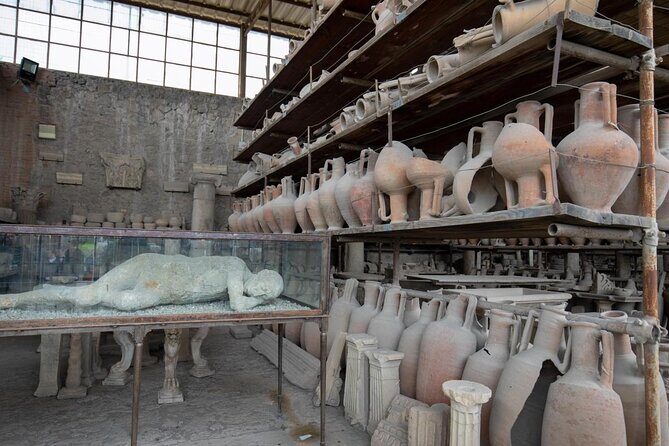
At Pompeii, the problem isn’t finding things to see. It’s standing around while everyone else funnels toward the same entrances. This tour includes skip-the-line access, which means you spend more time inside and less time waiting in the sun.
The value of priority entry is biggest if you’re arriving during busy hours. You don’t just save time—you also reduce the “I’m already tired before we start” feeling. Pompeii is famous for its size, but it can also be brutally hot. Cutting line time helps you arrive at your first major stop with enough energy to actually look.
There’s also a comfort factor. Your day starts with a transfer from Naples rather than you having to figure out trains, stations, and connections in your first hours in Italy. That takes stress off the table so you can focus on the ruins.
You can also read our reviews of more guided tours in Naples


Naples pickup and coach logistics: how to avoid the frustrating moments
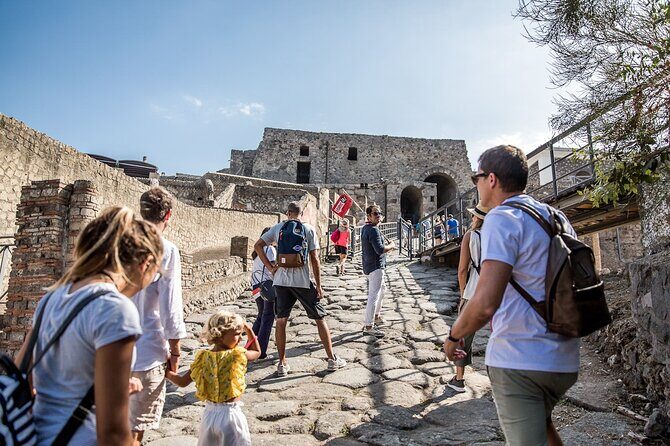
The tour meets at P.za Giuseppe Garibaldi, 91, 80142 Napoli and returns you to that same point. The meeting point is near public transportation, which is convenient if you’re navigating Naples already.
Here’s the practical advice that saves the most time: arrive early and be ready to look for the exact group leader and name on the day. Some people report that meeting-point signage or bus timing wasn’t as clear as it should be, even when the tour itself stayed on schedule once everyone was sorted.
On the ride to Pompeii, the tour includes round-trip transportation with air-conditioning. Still, if you travel in summer, don’t assume the airflow will feel perfect for everyone. If you’re sensitive to heat, wear lighter clothes and keep water on you once you’re on-site.
Pompeii’s Civil Forum: the city’s command center in plain sight
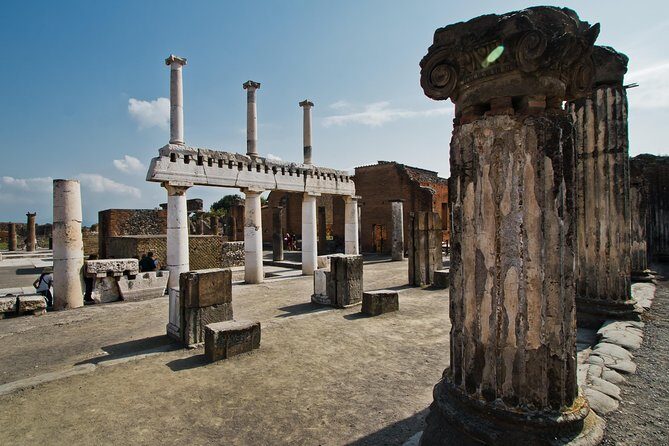
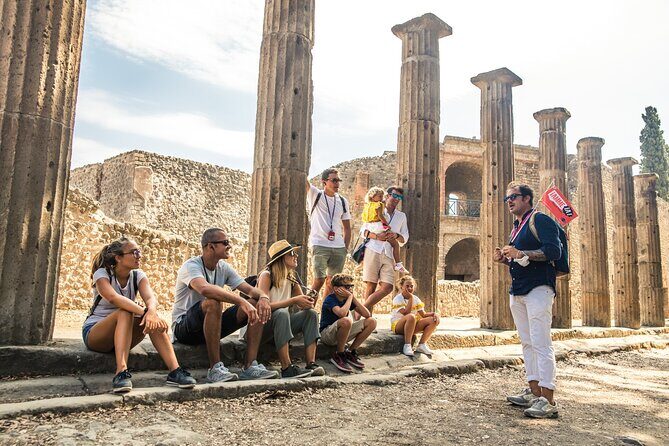
Your guided route gets you into the heart of how the city functioned. The Civil Forum wasn’t just a pretty square. It was where public life happened: administration, justice, business activity, markets, and worship.
When you stand in the Forum area with a guide, the ruins stop being random stone piles. You start recognizing patterns. For example, the guide’s explanation of what each major building did helps you connect the dots between everyday routine and political power.
A few standout Forum stops to listen for:
- The Basilica: This long, grand building (about 1,500 square meters) served as the city’s major courthouse and commercial hub. You’ll see how “legal business” and everyday transactions were housed under one roof.
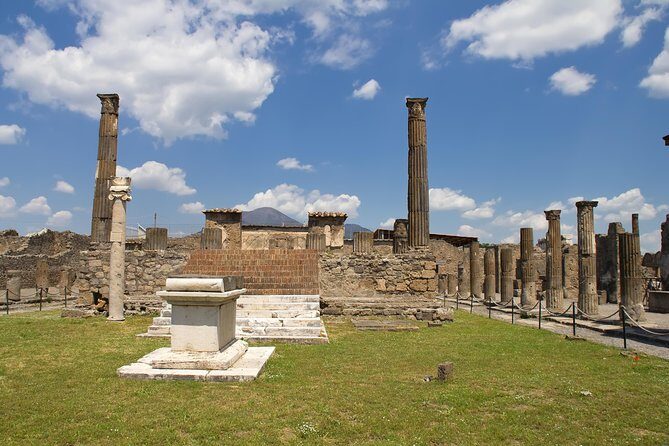
- Temple of Jupiter: This dominates the north side of the Forum, with Mount Vesuvius visible in the background on clear days. It’s also tied to major renovation after the colony was founded, so the guide can explain how the site’s role shifted as Pompeii changed.
- The Macellum: This market building is more than just a food stop. The guide points out how it connected worship with trading, including clues about imperial culture and even spaces that likely related to selling goods.
If you only do Pompeii once, the Forum route is the fastest way to understand what made Pompeii feel like a living city rather than an open-air museum.
Via dell’Abbondanza: Pompeii’s main street, shops, and noise you can almost hear
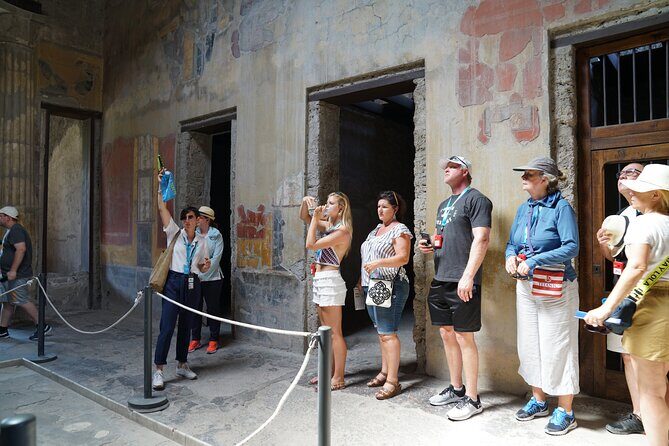
Next comes the street that gave Pompeii its daily rhythm. Via dell’Abbondanza was the main street—the decumanus maximus—linking key areas of town. Even in ruins, you can feel how designed it was for movement and trade.
What makes this stop work on a guided tour is interpretation. The guide helps you imagine the street packed with storefronts, workshops, snack bars, cafes, and food places. It’s the kind of context that self-guided visits often miss unless you already know what you’re looking for.
This is also a good place to pause for photos, because it’s visually readable: the street axis helps you orient yourself. Keep in mind you’re not getting an all-day wander here—this is a guided “best hits” pass—so use the moments you have to mark directions in your mind.
Stabian Baths: public bathing, gendered entrances, and daily routines
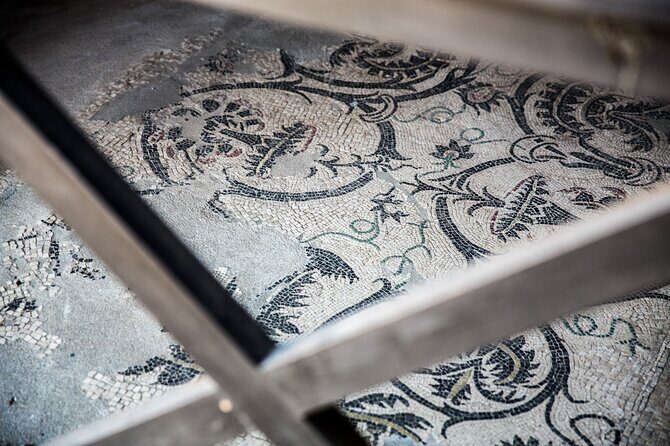
From the street you shift into a totally different side of city life: public bathing at the Stabian Baths (Terme Stabiane). The baths date to soon after Pompeii’s colony was founded (80 BC), and the guide uses that timeline to explain how quickly civic buildings were shaped.
What you should watch for during the stop:
- Separate entrances for women and men, which tells you a lot about how public space was organized.
- The men’s areas laid out across temperature zones, from dressing/changing spaces through cold and hot bathing rooms.
- The fact that the baths were damaged in the earthquake of 62 AD—so you’re seeing a site already marked by disaster before the eruption finishes the job.
This stop is short, so don’t treat it like a “read every wall” moment. Instead, focus on the layout and ask yourself: where would people enter, wait, change, and move between temps? That’s what makes the ruins click.
You can also read our reviews of more tours and experiences in Naples


House of the Faun and the Alexander Mosaic: when Pompeii shows its luxury side
One of Pompeii’s biggest jolts is realizing not everyone lived in modest homes. The House of the Faun (Casa del Fauno) is one of the largest private residences in the city block, tied to the bronze dancing faun statue found in its main atrium.
This stop matters even if you’re not chasing art history. It gives you a reality check about wealth and taste in Roman-era Pompeii. The guide highlights the famous Alexander Mosaic, a floor piece connected to the battle between Alexander the Great and Darius III.
If you’re trying to get real value from a guided format, this is exactly where it helps. A guide can explain why such mosaics were not just decorative—they were identity statements. Even a short look can feel powerful when you understand what it signaled to visitors inside.
Via delle Ville and the Villa of the Mysteries route: a calmer road outside the walls
The tour then turns to an area connected to Pompeii’s outskirts via Via delle Ville, often associated with the approach toward the Villa of the Mysteries. This road leads away from the city walls and into a quieter setting that connects urban life to suburbs and funerary zones.
The big hook here is the Villa of the Mysteries destination: it’s renowned for frescoes describing Dionysian rites. On a guided tour, you don’t just hear that the frescoes exist. You learn why the location feels different from the tight city grid—this is where the mood shifts.
If your goal is to leave Pompeii with more than one kind of memory, this segment is a smart change of pace. City streets are one story. Suburban villa culture is another.
Teatro Grande: how performance shaped everyday social life
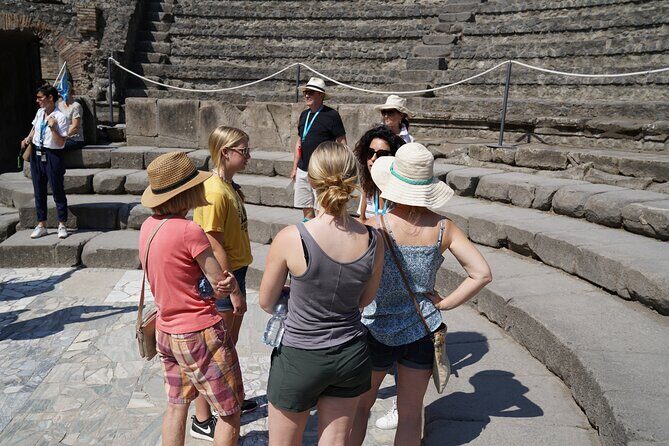
Pompeii also had massive public entertainment. The Teatro Grande is a horseshoe-shaped auditorium built into a hillside, designed for about 5,000 spectators. The guide points out its 2nd-century BC roots and its role as the key venue for public performances, including comedies, tragedies, and pantomimes.
This stop is one of the best “architecture lessons” on the route. You’ll likely find yourself looking at sightlines and stage layout, even in ruins. A good guide will connect the building’s design to who could attend and how performances functioned as social glue across different classes.
Again, the time is limited, so be intentional: stand where the guide directs you, watch the space from different angles, and imagine the crowd. You’ll get more from a short stop than you think.
Timing inside Pompeii: making 4 hours feel like more
The tour is roughly 4 hours total, with about 2 hours at the Pompeii Archaeological Site. That means you’re not seeing Pompeii “fully.” You’re seeing a structured route that hits the core public buildings and headline monuments.
This is exactly what makes it effective for first-timers. The Forum route teaches you the city’s civic map. The baths and main street add everyday texture. The house, theater, and villa approach broaden it into social and cultural life.
So how do you make the most of limited time?
- Wear comfortable shoes and plan for heat. Pompeii is outdoors and exposed.
- Bring sunscreen and treat water like a must-have item. You’ll spend time in direct sun.
- When the guide slows down, that’s when you should stop scrolling your camera. Listen, then look.
If you go in expecting a full, slow museum-style circuit, you’ll be disappointed. If you go in wanting clarity and a strong orientation, it works very well.
Price and value: what $72.01 buys you (and what to double-check)
At $72.01 per person for a guided, skip-the-line Pompeii experience from Naples, you’re paying for three real things:
- Entry to the Pompeii site (included)
- Transportation round-trip from central Naples (included)
- An official guide in English, plus headphones used for groups bigger than 10 passengers
Headphones sound small, but they matter. Pompeii gets loud with crowds and gaps in acoustics. If your group is larger, you’ll likely hear the guide better, which makes every stop more valuable.
One caution: not every ride feels identical. A few people noted the coach air-conditioning wasn’t as strong as expected. It doesn’t change the Pompeii experience itself, but it can affect comfort on the transfer. Plan your outfit for heat anyway.
Should you book this Pompeii tour from Naples?
I’d book it if you’re:
- Short on time in Naples and want an organized Pompeii visit
- A first-timer who benefits from explanations tied to what you’re seeing
- Interested in civic life, architecture, and how daily routines worked in a Roman city
I’d think twice if you:
- Want hours of free wandering with no group pace
- Get frustrated when explanations compete with crowds
- Are hoping for a Vesuvius hike or a longer add-on day structure (this format is Pompeii-focused)
If your main goal is to get oriented quickly and leave with a coherent picture of Pompeii, this is a solid use of a half day.
FAQ
How long is the Pompeii guided tour from Naples?
The tour is about 4 hours total, including round-trip transportation and time in Pompeii.
Where does the tour start in Naples?
It starts at P.za Giuseppe Garibaldi, 91, 80142 Napoli NA, Italy.
Is Pompeii admission included?
Yes. Entry to the Pompeii Archaeological Site is included.
Do I get skip-the-line admission?
Yes. The tour includes skip-the-line access with priority admission tickets.
What language is the tour guide?
The tour is offered in English.
Is there transportation included from Naples?
Yes. The tour includes round-trip transportation by an air-conditioned vehicle.
What should I bring for a summer visit?
Wear sunscreen and comfortable shoes, since it can get very hot outdoors.
Is there free cancellation?
Yes, you can cancel up to 24 hours in advance for a full refund.