REVIEW · BORGHESE GALLERY TOURS
Rome Golf Cart Tour from Villa Borghese Gardens
Book on Viator →Operated by ROME GOLF CART TOUR · Bookable on Viator
Rome is a lot to take in. This small-group golf cart tour turns first-day overwhelm into a doable plan, with guide commentary as you glide between major sights.
I love two things right away: you get historical context while you’re seeing the scenery, and the cart does the hard part for you—especially in Rome’s tight streets and between hilltop viewpoints. It also keeps the pace relaxed, so you’re not racing your own feet.
One consideration: time is limited. With lots of famous stops in roughly 3 hours, you’ll get excellent highlights and photos, but not long museum-style wandering everywhere.
In This Review
- Key things I’d watch for
- Why a golf cart from Villa Borghese makes Rome easier
- Meeting point and how the tour actually starts
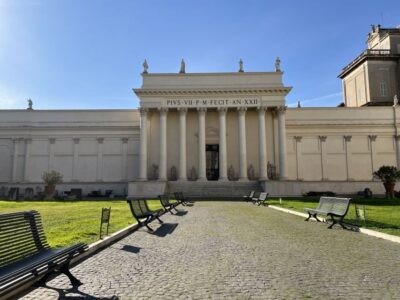
- Villa Borghese Gardens: the calm setup before the big sights
- Piazza del Popolo: monumental Rome, simplified
- Mausoleum of Augustus: ancient power in a circular form
- Column of Marcus Aurelius: storytelling carved in stone
- Piazza Venezia and the Roman core you can feel
- Trejan’s Markets and the Imperial Forums: your quick entrance into the big era
- Circus Maximus: scale that hits differently in person
- Giardino degli Aranci: the view break you’ll want to take
- Mouth of Truth and the Forum Boarium area: myths meet real stones
- Theatre of Marcellus: ancient design that echoes forward
- Pantheon, Piazza Navona, Campo de’ Fiori, then Trevi and Spanish Steps
- Price and value: what $171.68 buys you in real time
- Who this tour fits best
- Small details that make a big difference
- Should you book this Rome golf cart tour?
- FAQ
- How long is the Rome Golf Cart Tour from Villa Borghese Gardens?
- What is the price per person?
- Is the tour offered in English?
- How big is the group?
- Do I get a mobile ticket?
- Where do we meet, and where does the tour end?
- What major sights are included?
- Is admission included for the stops?
- Can I cancel for free?
- Is the tour good if I don’t want to walk far?
Key things I’d watch for
- Up to 7 people: you’ll move as a group without feeling swallowed by crowds.
- English on-board guide commentary: you get meaning, not just motion.
- Golf-cart comfort: a real help if you want to see a lot without long walking stretches.
- Great photo viewpoints: Villa Borghese and the Orange Garden angle you toward skyline Rome.
- Icon hits, fast: Pantheon, Trevi Fountain, and Piazza di Spagna are included, but in short stops.
- Heat and rain friendly: carts help on hot days, and the experience still works even when weather is less friendly.
Why a golf cart from Villa Borghese makes Rome easier
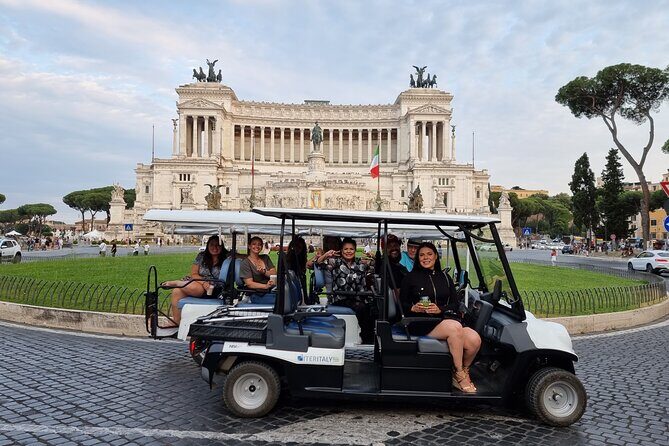
Rome is built for walking, but it’s also built to test your stamina. This tour gives you a smart middle ground: you still see the “greatest hits,” yet you’re not spending the day zig-zagging across hills and cobblestones on sore legs.
The golf cart also changes how you experience the city. You can take scenic routes and cut through areas that would be slow or exhausting on foot. That matters when you’re trying to do a first-day loop and still enjoy Rome rather than just survive it.
Best of all, you’re not just dropped at landmarks. There’s an English-speaking driver guide onboard, and they talk as you move. That means you start recognizing patterns—how squares connect, where the ancient city core was, and what you’re looking at when the dome of the Pantheon suddenly appears around a corner.
You can also read our reviews of more tours and experiences in Rome.



Meeting point and how the tour actually starts
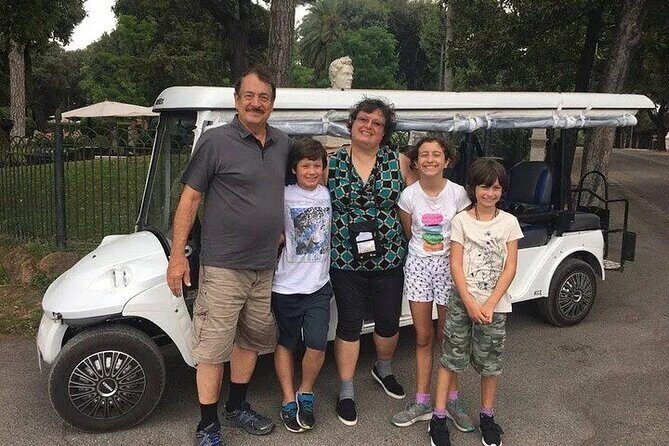
You meet at Pic Nic – Just Amir srl, Piazzale delle Canestre, SNC, 00197 Roma RM. The tour returns to the same meeting point, so you’re not trying to solve the “where do we end up?” problem.
You’ll also have a mobile ticket, and the meeting spot is noted as near public transportation. Still, I’d treat arrival timing seriously. Rome is full of confusing signage and lanes. Arrive a few minutes early so you’re not stressed before you even start rolling.
Villa Borghese Gardens: the calm setup before the big sights
The tour starts with Villa Borghese, one of Rome’s largest urban parks. In the 19th century the park was reshaped into an English-style garden layout, with ponds and fountains that soften the intensity of the city around it.
Why I like this stop on a golf cart tour: it’s the “breathing room” moment. You get a view-over-Rome feel, and you can mentally switch gears from traffic-and-stones Rome to something slower and more park-like. Even if you don’t go deep into the grounds, the timing works. It’s early enough to set a tone, and short enough that you don’t lose momentum.
The tour notes free admission for this stop. Even better, you’re not locked into a museum schedule. You’re free to stroll, snap photos, and get your bearings.
Piazza del Popolo: monumental Rome, simplified
Next is Piazza del Popolo, one of Rome’s most well-known squares. It’s closely tied to the idea of city gateways—specifically the Porta Flaminia area to the north—so the space feels like both a landmark and a transition point.
From a tour-planning view, this stop is useful because it’s a crossroads square. You’ll likely recognize it again later, even if you’ve never been to Rome before. It also gives you a clear sense of where the tour is steering you: away from random sightseeing and toward the city’s historic spine.
The stop is brief, but that’s the point. It helps you connect landmarks into a map in your head, rather than seeing each one like a separate postcard.
Mausoleum of Augustus: ancient power in a circular form
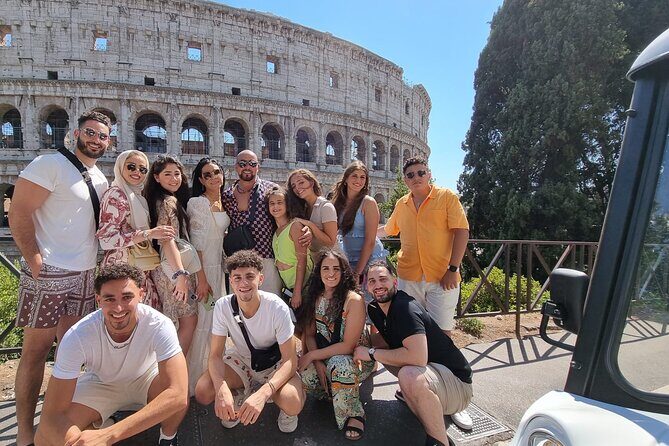
A key stop is the Mausoleum of Augustus. It’s a large circular tomb and an important monument for understanding how antiquities were reused and reinterpreted over time.
This is one of those sights where a little context makes a big difference. On a regular walking day, you might see the shape and move on. Here, the guide commentary helps you connect it to Augustus and to Rome’s longer story of how later eras treated older monuments.
This is also a great stop for quick photos, because the monument’s form is so distinct. Even if you only spend a short time here, you’ll leave with a mental image that lasts.



Column of Marcus Aurelius: storytelling carved in stone
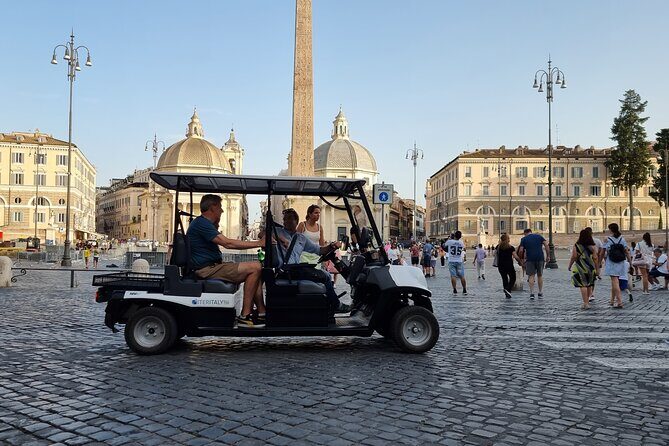
Then you reach the Column of Marcus Aurelius and Faustina, standing in Piazza Colonna. The column is thought to have been erected around 180 CE, and its reliefs show military campaigns—especially campaigns against the Quadi across the Danube (between 172 and 175 CE).
Here’s why this stop works on a golf cart route: the column is a tall, dense visual. If you’re on foot, you might skip it because it’s not immediately obvious from far away. In this tour format, you stop long enough to register the significance and appreciate that you’re looking at a Roman “storybook,” carved into a vertical monument.
Piazza Venezia and the Roman core you can feel

Next up is Piazza Venezia / Ancient City. It’s tied to the redevelopment of the area in the early 20th century, shaped by the construction of Monumento a Vittorio Emanuele II.
Even though that monument is modern compared to the ancient ruins around it, the square helps you “read” Rome. You understand how the city layers time on top of time. One second you’re seeing imperial-era geometry, the next you’re looking at how the 1900s marked power and nationhood in stone.
This is a good stop for photos where you catch both the grand scale of Rome and the sense of moving from one historical world to another.
Trejan’s Markets and the Imperial Forums: your quick entrance into the big era
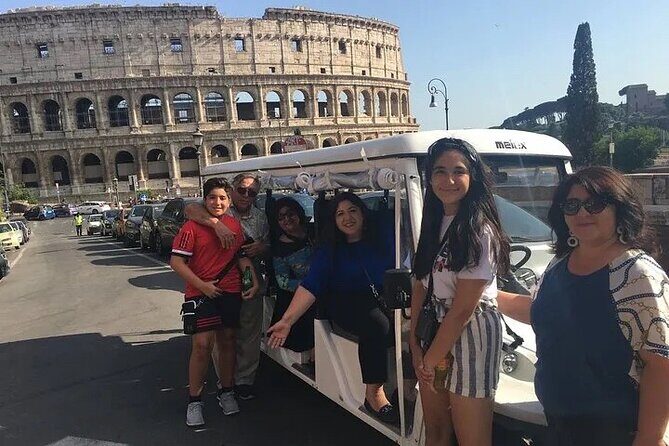
The tour then includes a stop that focuses on Trajan’s Markets (Mercati di Traiano) and an introduction to the Imperial Forums. It’s described as a museum-like experience with multimedia displays, explanatory panels, and some archaeological artefacts.
A fair warning: you’re not getting a multi-hour deep museum session here. You’re getting a strong orientation. The value is that you start understanding what the Imperial Forums were about—public life, power, and Roman engineering—before you see other nearby areas.
If you enjoy “how it all connects” more than “read every label,” this stop is a good match. The short format can be perfect when you’re pairing it with a packed Rome day.
Circus Maximus: scale that hits differently in person
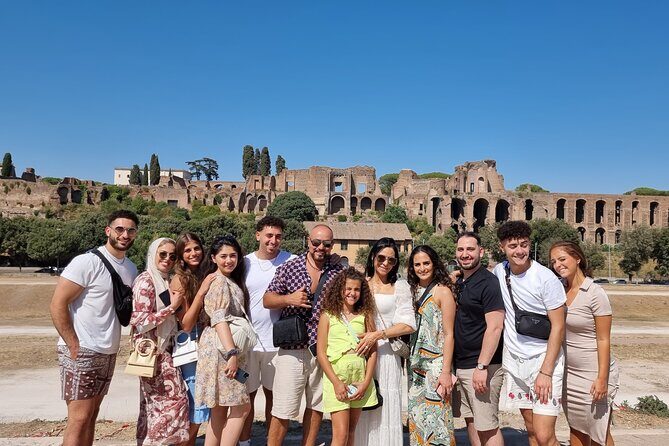
At Circo Massimo, you see the legendary Circus Maximus area between the Aventine and Palatine Hills. This was an extended precinct with space for roughly 300,000 spectators.
That number is mind-bending, and it’s exactly the kind of fact that sticks when you’re standing in the area. On a walking tour, it’s easy to pass quickly. Here, the cart helps you pause long enough to notice the scale and imagine the noise, the crowd, and the motion.
It’s brief, but it’s memorable because the concept of Roman entertainment becomes physical.
Giardino degli Aranci: the view break you’ll want to take
Then you reach Giardino degli Aranci (the Orange Garden), on the Aventine hill. The park covers almost 8,000 square meters and is loved for its panorama over Rome.
This is where the tour earns points beyond “you checked the box.” It gives you a moment to breathe and reset, plus a viewpoint that feels different from the typical street-level photos. The tour also notes that if there’s time, you may stop at the Keyhole of Rome.
If your day in Rome is hitting you with heat and fatigue, this stop can be the relief you’re hoping for. You get sky, framing, and a slower rhythm without losing your place in the route.
Mouth of Truth and the Forum Boarium area: myths meet real stones
Next comes Bocca della Verità (Mouth of Truth), with its famous legend about liars and the ancient carving. Long before pop-tech detectors, the story was simple and theatrical—hands in the mouth, consequences in the imagination.
From there, the tour heads into the Forum Boarium area near the Tiber for two temple stops:
- Temple of Hercules, described as the only surviving sacred structure in ancient Rome made of Greek marble.
- Temple of Portunus, a well-preserved example of ancient Roman architecture that once overlooked the fluvial port.
These are the kind of stops that shine when you have the guide commentary. Marble type, location, and purpose are easy to miss when you’re just passing by. In the cart format, you slow down just enough to notice what makes these buildings rare.
Theatre of Marcellus: ancient design that echoes forward
The route also includes the theatre of Marcellus, noted as the largest and most important theatre in Rome, completed in the late 1st century BCE during Augustus’ reign.
This stop has a neat effect: it helps you connect Roman architecture to later empire building. Even if you’re not an architecture nerd, you’ll start seeing the same design logic repeating across famous buildings.
Again, it’s not a long linger stop. It’s more like a high-impact introduction, the kind that makes your next big sight feel more readable.
Pantheon, Piazza Navona, Campo de’ Fiori, then Trevi and Spanish Steps
Now the tour hits the part most people dream about.
You’ll spend time around:
- Piazza Navona, formed in 86 CE by Domitian and shaped by its earlier function as an athletics stadium.
- The Pantheon, dated to the early second century AD, celebrated for its massive dome and central opening (the oculus).
- Campo de’ Fiori, a lively area connected to the Navona zone in the city center.
The Pantheon stop is specifically listed with around 15 minutes. That’s enough time to appreciate the building and take photos, but not enough to treat it like a half-day pilgrimage. Plan your expectations accordingly: you’ll get the impact, not the deep hours.
From there, you roll to Fontana di Trevi, a late Baroque masterpiece completed in 1762. If you’ve seen Trevi in photos, you’ll still be surprised by the scale in person. The legend about tossing coins is part of the appeal, and the guided stop makes it easier to enjoy the spectacle without getting stuck in random wandering.
Finally, the tour includes Piazza di Spagna and a short look at the area around it, including the Spanish Steps. This is a perfect ending because it’s open, scenic, and easy to sit with for a moment after a full loop.
Price and value: what $171.68 buys you in real time
At about $171.68 per person for roughly 3 hours, this tour isn’t the cheapest way to see Rome. But it is strong value if you consider what you’re paying for:
- A cart that gets you between far-flung areas quickly
- On-board English guide commentary
- A planned route that hits major monuments without you figuring out transportation or timing
- A maximum of 7 travelers, which keeps the experience from turning into a shuffle line
If you’re traveling with anyone who struggles with lots of walking, the cart changes the trip from “we saw a few things” into “we covered a lot.” Several guide experiences highlight how helpful this format can be when people want movement without the strain.
The only place value can feel tight is if you’re the type who wants long stays at one site. This route is built for variety. If you want depth over breadth, you may prefer a slower, single-neighborhood plan instead.
Who this tour fits best
This tour is a smart choice if you:
- Want a first-day Rome overview with history in plain language
- Prefer fewer steps and more “see it, understand it, photograph it”
- Like a relaxed pace with a small group (up to 7)
- Travel with kids, older adults, or anyone who can’t handle a long walking day
- Are visiting in summer or heat-heavy months and want a built-in break from pavement
It’s less ideal if you:
- Want long museum time at multiple stops
- Get annoyed by short photo-and-look moments
- Plan to treat every stop like a stand-alone attraction
Small details that make a big difference
A lot of the best moments come down to how the guide runs the day. Names like Jean Luca / Gian-Luca, Gian-Luca, Marco, Sabrina, Paul, Pietro, and Nikolai show up in people’s experiences, and several accounts highlight traits like patience, kindness, humor, and helping with photos.
One especially practical theme: good guides pay attention to comfort. On hot days, you’ll feel it when your guide avoids parking you in full sun for too long. If you’re sensitive to heat, that choice matters.
Also, because this is a cart tour, you can get better photos than you might expect. The group pauses, the guide helps position, and you’re not constantly stopping and restarting on foot.
Should you book this Rome golf cart tour?
I’d book it if your goal is a fast, friendly hit list of Rome’s top sights with real context—without spending your day exhausted.
I’d think twice if you want long deep time at museums and want to wander on your own without a guided route. This tour is built for smart coverage in about 3 hours, not for marathon sightseeing.
If you like clear planning, small-group energy, and a route that mixes viewpoints with major monuments—especially around Villa Borghese, the Pantheon, and Trevi—this is one of the more practical ways to get your bearings fast.
FAQ
How long is the Rome Golf Cart Tour from Villa Borghese Gardens?
It’s about 3 hours.
What is the price per person?
The price is listed as $171.68 per person.
Is the tour offered in English?
Yes, the tour is offered in English.
How big is the group?
The tour has a maximum of 7 travelers.
Do I get a mobile ticket?
Yes, you’ll receive a mobile ticket.
Where do we meet, and where does the tour end?
You meet at Pic Nic – Just Amir srl, Piazzale delle Canestre, SNC, 00197 Roma RM, and the tour ends back at the same meeting point.
What major sights are included?
The route includes stops such as Villa Borghese, Piazza del Popolo, the Mausoleum of Augustus, the Column of Marcus Aurelius, Piazza Venezia, Circo Massimo, Giardino degli Aranci, Bocca della Verità, areas around the Forum Boarium (including the Temple of Hercules and Temple of Portunus), Theatre of Marcellus, Piazza Navona / Pantheon / Campo de’ Fiori, Fontana di Trevi, and Piazza di Spagna.
Is admission included for the stops?
The tour notes free admission ticket for several stops (like Villa Borghese, Piazza del Popolo, Column of Marcus Aurelius, Piazza Venezia, Pantheon, Trevi Fountain, and more).
Can I cancel for free?
Yes, there is free cancellation up to 24 hours before the experience starts.
Is the tour good if I don’t want to walk far?
The tour is described as suitable for most travelers, and people highlight that the golf cart helps you see more without long walking days.