REVIEW · PRIVATE
Rome: Angels and Demons Private Tour with Transfers
Book on Viator →Operated by Eyes of Rome · Bookable on Viator
One story. Seven stops. And tons of art.
This private tour is a smart way to see Rome through the lens of Dan Brown’s Angels and Demons, with an expert guide tying myth to what’s really in front of you. I especially like the hotel pickup/drop-off that saves time, and the way the route hits major landmarks like the Pantheon and Piazza Navona without feeling rushed into a photo sprint. The main drawback is simple: with only about 3 hours 30 minutes, each stop is brief, so you’ll need to be ready to look, learn, and move.
The pacing is ideal if you want a story-driven walking tour with real architectural details, not a lecture that forgets you’re outside. You’ll also get practical Rome logistics, like a mobile ticket and a private group format, which usually means fewer waits. Just keep in mind the dress code for churches: no shorts or sleeveless tops, and knees/shoulders must be covered, or entry can get refused.
In This Review
- Key highlights worth planning for
- Dan Brown-style Rome without the wasted wandering
- Price and logistics: where your money actually goes
- Stop 1: Santa Maria della Vittoria and Bernini’s Cornaro Chapel
- Trevi Fountain: quick wish-making and big baroque drama
- Pantheon: ancient power you can feel in the dome
- Piazza Navona and the Four Rivers fountain connection
- Ponte Sant’Angelo: angels, Christ’s Passion, and Bernini’s touch
- St. Peter’s Basilica area and St. Peter’s Square symbolism
- Timing shifts you should expect in real Rome
- Is this tour right for you?
- Should you book this Angels and Demons private tour?
- FAQ
- How long is the Rome Angels and Demons private tour with transfers?
- What’s included in the tour price?
- Is hotel pickup available?
- Is this a private tour?
- What language is the tour offered in?
- Do I need entrance tickets for the sites on the itinerary?
- What should I wear for churches and religious sites?
- Are food and drinks included?
- Are service animals allowed?
- What if something is closed due to ceremonies or the Jubilee?
- What is the cancellation policy?
Key highlights worth planning for
- Dan Brown meets reality: You’ll hear Illuminati myths and match them to what you can actually see in Rome’s churches and landmarks.
- Pickup inside the Aurelian Walls: Centrally located hotels get easier access with a sanitized vehicle.
- Church art first: Santa Maria della Vittoria and Bernini’s Cornaro Chapel sculpture help set the tone fast.
- Baroque font-size cues: Piazza Navona and the Fontana dei Quattro Fiumi are explained with clear, visual takeaways.
- Quick-hit Vatican views: St. Peter’s Square is short, but packed with symbolism and big architecture.
Dan Brown-style Rome without the wasted wandering
This is a private walking tour built around the ideas behind Angels and Demons and the Illuminati. The payoff is that you’re not just ticking off famous addresses. You’re getting a guided thread that helps the sights click together: who built what, why it matters, and how religious and political power shaped what ended up on stone.
You’ll also spend time on some stops that most first-time Rome plans treat like quick checkpoints. The guide’s job is to slow you down just enough to notice details that you’d normally miss while dodging crowds. When you’re done, Rome feels less like a list and more like a connected map.
And yes, you’ll still see the heavy hitters. The Pantheon and Piazza Navona are here for a reason: they’re visually dominant, and they’re perfect for storytelling. Short stops can still feel satisfying when someone gives you the right prompts.
You can also read our reviews of more private tours in Rome

Price and logistics: where your money actually goes
At $460.57 per person for roughly 3 hours 30 minutes, this isn’t a “bargain tour.” You’re paying for two things that matter in Rome: a licensed Blue Badge guide and a private format with hotel pickup and drop-off.
That pickup is a real value driver. Rome is full of dead time—walking from the wrong corner, figuring out which entrance is open, or arriving late because transit or traffic was weird. With pickup for hotels within the Aurelian Walls, you start the tour ready to go, and you end with a ride back instead of standing around with a confusing map.
Also worth noting: this tour uses a mobile ticket, and it’s private, meaning only your group participates. That matters when timing is tight and you want the guide to keep the flow without waiting on strangers.
One more practical point: some sights don’t require entrance tickets, which can keep the tour’s cost from ballooning on top of the base price. That said, you should still expect that churches may have access rules on the day—especially with ceremonies.
Stop 1: Santa Maria della Vittoria and Bernini’s Cornaro Chapel
Your first major art stop is Santa Maria della Vittoria, famous for housing Bernini’s Ecstasy of Saint Teresa in the Cornaro Chapel. Even if you’re not an art nerd, this is one of those places where the details feel like they’re trying to tell you something. The church’s Baroque design is all movement—sculpture, marble, light, and theatrical presentation.
Time here is listed at about 15 minutes, and that’s both a strength and a constraint. It’s a strength because you’ll get a focused introduction to the main “wow” factor without losing your whole morning. It’s a constraint because you won’t have long to wander and read every side chapel text.
If you want to maximize it, go in knowing what you’re there for: the sculpture in the Cornaro Chapel. Let the guide point out what’s special about the composition and the setting, and then you can do a quick scan for the surrounding Baroque flourishes.
Dress code applies here. Plan ahead so you don’t spend your best minutes dealing with entry refusals.
Trevi Fountain: quick wish-making and big baroque drama
Next up is Trevi Fountain, Rome’s iconic Baroque showpiece. It’s the kind of landmark where you can understand the appeal in one glance—sculpture layers, the dramatic central figure groups, and the overall theatrical feel.
The tour gives you around 15 minutes here. That’s enough time for photos, a brief look at the main sculptural elements, and hearing the story behind why people toss coins and what that tradition symbolizes. It’s also a good time to let the guide set up how the baroque style works as “message,” not just decoration.
Reality check: Trevi can be crowded. The value of this tour is that you’re not left to guess where to stand or what angles matter. You’re also not stuck there for hours waiting out congestion.
Pantheon: ancient power you can feel in the dome
The Pantheon is the kind of stop that doesn’t need a marketing campaign. It was built between AD 118–125 under Emperor Hadrian, and for centuries its dome was the largest in the world until later developments in Renaissance Florence (Brunelleschi’s dome, built 1420–1436).
You get about 15 minutes. That’s enough for one smart round: take in the dome scale, look toward the interior details the guide flags, and understand why this building still reads as a miracle of engineering even today.
What makes this stop so useful in a story-driven tour is contrast. You’re moving from Baroque “theater” (church spectacle and dramatic sculpture) into ancient Roman “authority” (a monumental space with simple, controlled geometry). The guide’s job here is to connect those styles so Rome feels intentional, not random.
Also, the Pantheon is among the best-preserved ancient structures in Rome, so it’s an ideal place to learn without needing a lot of imagination.






Piazza Navona and the Four Rivers fountain connection
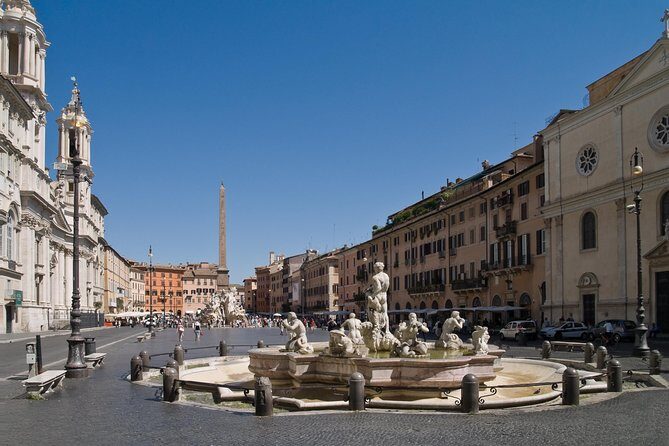
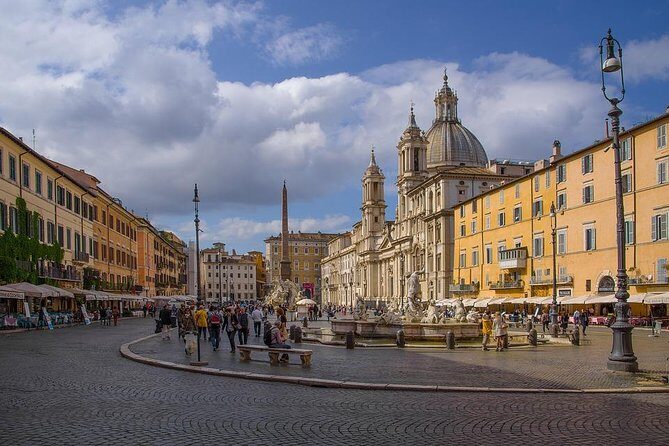
Then you walk into Piazza Navona, one of the most memorable squares in central Rome. It’s known for its fountains, including Bernini’s Fontana dei Quattro Fiumi, and it offers a strong sense of how Rome treats public space as performance space.
You’ll spend about 15 minutes at Piazza Navona, and then a separate focused moment on the Fontana dei Quattro Fiumi (around 5 minutes). That split is helpful because the fountain is where the details matter. If you only got a quick glance, the symbolism could blur. With time carved out, you can actually understand what you’re looking at.
Here’s the story the guide ties to your view: the Fountain of the Four Rivers was commissioned in the mid-17th century and represents the world’s major rivers across four continents—the Nile, Danube, Ganges, and Rio de la Plata. Each river is shown by a distinct carved figure meant to represent a different character, which is very “Baroque thinking”: a visual message delivered in stone.
If you like decoding symbols, you’ll enjoy this stop. If you prefer architecture-first sightseeing, it still works because you can study the composition, figure placement, and the drama of the sculpted water world.
Ponte Sant’Angelo: angels, Christ’s Passion, and Bernini’s touch
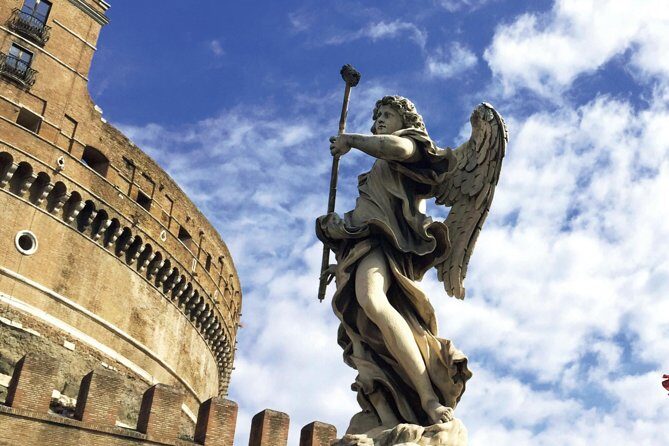
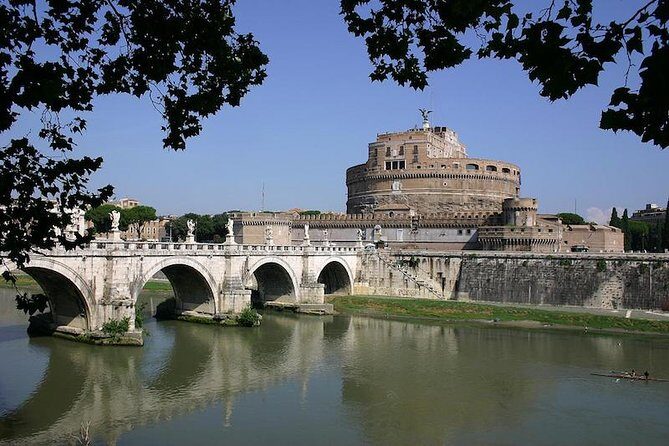
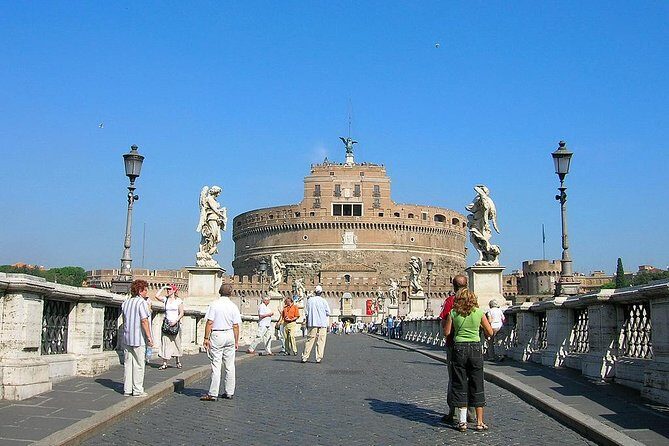
From the square area you head toward St. Angelo Bridge (Ponte Sant’Angelo), where the stone story becomes even more religious and specific. The bridge was originally built by Emperor Hadrian in 134 AD, and later the angel statues were supervised by Gian Lorenzo Bernini in the 17th century.
The angel statues are described as embodying the Passion of Christ, which changes how you read the bridge. It isn’t just a scenic crossing. It’s a procession-like visual line of devotion.
You’ll have about 10 minutes here. That’s enough to appreciate the design and listen for the guide’s explanation of what the angels are meant to communicate. It’s also enough time to stop for a steady look from a couple of spots without turning it into a long detour.
If you’re walking quickly, remember: bridge viewing is better when you slow down for the angel line itself, not just the overall bridge silhouette.
St. Peter’s Basilica area and St. Peter’s Square symbolism
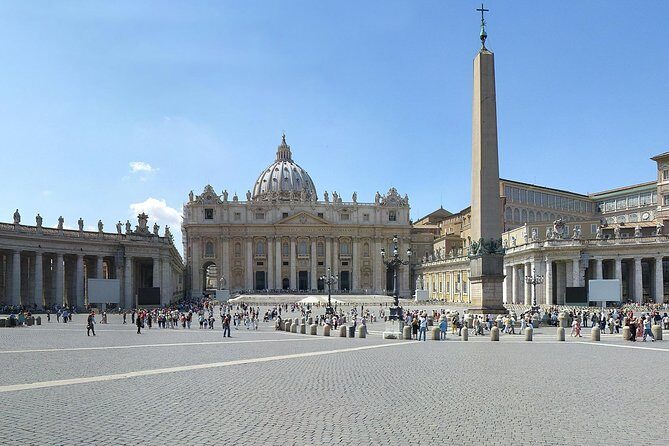
Your Vatican-area time centers on St. Peter’s Square (about 15 minutes listed) and the surrounding context of St. Peter’s Basilica. St. Peter’s Basilica is described as built over what’s traditionally considered the tomb of Saint Peter, and associated with major Renaissance and Baroque names like Bramante, Michelangelo, and Bernini.
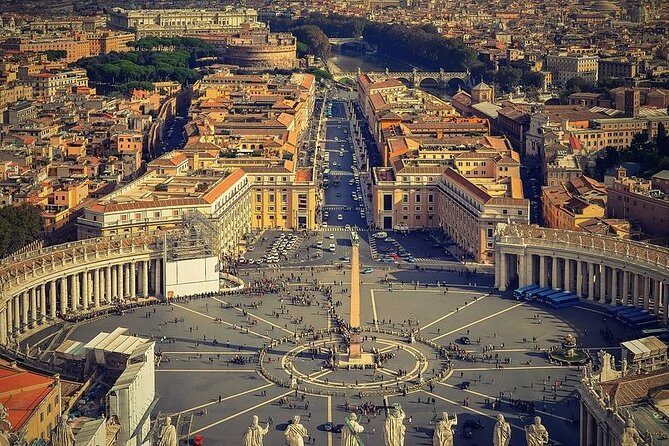
The guide’s focus here is the idea that the square hides mysterious and alchemical symbols. That’s exactly the kind of “look again” detail that makes a themed tour worth paying for. Even if you’ve seen photos, the guide helps you connect the symbols to why people used architecture and art to communicate big ideas.
One caution: the tour notes that St. Peter’s Square admission is not included. At the same time, your tour info also says no entrance tickets are required for the suggested sites. That usually means you can see and experience the key exterior areas, but you shouldn’t assume any paid basilica-entry upgrade or special-access ticket is part of the standard plan.
Dress code matters again. Churches and Vatican areas have strict rules, and they’re not flexible. Bring something that covers knees and shoulders.
Timing shifts you should expect in real Rome
Rome does not run like a spreadsheet. This tour explicitly warns that the order of sites may vary due to opening hours and special ceremonies. With the Jubilee, some monuments could be under restoration or closed due to extraordinary celebrations.
So if you’re the type who plans around exact minutes, treat this itinerary as a best-fit structure. You’ll still get the core landmarks and the story thread, but the sequence might shuffle depending on what’s accessible that day.
It’s also why a private guide matters. When the schedule changes, you want someone who can adjust the flow on the ground without leaving you stranded or bored.
Is this tour right for you?
This tour fits you best if:
- You’re a Dan Brown fan or you want Illuminati talk translated into real visual clues.
- You want a first-timer Rome plan that hits major landmarks in a tight loop.
- You like Baroque art and symbolism, especially when someone points out what to look at.
- You value hotel pickup/drop-off and don’t want to navigate meeting points or transit on your own.
You might want a different option if:
- You prefer longer museum time at fewer sites.
- You hate short stops and prefer unhurried roaming.
- You’re worried about dress code compliance in churches.
Should you book this Angels and Demons private tour?
I’d recommend booking if you want a story-driven Rome walk that doesn’t turn into a random checklist. The strongest reasons are the private format, the pickup convenience, and the way the route is designed around artworks and symbols that actually connect to what people look for in Angels and Demons.
It’s also a good choice when time is tight. With about 3.5 hours, you can see a concentrated chunk of Rome without losing your day to logistics.
Just be honest with yourself about pacing. This isn’t a slow “linger and photograph everything” tour. It’s a focused “see the core, learn the meaning, then go back out into Rome with better eyes” kind of plan.
FAQ
How long is the Rome Angels and Demons private tour with transfers?
It’s approximately 3 hours 30 minutes.
What’s included in the tour price?
Included are a professional licensed Blue Badge tour guide, a private walking tour, and hotel pickup and drop-off with a sanitized vehicle.
Is hotel pickup available?
Yes, pickup is available for hotels/accommodations in Rome city center within the Aurelian Walls.
Is this a private tour?
Yes. Only your group participates.
What language is the tour offered in?
The tour is offered in English.
Do I need entrance tickets for the sites on the itinerary?
No entrance tickets are required for the suggested sites on this tour. Santa Maria della Vittoria is listed as free.
What should I wear for churches and religious sites?
A dress code is required: no shorts or sleeveless tops, and knees and shoulders must be covered for both men and women.
Are food and drinks included?
No. Food and drinks are not included.
Are service animals allowed?
Yes, service animals are allowed.
What if something is closed due to ceremonies or the Jubilee?
The order of sites may vary due to opening hours and special ceremonies, and some monuments may be under restoration or closed. You should watch for messages about possible changes.
What is the cancellation policy?
Free cancellation is available up to 24 hours in advance for a full refund. Canceling less than 24 hours before the start time isn’t refundable.