REVIEW · PRIVATE
Roman Forum Myths and Legends Private Guided Tour
Book on Viator →Operated by Kirba Tours · Bookable on Viator
Rome’s myths are written in stone.
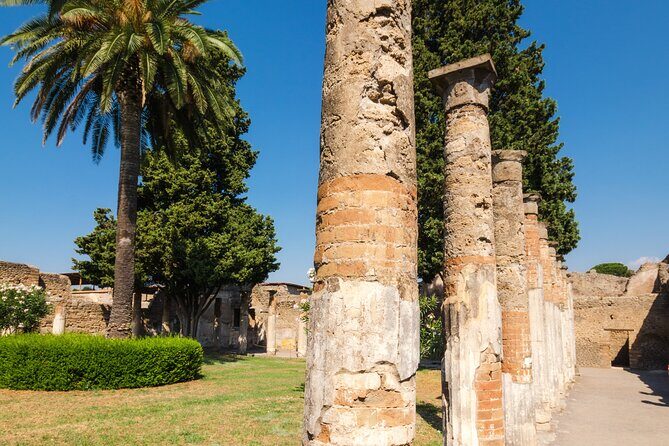
This private walk through the Roman Forum connects the ruins you can see with the stories Romans told to explain power, religion, and identity. You’ll move site to site while your guide links temples, civic buildings, and legendary moments into one clear thread of Roman belief, from Romulus and Remus to the cult of Julius Caesar, with the Roman Forum acting like a real-life stage.
Two things I really like: first, the tour style is built for understanding, not just sightseeing, and guides like Paolo help you visualize what you’re looking at with stories and even artists renderings. Second, the experience is private, so the pace and questions stay focused on your group instead of getting lost in a crowd.
One possible drawback: you cover a lot of ground in about two hours, and several stops are short (often around 5 to 15 minutes). So if you prefer to linger for long photos and extra reading, you may feel slightly rushed.
In This Review
- Key highlights worth knowing
- Why the Roman Forum makes myths feel real
- Private guidance, clear audio, and a smart way to structure time
- Stop-by-stop: Roman Forum myths and the places they shaped
- Lapis Niger: the Black Stone shrine over Romulus
- Basilica Emilia: where law, commerce, and politics mixed
- Temple of Antoninus Pius and Faustina: deified love and imperial worship
- Regia: residence of kings and the pontifex maximus
- Temple of Vesta and the Vestal Virgins: the eternal flame with real consequences
- Casa delle Vestali: the working complex behind the ritual
- Fonte di Giuturna: a myth-born spring with healing legend
- Temple of Castor and Pollux (Dioscuri): victory delivered by horseback
- Lacus Curtius: sacrifice, prophecy, and a chasm that closed
- Temple of Saturn: agriculture, treasury, and the Saturnalia ritual calendar
- Umbilicus Urbis: the center of the city and the Mundus opening
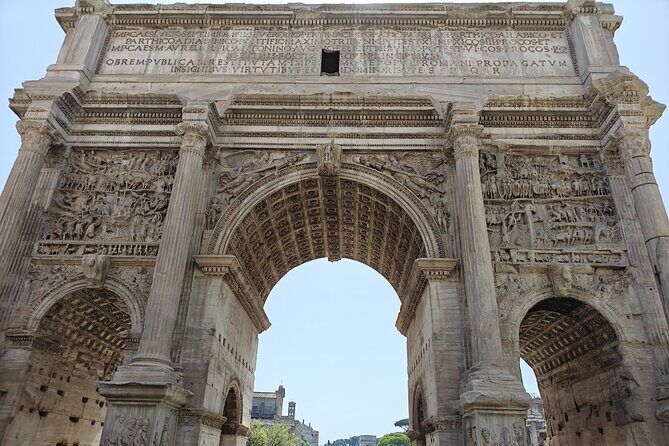
- Arch of Septimius Severus: victory reliefs and a fortress past
- Miliarium Aureum and the idea behind all roads lead to Rome
- Basilica Julia and Curia Julia: courts and the Senate in one walking loop
- Temple of Divus Julius: when Caesar became a worship idea
- Price and what you really get for $286.60 per person
- Getting more from the guide’s stories (without needing extra studying)
- Who should book this Roman Forum myths tour
- Should you book it? My honest take
- FAQ
- How long is the Roman Forum Myths and Legends private guided tour?
- Is this a private tour?
- What’s included with the tour price?
- Do I need ID for entry?
- Where does the tour start and end?
- Does the tour include Colosseum access?
Key highlights worth knowing
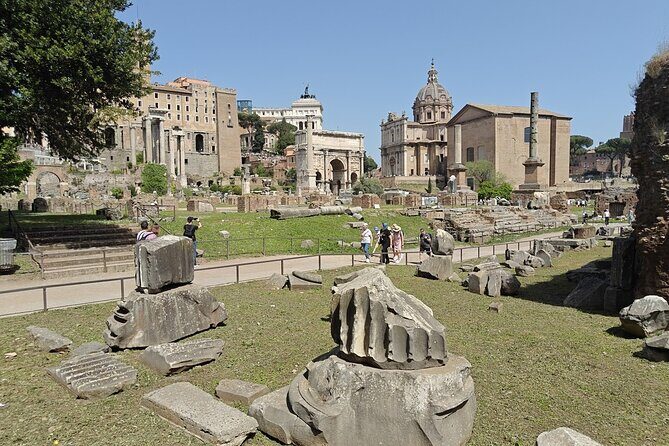
- Paolo-led storytelling that makes the Forum feel readable, not just impressive
- A private 2-hour format focused on myths tied to specific ruins
- Included entrance for the Roman Forum, Palatine Hill, and Imperial Forums
- A headset option to hear clearly even when you’re in a larger group
- Legend-to-architecture links at every stop, from the Lapis Niger to Divus Julius
- Well-preserved monuments like the Arch of Septimius Severus that anchor the myths with real stone
Why the Roman Forum makes myths feel real
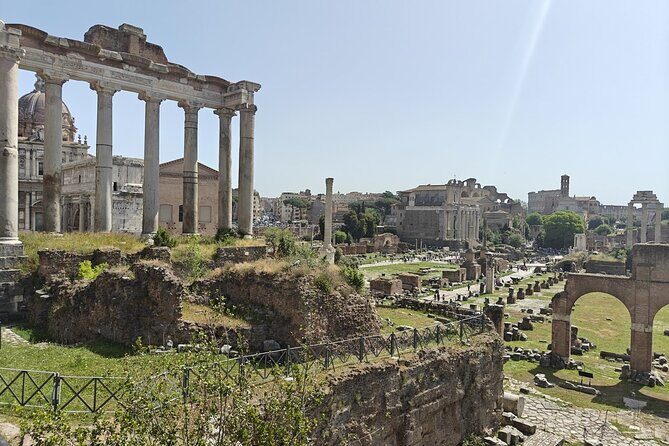
Most ruins are quiet. The Roman Forum isn’t. It’s crowded with meaning—politics, religion, law, and ceremony all layered together in one compact area. That’s why a myths-and-legends approach works so well here: you’re not just learning who ruled Rome, you’re learning how Romans explained why their world made sense.
On this tour, the stories do practical work. When you stop at the Lapis Niger, you’re not only hearing about Romulus. You’re seeing how a mysterious ancient shrine became tied to Rome’s origins and a question people argued about for centuries. Later, the Vestal Virgins at the Temple of Vesta show you the other side of myth: the kind that controlled behavior through ritual and fear. It’s the same theme over and over—religion and myth weren’t decoration in ancient Rome. They were systems.
And you’ll notice the pattern as you go: a myth gives a reason for why a place matters, and then the architecture gives that reason a physical home. That connection is what makes the walk stick.
You can also read our reviews of more guided tours in Rome



Private guidance, clear audio, and a smart way to structure time
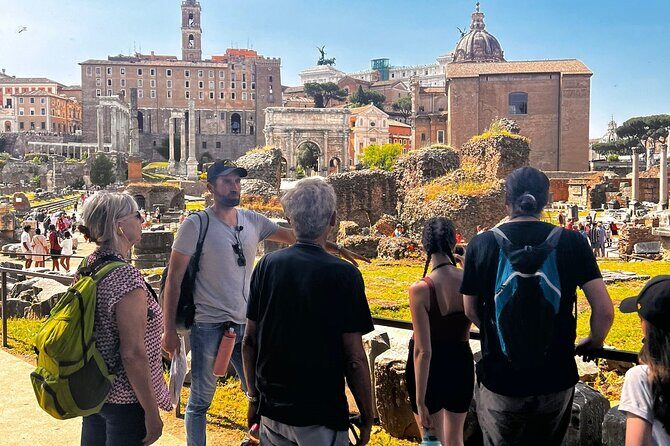
This is a private tour, meaning it’s only for your group. That matters in a site like the Roman Forum, where it’s easy to drift, miss key details, or feel overwhelmed by all the partial ruins. A good guide helps you keep the story straight.
You’ll also get an official guide and a headset setup if your group size triggers it, which helps a lot in an open-air space where voices can carry poorly. The tour runs about two hours, so the timing is tight but workable. Think of it as a guided hit list: you get the origin myths, the civic myths, and the big political-religious signals without wandering for hours.
One practical note that can affect your entry: the tour requires full participant names exactly as on your ID or passport at booking time, and ID or passport is mandatory for entrance. If the name on your booking is incomplete, entrance can’t be guaranteed. So if you’re traveling with a name mismatch risk, fix it early.
Stop-by-stop: Roman Forum myths and the places they shaped
Lapis Niger: the Black Stone shrine over Romulus
You start at the Lapis Niger, the ancient shrine known for its association with Rome’s earliest legendary king. The key idea is straightforward: legend links this spot to Romulus after his death—built over where his body was said to be buried after he was murdered by his own people.
What makes this stop extra interesting is the discovery story. The Lapis Niger wasn’t something archaeologists confidently found and cataloged from day one. It turned up in 1899, during excavations beneath a medieval pavement—an accidental find that surprised scholars at the time. Standing there, you get a rare feeling in archaeology: not just what was found, but the fact that history still has surprises.
Time check: you’ll spend about 5 minutes here, so listen for the way your guide connects legend, sacred space, and why this location mattered to Rome’s story of itself.
Basilica Emilia: where law, commerce, and politics mixed
Next is Basilica Emilia, an important public building in ancient Rome. In plain terms, this is where serious stuff happened: senators could meet, and the building served as a hub for legal and commercial activity.
The myth layer isn’t the headline here. Instead, it’s the civic layer: Romans didn’t separate government from daily life. This basilica was built in the 2nd century BCE, later destroyed by fire, and rebuilt multiple times. Even though you’re looking at ruins, the repeated rebuilds show how persistent Rome’s civic machinery was.
Time check: about 10 minutes. It’s enough to get the function, but not enough to treat this like a slow museum stop. Let the guide’s explanation do the heavy lifting.
You can also read our reviews of more private tours in Rome



Temple of Antoninus Pius and Faustina: deified love and imperial worship
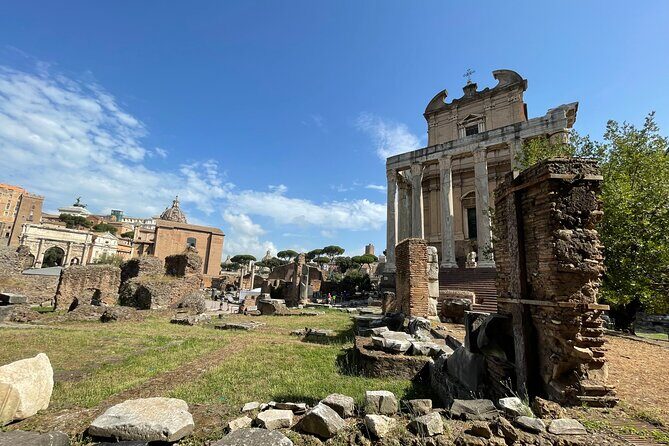
After that, you’ll move to the Temple of Antoninus Pius and Faustina, dedicated to the deified emperor and his wife. The story tied to the temple is about love—legend frames it that way, with the temple commemorating the pair as ideals of devotion and public virtue.
This stop is useful because it explains a major Roman shift: emperors weren’t only rulers, they became objects of worship. You’ll hear how Antoninus Pius was known for a peaceful reign and commitment to arts and sciences, while Faustina the Elder was linked with beauty and philanthropy. Whether you take those details at face value or as propaganda, the result is the same: the temple shows how faith, status, and loyalty were managed.
After the fall of the empire, the temple fell into disrepair and was used for different purposes. That part matters, because it reminds you that Rome’s sacred spaces didn’t remain frozen. They changed hands, changed roles, and kept aging with the city.
Regia: residence of kings and the pontifex maximus
The Regia is one of those spots where Rome collapses multiple eras into one theme. It served as the official residence of the kings of Rome and later became linked to the pontifex maximus, the high priest.
Legend adds another layer. The Regia is said to have been built after advice from the goddess Egeria, who advised King Numa Pompilius in meetings on state and religion. So when you’re standing near the ruins, you’re not just looking at a building—you’re looking at the idea that governance and divine guidance were supposed to work together.
This stop is also a good example of why myths matter even when the physical remains are limited. The Regia survives as ruins, but it’s remembered as sacred and important, tied to ceremonies that shaped public life.
Temple of Vesta and the Vestal Virgins: the eternal flame with real consequences
Then comes the Temple of Vesta, and it’s a big one. This is where the Vestal Virgins tended the sacred flame, which represented Rome’s eternal life.
Here, the tour gets specific about the system. Vestal Virgins were chosen when very young—about ages six to ten—and served a term of thirty years while expected to remain celibate. The flame wasn’t symbolic in a casual way. Their purity was treated as essential to the state’s well-being. A breach of vows was treated as a grave offense, and the punishment described is severe: a Vestal Virgin found guilty was buried alive.
That’s heavy material. But it’s also exactly why this tour format works. You can see the religious structure, and the guide’s story explains why the Romans would have cared so intensely about a flame.
Casa delle Vestali: the working complex behind the ritual
Just after the temple, you’ll reach the Casa delle Vestali, the larger complex associated with the Vestal Virgins. Think of it as the full package: living quarters, spaces connected to the temple of Vesta, and administrative and ritual areas.
This stop also adds the social side of the myth. Vestal Virgins weren’t low-status priestesses. They were respected by the Roman people, and their position came with major privileges—like the right to own property and the power to grant clemency to condemned prisoners. That detail helps you understand why the role mattered to Rome beyond religion.
Time check: around 15 minutes. It’s enough time to connect the dots between daily life and public authority.
Fonte di Giuturna: a myth-born spring with healing legend
Next is Fonte di Giuturna, connected to Juturna, the goddess of fountains, wells, and springs. In Roman mythology, she’s transformed into a spring after being pursued. The story describes her escape from Iuppiter (Zeus) and her transformation into the water source.
In practice, Rome treated this as more than folklore. The spring was believed to have healing powers, and people came to bathe there.
If you like myths that explain why people used real water sources, this is a satisfying stop. It bridges the supernatural and the everyday in a very Roman way.
Time check: about 5 minutes.
Temple of Castor and Pollux (Dioscuri): victory delivered by horseback
A bit later you’ll visit the story-linked area connected to the Dioscuri, the twin gods Castor and Pollux. Their myth is tied to the legendary Battle of Lake Regillus between Rome and the Latin League.
After the battle, the story says the twins appeared on horseback at the Roman Forum and announced Roman victory. That’s the kind of scene-setting myth that explains why Romans would build sacred space for protection and public confidence.
A temple dedicated to them was built in the Forum, and part of it still stands. So you’re not just hearing a legend; you’re seeing what Rome chose to preserve as a marker of divine support.
Lacus Curtius: sacrifice, prophecy, and a chasm that closed
One of the most dramatic stops is Lacus Curtius. The legend goes like this: a deep chasm opened in the Forum. The Sibylline Books prophesied that Rome would be saved only if its most valuable possession was thrown into the abyss.
Curtius steps in—fully armored and riding his horse—and rides into the chasm, disappearing as a sacrifice. The chasm closes, and Rome is saved. Afterward, a small lake was created at the spot.
This is myth as moral lesson and civic reassurance. It turns a terrifying problem into a story that trains people in devotion to the city. If you want your myths to feel practical rather than just entertaining, this one delivers.
Time check: about 10 minutes.
Temple of Saturn: agriculture, treasury, and the Saturnalia ritual calendar
Then you’ll reach the area tied to the Temple of Saturn. Legend places Saturn’s establishment of reign at this site. Saturn is framed as a god of agriculture who taught early Romans how to farm—so his role is foundational to civil life, not just seasonal celebration.
The temple’s civic function matters too: it housed the state treasury. During Saturnalia, the treasury was opened and gifts were exchanged, with Saturnalia celebrated from December 17 to December 23.
This stop is a strong reminder that Roman religious life was woven into public finance and public rhythms.
Umbilicus Urbis: the center of the city and the Mundus opening
Next is Umbilicus Urbis, described as a conical brick structure with a door leading to an underground cavity. The legend linked to it traces back to Plutarch’s account of Rome’s founding.
Romulus dug a circular pit in the Comitium, threw in offerings and soil from followers’ homelands, and the pit became the Mundus—considered the center of Rome’s sacred boundary. The Mundus was opened only three days a year to connect living and dead, and it was considered impious to do public activities then.
This is where myth becomes geography. Rome didn’t just think it was in the world. It believed the city’s center was a sacred hinge between realms. Seeing the small structure after hearing that idea gives you a clear mental picture of how Romans structured belief onto physical points.
Time check: about 10 minutes.
Arch of Septimius Severus: victory reliefs and a fortress past
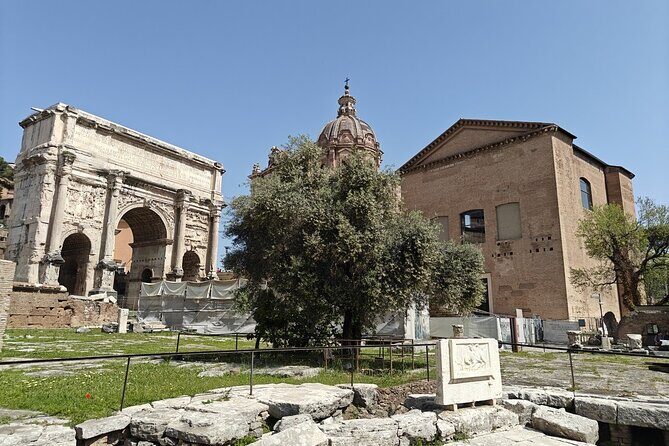
Then comes the Arco di Settimio Severo, one of the best-preserved triumphal arches in Rome. It’s famous for reliefs showing scenes from the emperor’s military campaigns. That relief storytelling is part of why arches mattered: they broadcast power and memory in stone.
You’ll also hear a useful comparison: the arch was later used as a model for the Arc de Triomphe in Paris. It’s also described as having survived earthquakes and floods over the centuries and even served as a medieval fortress in the 14th century.
This stop is a nice shift in tone from myth to real-world durability. The story is still about Rome’s power, but the evidence is physical and hard to ignore.
Time check: about 15 minutes.
Miliarium Aureum and the idea behind all roads lead to Rome
Near the arch area, you’ll hear about the Miliarium Aureum, a monument tied to measuring distances from Rome across the empire. It was erected by Emperor Augustus in the early 1st century AD and is described as one of the oldest surviving milestones in the world.
This is more than a trivia stop. It’s where the tour connects Rome’s myths and religion to empire logistics and identity. The expression all roads lead to Rome connects to the reality that the Romans built a massive network of paved roads—more than 50,000 miles—radiating outward from Rome.
When you understand the measurement hub, the phrase feels less like marketing and more like imperial infrastructure turned into a cultural slogan.
Basilica Julia and Curia Julia: courts and the Senate in one walking loop
After the distance theme, the tour moves into the legal and political core.
The Basilica Julia played a major role in Rome’s legal system. It was used for trials and legal proceedings, and it also housed government offices. A raised platform or tribunal is part of how judges conducted cases in the space. It also served as a Senate meeting place.
Then you reach the Curia Julia, the Senate’s meeting place. The guide explains it was built by Julius Caesar in 44 BC after he became dictator, replacing an older Senate house. The Senate is described as about 300 members, meeting regularly to debate matters of state, with consuls (or other magistrates) presiding. The Senate could pass laws, approve or reject treaties, and make major foreign and domestic decisions.
This pair of stops is where the myths stop being separate stories. You see how belief shaped institutions, and how institutions shaped public life.
Temple of Divus Julius: when Caesar became a worship idea
You end at the Temple of Divus Julius, also known as the Temple of Caesar. This temple was built by Augustus after Julius Caesar’s death and is described as the first temple in Rome dedicated to an individual who wasn’t a god or goddess.
The tour brings in the human reaction too: the plebs were reportedly devastated by Caesar’s death and mourned him deeply. The story describes unrest in the city and a massive funeral procession, with an estimated crowd of over 100,000.
This stop is powerful because it shows you the myth-making engine at work. Caesar’s memory was turned into an official religious framework. Myth wasn’t just old legend. It could be newly manufactured to stabilize a political world.
Time check: about 20 minutes, giving this ending room to land.
Price and what you really get for $286.60 per person
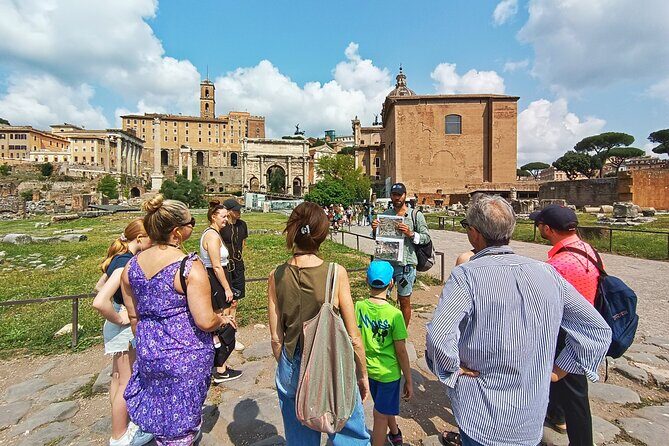
At $286.60 per person, this tour isn’t a budget whim. It’s priced like a guided, timed, and ticket-supported experience. You’re paying for a private format, an official guide, and an included entrance ticket covering the Roman Forum, Palatine Hill, and Imperial Forums, plus headset support designed for clearer audio.
For value, ask yourself one question: do you want the Forum explained as an interconnected story, or do you just want to wander? If you enjoy myth and want the ruins placed in context—founding legends, religious power, state rituals, and Caesar’s cult—the guided format can feel worth it because it saves you from piecing together a puzzle while you’re standing in the wind and crowds.
Two cautions to keep in mind:
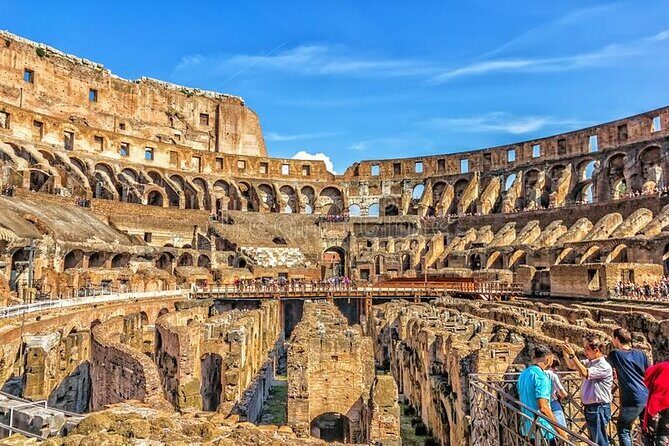
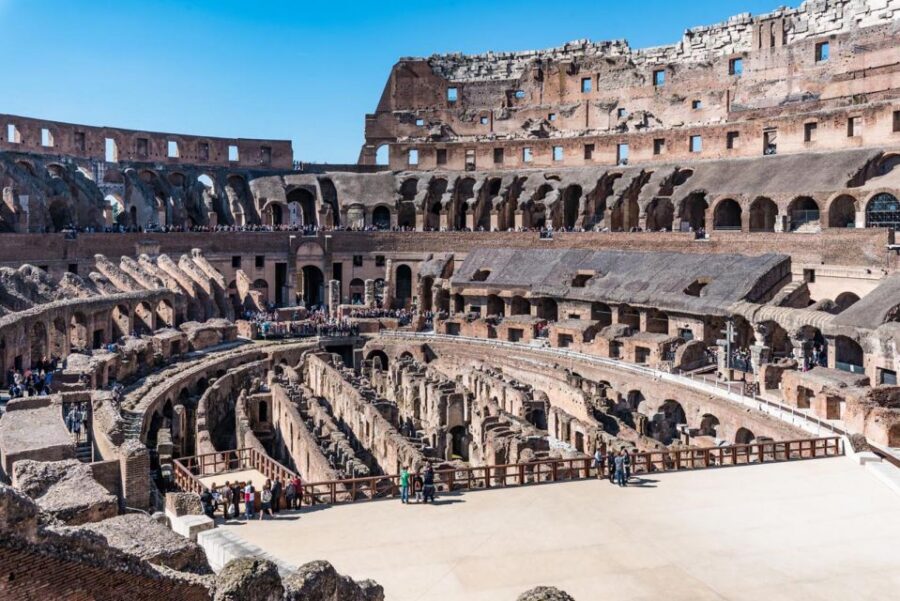
- Colosseum access isn’t included, so don’t expect this to cover the big neighbor site.
- Many stops are short because the tour is only about two hours, so it’s best if you’re okay with a brisk but focused route.
Getting more from the guide’s stories (without needing extra studying)
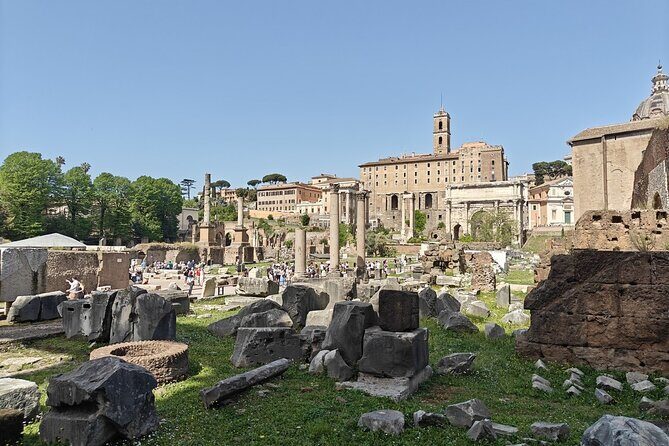
If you want this to click, listen for the linking logic. For example:
- When you hear about Vesta, connect it to what Rome feared and protected, not just the legend itself.
- When you hear about Saturnalia, connect it to why the treasury mattered.
- When you hear about Umbilicus Urbis, connect it to Rome’s idea of a sacred city center and the Mundus.
Also, come prepared to move. This is a walking tour with many stops, including some emotionally heavy themes tied to the Vestals. That’s part of the experience; the upside is that the guide keeps it grounded in what the ruins represent.
And because entrance requires your ID/passport and exact names, take 30 seconds before you go to double-check everything matches what you booked.
Who should book this Roman Forum myths tour
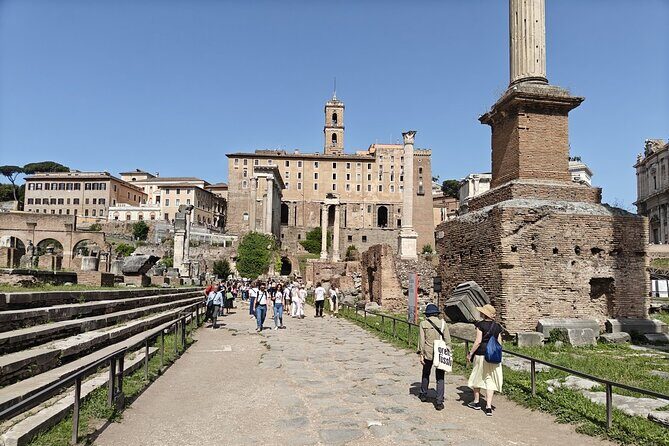
This tour is a good fit if:
- You love mythology and want it anchored to real places, not told in generic terms.
- You want the Forum explained as politics plus religion, not just archaeology.
- You prefer a private setting where the guide can keep the story tight for your group.
It’s less ideal if:
- You’re only interested in the Colosseum and want a plan that includes it.
- You prefer long, slow museum-style pacing and lots of time at just one or two stones.
Should you book it? My honest take
Book it if you want the Roman Forum to make sense in a single sitting. A guide-led myth route like this is one of the most efficient ways to turn scattered ruins into a coherent picture of how Romans saw their own origin, their gods, their laws, and their leaders.
Skip it only if you’re trying to replace the Colosseum plan or you hate brisk stop-and-go touring. Otherwise, this is a strong way to see the Forum while actually understanding why each place mattered.
FAQ
How long is the Roman Forum Myths and Legends private guided tour?
The tour lasts about 2 hours.
Is this a private tour?
Yes. It is a private tour/activity, and only your group will participate.
What’s included with the tour price?
The tour includes the entrance ticket to the Roman Forum, Palatine Hill, and Imperial Forums, plus a Roman Forum guided tour with an official guide and a headset to hear the guide clearly.
Do I need ID for entry?
Yes. Full names exactly as written in your ID or passport are required at booking, and ID or passport is mandatory for entrance. If you show up without ID or passport, entrance cannot be guaranteed.
Where does the tour start and end?
The tour starts at Largo della Salara Vecchia (L.go della Salara Vecchia, 00186 Roma RM, Italy). It ends back at the meeting point.
Does the tour include Colosseum access?
No. Colosseum access is not included.