REVIEW · MUSEUMS
Leonardo da Vinci Museum: the Universal Genius and His Works
Book on Viator →Operated by Mostra di Leonardo · Bookable on Viator
Leonardo’s ideas feel alive here. This small Rome exhibition uses real-life scale replicas, hands-on elements, and modern multimedia to explain how Leonardo thought like an artist, engineer, and craftsman. You also get a surprising ending: an underground pond revealing the tomb of Aulo Irzio dating to 43 B.C.
I especially love how many pieces are touchable and tryable, so you’re not just reading panels. I also like the way 3D holograms and videomapping make his sketches feel like working inventions, which is great when you’re traveling with mixed interests.
One consideration: without an audio guide, you can move through quickly, so plan for at least 40 minutes and consider renting the device if you want the full explanations.
In This Review
- Key things to know before you go
- Leonardo da Vinci museum in Rome: where the exhibition is and what to expect
- Inside the Museo/Mostra Leonardo da Vinci: Il Genio le Invenzioni
- 3D holograms and videomapping: making sketches feel mechanical
- The underground pond and the tomb of Aulo Irzio (43 B.C.)
- Audio guide at €3: when it’s worth it and what languages are offered
- How long to plan: minimum 40 minutes, best pacing, and comfort tips
- Price and value: is $10.81 a fair deal for this kind of Leonardo show?
- Who should book this Leonardo da Vinci exhibition at Piazza della Cancelleria?
- Booking advice: how to avoid the most common Rome mix-ups
- Should you book this Leonardo da Vinci museum ticket?
- FAQ
- Where is the Leonardo da Vinci exhibition located?
- How long does the visit take?
- What is the ticket price?
- Is the exhibition audio included?
- What languages are available for the audio guide?
- Is the tour offered in English?
- What are the opening hours?
- Is it closed on any date?
- Do children need to be accompanied?
- Is there free cancellation?
Key things to know before you go
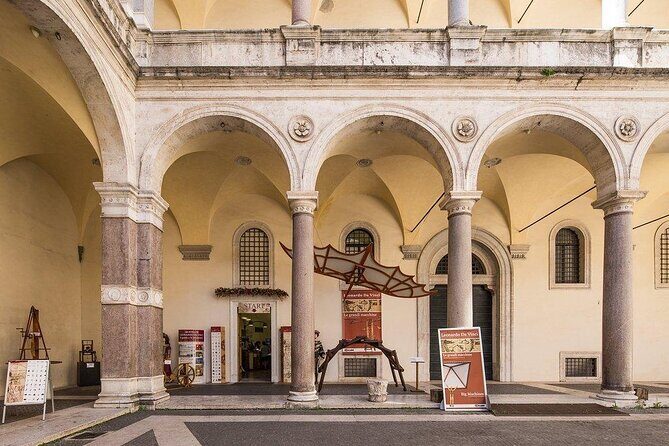
- Full-size reproductions: More than 65 machine drawings in real-life scale, plus interactive testing
- Multimedia effects: 3D holograms and videomapping that explain motion and design
- A real surprise finish: An underground pond connected to the tomb of Aulo Irzio (43 B.C.)
- Audio guide is extra: Rental at the entrance costs €3 per person
- Plan for timing: Minimum 40 minutes, with many visits landing around 45–60 minutes
- Avoid Leonardo mix-ups in Rome: Use Piazza della Cancelleria 1 as your anchor address
Leonardo da Vinci museum in Rome: where the exhibition is and what to expect
This Leonardo experience takes place in the heart of Rome at Piazza della Cancelleria 1, in a historic Renaissance setting. The building and the location matter here because the exhibition doesn’t feel like a random stop—it feels placed, like it belongs to the city.
The format is built for an easy visit. You’re not committing to a long, museum-day schedule. Instead, you’re stepping into a focused exhibition that’s designed to work for different ages and attention spans, from kids who want to touch things to adults who want the engineering logic behind the designs.
The practical upside: you’ll likely find it straightforward to fit into a sightseeing plan around the Vatican area. The venue is also near public transportation, which helps if you’re trying to avoid hauling across town.
You can also read our reviews of more museum experiences in Rome



Inside the Museo/Mostra Leonardo da Vinci: Il Genio le Invenzioni
Your main stop is Museo/Mostra Leonardo da Vinci – Il Genio le Invenzioni. This is where the exhibition earns its reputation as an interactive Leonardo show, not just a display of images.
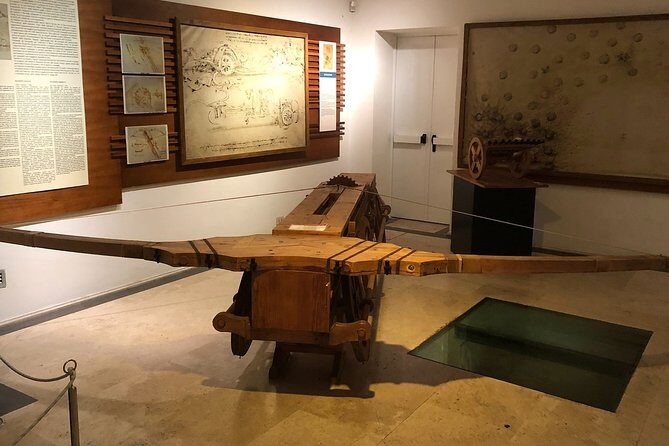
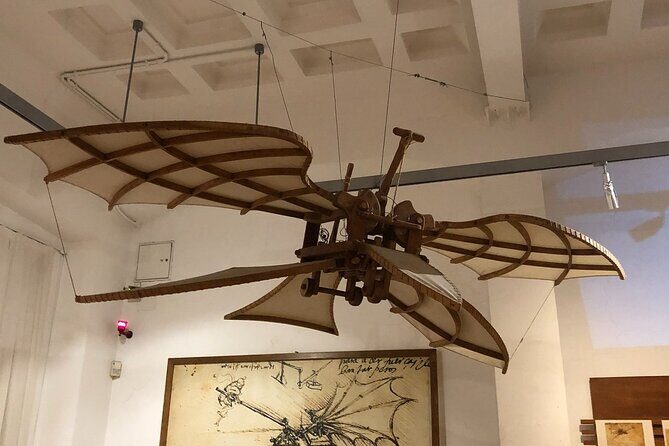
You’ll start by looking at more than 65 reproductions of Leonardo’s machine drawings in real-life scale. That detail is more important than it sounds. When you see full-size proportions, you understand why certain mechanisms make sense, and why others would have been hard to build in practice with the tools of Leonardo’s era.
Then comes the fun part: you can touch and try many of the inventions. That hands-on approach changes the whole experience. Leonardo becomes less like a name from a textbook and more like a practical thinker. You’ll notice how the exhibition pushes you to interact, not just observe.
A good way to experience this section is to slow down at the machines that catch your eye, not the ones you already know. If you’re curious about how engineering works, watch for how the replicas show function. If you’re more art-focused, pay attention to how Leonardo’s drawings mix clarity with imagination—this exhibition treats that mix like it’s the point.
3D holograms and videomapping: making sketches feel mechanical
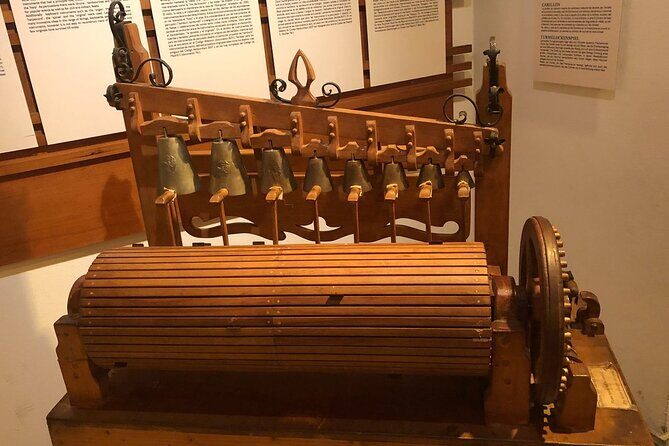
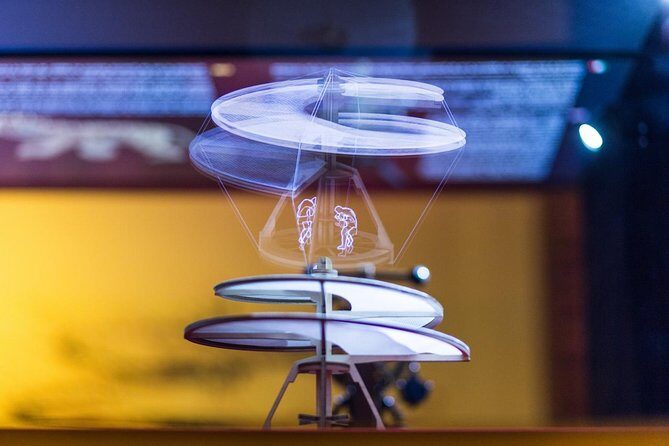
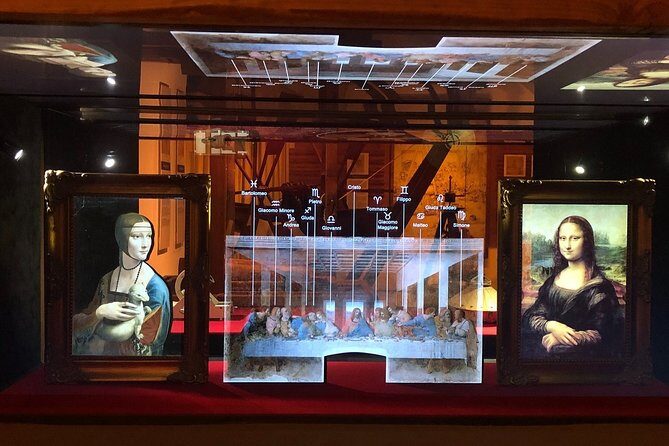
In between the replicas, the exhibition adds modern presentation tools: holograms in 3D and videomapping. These effects aren’t decoration. They’re there to help you see how ideas move from concept to mechanism.
When the multimedia kicks in, you’ll get a better sense of how designs are meant to operate. You’re not stuck guessing what a drawing would do. The visuals can make motion and relationships between parts feel more obvious, even if you’re not an engineer.
This is also where the exhibit tends to work for families. Kids can enjoy the visuals without needing a long lecture. Adults get enough context to understand what they’re looking at, without forcing a technical class.
If you tend to skim, you might miss the quiet value of these segments. They’re often the difference between seeing replicas as cool props and understanding them as ideas Leonardo developed with system thinking.
The underground pond and the tomb of Aulo Irzio (43 B.C.)
At the end of the exhibition, the show reveals its wild card: a hidden treasure. You can see an underground pond that connects to the tomb of Aulo Irzio, dating to 43 B.C.
This part changes the tone. Everything before it is about invention and design. Then you step into a scene that feels archaeologically real, like history is layered under the present building.
It’s a smart ending because it gives your brain a new lens. You stop thinking only about Leonardo’s machines and start thinking about time itself: Rome is full of surviving details, and this exhibition literally reminds you that the site carries older stories beneath your feet.
If you love surprise endings—short, unexpected detours—this one is worth being present for. Don’t rush out before you reach the underground feature.
Audio guide at €3: when it’s worth it and what languages are offered
Admission includes entry to the exhibition, but audioguides are not included. You can rent them at the entrance for €3.00 per person.
If you’re the type who likes to know the why behind what you’re seeing, I think the audio guide is a good value add. The exhibition is hands-on, and you can easily spend most of your time testing mechanisms. The audio helps turn that activity into understanding—especially with the machine concepts and the way the exhibition explains them.
Choosing a language is simple. The available options include: Italian, Spanish, English, French, German, Portoghese, Russian, Dutch, Romanian, Polish, and Hebrew. If you’re traveling with someone who prefers English, you’re covered.
One more practical point: don’t assume audio is optional. If you skip it, you can still have a great time, but you may move through sections faster than you expect. The show has enough going on that it rewards slow attention.




How long to plan: minimum 40 minutes, best pacing, and comfort tips
The museum notes a minimum of 40 minutes to visit. In real terms, you should probably plan for a little more if you want time to try the interactive parts and not feel rushed.
A lot depends on your pace:
- If you mainly want photos and fast viewing, you can likely finish in under an hour.
- If you stop to test multiple machines, read more carefully, and watch the multimedia, expect closer to the upper end of the 45 minutes to 1 hour range.
This is also one of those Rome stops that works even on a tight schedule because it’s time-boxed. You can pop in, explore, then move on without losing an entire morning.
Comfort is another factor. The exhibition is indoors, and some people report it’s comfortable enough to enjoy without feeling overheated, which matters in summer heat. If you’re traveling with kids, this kind of controlled environment makes the whole outing smoother.
And yes, kids need an adult. The exhibition requires that children be accompanied by an adult, so plan accordingly if you’re traveling as a family.
Price and value: is $10.81 a fair deal for this kind of Leonardo show?
At $10.81 per person, this ticket price is low enough that you can feel good about committing, especially because admission is what you’re paying for. The experience includes entry to the Leonardo exhibition itself.
The main add-on cost is the audio guide: €3.00 per person. Whether that’s worth it depends on your style:
- If you like explanation and context, budget for it.
- If you prefer hands-on exploration and don’t mind reading short labels, you might skip it.
Here’s the value logic: you’re not just paying for access. You’re paying for a structure that mixes full-size replicas, interactivity, and multimedia. That combination is usually what makes a small museum feel like more than a quick stop.
Also, a lot of similar attractions in Rome can burn time without giving much back. This one aims to use your time efficiently. Even if you’re not a die-hard Leonardo fan, the engineering-meets-art concept is easy to enjoy.
Who should book this Leonardo da Vinci exhibition at Piazza della Cancelleria?
I’d book this if you want a smart, hands-on Leonardo stop that doesn’t demand hours. It’s a good fit for:
- Families who want to do something with their hands, not just walk and look
- Travelers who like museum exhibits with multimedia that actually explains what you’re seeing
- People who want a time-efficient cultural visit in central Rome
You might skip it if:
- You hate interactive exhibitions and only want traditional, quiet displays
- You’re short on time and only want the biggest, most famous masterpieces (this is a focused exhibition, not a full collection museum)
- You’re not interested in paying a small extra amount for audio context (even though the show includes plenty visually)
Booking advice: how to avoid the most common Rome mix-ups
Rome has more than one Leonardo da Vinci-related exhibition, and the experience you want is tied to a very specific address: Piazza della Cancelleria 1. I’d treat that address like a checklist item.
Also, get your timing right. The museum runs Monday–Friday from 9:30 AM to 7:00 PM (as listed), and it’s closed on December 25th. If you’re visiting around holidays, plan earlier days.
Finally, if you like an easy entry flow, it helps that the ticket is mobile. You’ll reduce the hassle of printed vouchers and the kind of time-wasting confusion that can happen when you arrive without a clear plan.
Should you book this Leonardo da Vinci museum ticket?
If you want a short, satisfying Leonardo experience with touchable inventions, 3D multimedia, and a memorable ending underground, I think this is an easy yes. The price is reasonable, the time commitment is manageable, and the format makes it accessible for different ages.
Book it if you:
- Want a hands-on museum moment in central Rome
- Enjoy seeing engineering ideas explained in a visual way
- Like finishing with something unexpected (the 43 B.C. underground tomb moment)
Consider skipping the audio only if you’re confident you’ll enjoy the machines without added explanations. If you want the story behind the mechanics, the €3 audio guide is a small cost for better understanding.
FAQ
Where is the Leonardo da Vinci exhibition located?
It’s at Piazza della Cancelleria 1 in Rome, Italy.
How long does the visit take?
Plan for about 45 minutes to 1 hour. There is also a minimum of 40 minutes needed to visit.
What is the ticket price?
The price is listed as $10.81 per person.
Is the exhibition audio included?
No. Audioguides are not included. They are available at the entrance for €3.00 per person.
What languages are available for the audio guide?
Audio guides can be rented in Italian, Spanish, English, French, German, Portoghese, Russian, Dutch, Romanian, Polish, and Hebrew.
Is the tour offered in English?
Yes, the experience is offered in English.
What are the opening hours?
The listed hours are Monday–Friday, 9:30 AM to 7:00 PM.
Is it closed on any date?
Yes, the exhibition is closed on December 25th.
Do children need to be accompanied?
Yes. Children must be accompanied by an adult.
Is there free cancellation?
Yes. There is free cancellation, and you can cancel up to 24 hours in advance for a full refund.