REVIEW · MUSEUMS
Leonardo da Vinci Experience Museum Admission
Book on Viator →Operated by TOURISTATION · Bookable on Viator
Leonardo in Rome, but practical. With this ticket, you get guaranteed access to the Leonardo da Vinci Experience set in the Vatican area near St. Peter’s, and you can go any time during opening hours. I also like the self-guided setup because you can linger over the machines and move on when you’re done. The main thing to consider: it’s a small, indoor exhibition, and some displays are reproductions rather than originals.
If you’re already doing the Vatican Museums or St. Peter’s Basilica, this is a tidy way to add Leonardo without another guided tour. The museum runs in a simple rhythm: five rooms, interactive models, and an audio guide that keeps you on track.
In This Review
- Key things to know before you go
- What This Leonardo da Vinci Experience Ticket Really Guarantees
- Getting There Near St. Peter’s Basilica (Via della Conciliazione, 19)
- Room-by-Room: Flying Machines, War Machines, Optics, and More
- Room I: Flying Machines and the Last Supper
- Room II: War Machines and Multi-Barrel Engineering
- Room III: Music, Optics, and the Room of Mirrors
- Room IV: Everyday Inventions That Came From Principles
- Room V: Paintings and Leonardo Through Art Reproductions
- Audio Guide and Hands-On Exhibits: How You’ll Learn
- How Long It Takes, and When to Pair It With the Vatican
- Price and Value: Is $19.22 a Smart Use of Your Time?
- It’s good value if you want ideas you can explore
- It can feel pricey if you want original artworks
- It’s also a budget win for families and mixed ages
- Who Should Book This Leonardo da Vinci Admission (and Who Might Skip)
- My Booking Advice: Should You Go?
- FAQ
- FAQ
- Where do I redeem my ticket for the Leonardo da Vinci Experience Museum admission?
- How long does the Leonardo da Vinci Experience visit take?
- Is this admission self-guided, or do I get a tour guide?
- What’s included with the admission price?
- What languages are available for the audio guide?
- What time can I visit?
- Where is the museum located relative to St. Peter’s Basilica?
- Can I get a full refund if I cancel?
Key things to know before you go
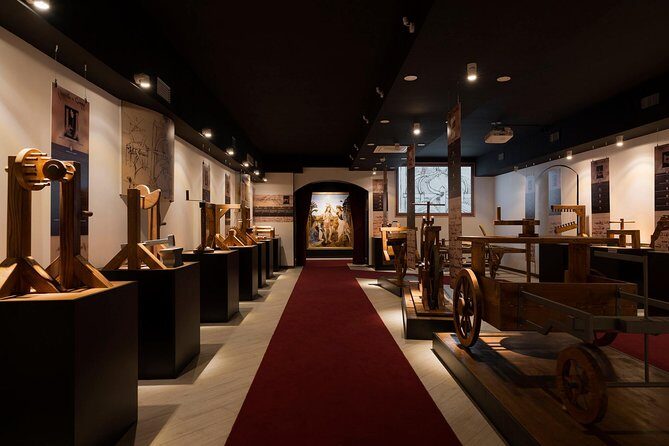
- Guaranteed entry during opening hours means less waiting anxiety near St. Peter’s
- Five-room layout covers flying, war machines, optics, everyday inventions, and art
- Audio guide included (English among many other languages) helps you pace the visit
- Hands-on mechanics make it good for families and for anyone who likes tinkering
- Reproductions everywhere shifts it more toward ideas than rare originals
- Small space can feel cramped at busy moments, so plan for close quarters
What This Leonardo da Vinci Experience Ticket Really Guarantees

This admission is built for people who want Leonardo da Vinci content without the long “where do I line up?” dance. You show up with your voucher, and you’re guaranteed entry to the Leonardo da Vinci Experience exhibition. The key benefit is flexibility: your visit can happen at any time within the museum’s opening window, so you can slot it around St. Peter’s Basilica, the Vatican Museums, lunch, or even a last-minute change of plan.
You’re also getting a format that’s low pressure. There’s no requirement to stick with a group. Instead, you explore at your own pace while using the audio guide. That matters because Leonardo’s inventions can be either fascinating or overwhelming, depending on how fast you like to absorb details. Here, you can slow down for the weird-but-cool mechanical concepts, or skim and move on.
One more practical note: the museum focuses on Leonardo’s ideas through displays and models. Several items are reproductions, and some exhibits may include clarifications about whether certain models were actually built or used in Leonardo’s lifetime. So if you’re hunting for museum-grade authenticity and originals, you may feel a bit underwhelmed.
You can also read our reviews of more museum experiences in Rome



Getting There Near St. Peter’s Basilica (Via della Conciliazione, 19)
The ticket redemption point is on Via della Conciliazione 19, 00193 Roma, right by St. Peter’s Basilica. That location is a big part of the value. You’re not traveling across town for this stop; you’re staying in the Vatican orbit, which is where most people already spend time.
It’s also described as near public transportation, which helps because traffic and walking in this area can be a bit of a choose-your-own-adventure. I like this for days when your feet are already tired. You can do a focused museum visit without adding a major commute.
Plan for an indoor visit, though. This exhibition is in a compact space. On busier days, crowds can make it feel tighter, especially around hands-on areas. If you’re sensitive to enclosed spaces or prefer breathing room, you’ll want to time it with care.
Room-by-Room: Flying Machines, War Machines, Optics, and More
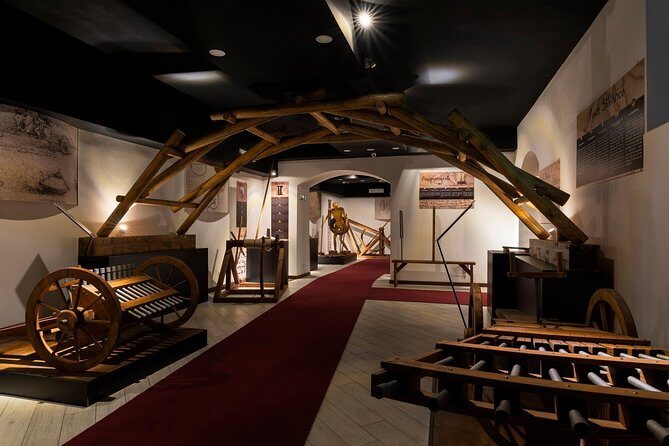
The exhibition is arranged across five rooms, and the flow is logical: it starts with imagination (flying), shifts to conflict (war machines), then moves into thinking tools (optics and perspective), everyday physics (principles), and finally Leonardo’s artwork.
Here’s what you’ll see as you move through.
Room I: Flying Machines and the Last Supper
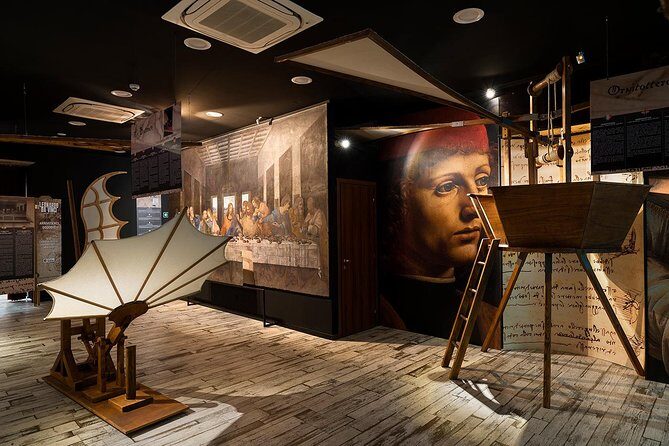
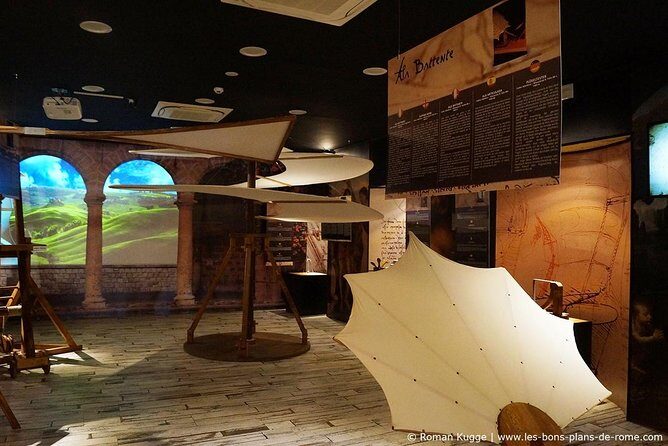
Room I is where the wow-factor tends to hit first. You get Leonardo’s flying-machine ideas, including a prototype of a hang glider. There’s also a life-size reproduction of Leonardo’s Last Supper.
This room is a good warm-up even if you’re not a mechanical-geek. You can take the flying concepts visually, then use the audio guide to translate the logic behind them: how Leonardo was thinking about motion, control, and practical constraints. If you like art, the Last Supper stop gives you a change of pace and reminds you he wasn’t only designing machines.
Room II: War Machines and Multi-Barrel Engineering
Room II turns more technical and more intense. Expect drawings and models related to artillery and war machines, including a multi-directional gun machine with twelve barrels and a catapult.
If you come in curious but not expert, this is where the audio guide becomes important. Otherwise, it can turn into a collection of interesting shapes. With the guide, you get the context for why these designs matter as examples of Leonardo’s engineering thinking, even when they weren’t “ready for real-world use” in the way modern weapons are.
A practical tip: slow down here if you want to understand the layout of the mechanisms. Moving too quickly can make the inventions feel repetitive instead of clearly different.




Room III: Music, Optics, and the Room of Mirrors
Room III is one of the most distinctive sections because it connects Leonardo’s curiosity to perception—how we see and how we experience sound. You’ll find devices related to music and optics, such as a projector and a perspectograph, plus the Room of Mirrors.
This is the part that often feels most modern. You’re not just staring at a machine—you’re experiencing the idea of how light behaves and how perspective can be engineered. If you enjoy art history, this room also helps explain why Leonardo was obsessed with observation and accuracy.
Room IV: Everyday Inventions That Came From Principles
Room IV shifts from dramatic machines to everyday concepts. You’ll see inventions and principles that show up in later technology: think a bicycle concept, springs, and a life preserver.
This is a favorite for many visitors because it bridges the gap between “Renaissance genius” and “why I care today.” The audio guide can help you connect Leonardo’s underlying physics to objects you already know—so the room feels relevant, not just historical.
It’s also a good place to pause and reset if the earlier rooms felt too technical or too heavy.
Room V: Paintings and Leonardo Through Art Reproductions
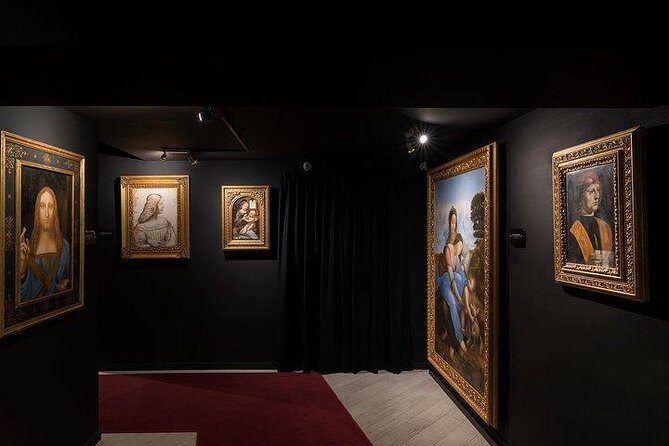
Room V is the final art-focused stop. It contains 20 works of art, including reproductions of some of Leonardo’s best-known paintings.
This room is where you decide what kind of Leonardo visitor you are. If you want machines first and art second, you might move through faster. If you want art to ground the experience, take your time and let the audio guide walk you through what you’re seeing and why each piece matters.
Audio Guide and Hands-On Exhibits: How You’ll Learn
The admission includes an audio guide in English and multiple other languages (Italian, French, Spanish, German, Russian, Chinese, and Portuguese). Even if you pick English, it helps to know you can switch languages if needed.
The museum also uses interactive elements. Some are touch-and-listen style, and some involve hands-on interaction where you can try things directly. That’s a major reason families like this stop: kids can do more than just look.
But here’s the honest balance: not every audio experience is equally smooth. Sound quality can vary by exhibit, and in some areas the information display may feel more basic than you’d expect for the ticket price. If you’re the type who wants lots of video-style explanation, you might find yourself doing more reading/listening than watching.
Still, the self-guided approach works. You can scan quickly when you’re tired, then slow down when something truly clicks. That’s the advantage of this kind of museum: it’s built for pacing rather than marching.
Also note: some interactive stations may attract more attention and create small bottlenecks. If you want a calmer visit, aim for off-peak time slots rather than the middle of the day.
How Long It Takes, and When to Pair It With the Vatican
You should plan for about 1 to 2 hours. In practice, the experience often fits shorter than that if you’re moving quickly, and longer if you stop for the interactive sections and listen carefully to the audio guide.
I like using it as a “breather museum” between heavier landmarks. After St. Peter’s Basilica, your brain may be full of marble and scale. Leonardo da Vinci Experience is smaller, more focused, and usually feels easier to manage when you’re already walking all day.
It also pairs well with Vatican Museums for a simple reason: both experiences reward curiosity. The Vatican side can be overwhelming; Leonardo gives you a different kind of thinking—how inventions grew from observation and experimentation.
One good strategy:
- Do St. Peter’s first, then schedule Leonardo later.
- Or do Leonardo earlier and let it set your mindset before you see larger art in the Vatican.
Either way, you’re close by. That proximity is part of the value.
Price and Value: Is $19.22 a Smart Use of Your Time?
At about $19.22 per person, the ticket sits in the “worth it if it matches your interests” category. Here’s how I judge the value:
It’s good value if you want ideas you can explore
The museum leans into understanding Leonardo’s thinking through inventions, models, and devices. The included audio guide makes that easier. If you’re the type who likes science and design themes, you’ll likely feel satisfied without needing a long museum day.
It can feel pricey if you want original artworks
Since the painting side includes reproductions and the overall exhibition is described as relatively small, you may want to ask yourself what you’re paying for: access and experience, not rare artifacts. If your baseline expectation is major museum collections, you could end up thinking, “This is fine, but I could spend less elsewhere.”
It’s also a budget win for families and mixed ages
The hands-on aspects and short time commitment make it a practical stop when you want something educational but not exhausting. If your group includes teens who don’t want another hour of reading, interactive rooms help.
Balancing it all: this ticket is best as a well-timed supplement to your Vatican day, not as the main event you center your whole trip around.
Who Should Book This Leonardo da Vinci Admission (and Who Might Skip)
This is a strong pick for:
- People who like invention-focused museums with interactive elements
- Families looking for a short, educational stop that doesn’t require patience for hours
- Visitors who want an easy match to St. Peter’s Basilica and the Vatican area
- Anyone who enjoys audio-guided self-paced exploring
You might consider skipping if:
- You’re only interested in originals and museum-grade authenticity
- You need lots of space to move around comfortably
- You expect big theater-style video storytelling rather than audio and models
- You’re easily put off by cramped indoor layouts
It also helps to calibrate your expectations. The experience is educational, but it’s not trying to be the Vatican in miniature. It’s more like a concentrated “Leonardo ideas workshop,” packaged in five rooms.
My Booking Advice: Should You Go?
If your plan already includes St. Peter’s Basilica (and maybe the Vatican Museums), I think this is an easy yes. The biggest reasons are practical: guaranteed entry, self-guided flexibility, and a layout that fits into a busy Rome day without stealing half your holiday.
Book it if Leonardo da Vinci’s inventions, optics, and clever engineering ideas appeal to you, even if you’re not an expert. The audio guide gives enough structure to make the machines make sense, and the interactive parts keep the experience moving.
Skip it if you’re traveling with very specific expectations—like wanting authentic paintings or a massive museum setting. In that case, it may feel small, and the reproductions can reduce the wow factor.
FAQ
FAQ
Where do I redeem my ticket for the Leonardo da Vinci Experience Museum admission?
You redeem at Via della Conciliazione, 19, 00193 Roma RM, Italy.
How long does the Leonardo da Vinci Experience visit take?
It’s listed as about 1 to 2 hours.
Is this admission self-guided, or do I get a tour guide?
It’s self-guided. A tour guide is not included.
What’s included with the admission price?
Entrance to the Leonardo da Vinci Experience Museum is included, along with an English audio guide (and the audio guide is available in multiple languages).
What languages are available for the audio guide?
The audio guide languages listed are English, Italian, French, Spanish, German, Russian, Chinese, and Portuguese.
What time can I visit?
You can visit at any time during the museum’s opening hours (open daily during the listed dates).
Where is the museum located relative to St. Peter’s Basilica?
It’s near St. Peter’s Basilica, in the Vatican area, with the ticket redemption point at Via della Conciliazione 19.
Can I get a full refund if I cancel?
Yes. Free cancellation is available up to 24 hours in advance of the experience start time for a full refund. If you cancel less than 24 hours before, the amount paid is not refunded.
If you want, tell me your dates and whether you’re doing the Vatican Museums too, and I’ll suggest a smart way to fit Leonardo into your day.