REVIEW · MOTORBIKE & SCOOTER RENTALS
Guided Vespa Tour of Rome – Ride a Vespa with a Local Guide
Book on Viator →Operated by Rome by Vespa · Bookable on Viator
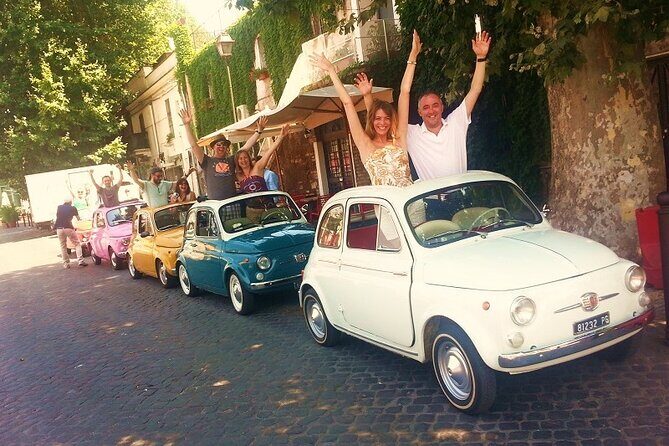
Rome on two wheels is magic. A guided Vespa tour turns Rome into a moving viewpoint, with Francesco, an officially licensed guide, telling the story as you zip between landmarks in a small pack. I especially like the way you get a relaxed rhythm—enough time to look, take photos, and hear the details without feeling herded.
I love the built-in flexibility too: you can choose the self-drive Vespa if you’re ready, or ride with a driver if you want the thrill with less pressure. The main drawback is simple—self-driving isn’t for beginners. You need prior 125cc/motorcycle experience, you’ll be in busy city traffic, and there’s a refundable 500€ deposit per Vespa on the day.
In This Review
- Key highlights worth your attention
- Why a guided Vespa tour works so well in Rome
- Meeting point, helmets, and what you’re signing up for
- The price question: what you’re really paying for
- Colosseum first: the story and the photo moment
- Rione Monti: helmets on, then Rome’s real streets
- Trevi Fountain: the coin tradition and the big scale
- Spanish Steps, Vittoriano views, and that palace stop
- Piazza Navona: Bernini’s Four Rivers in the middle of it all
- Castel Sant’Angelo: from Hadrian’s tomb to papal power
- Gianicolo viewpoint and the cannon shot tradition
- Fontanone (Fontana dell’Acqua Paola) and a Vespa photo moment
- Trastevere back streets: the ride that feels like a movie scene
- What I’d watch out for (so your day stays fun)
- Who this tour is best for
- Should you book the Guided Vespa Tour of Rome?
- FAQ
- How long is the Guided Vespa Tour of Rome?
- What does the tour cost?
- Is the tour in English?
- Can I drive the Vespa myself?
- Can I ride without driving?
- Are helmets included?
- Is there a deposit?
- Do I need an International Driving Permit (IDP)?
- Are entrance tickets included for the landmarks?
- Where does the tour meet and end?
Key highlights worth your attention

- A licensed local guide (Francesco) sharing on-the-road stories and context at each stop
- 125cc Vespa comfort check: a test drive before you join traffic (for self-drive)
- Small-group feel with a max of 15 people, so it stays personal
- Short, efficient photo stops close to the sights—less walking, more seeing
- Janiculum cannon shot chance on the 12:00 morning slot (when available)
- Two ways to ride: self-drive or ride behind a guide/driver
Why a guided Vespa tour works so well in Rome
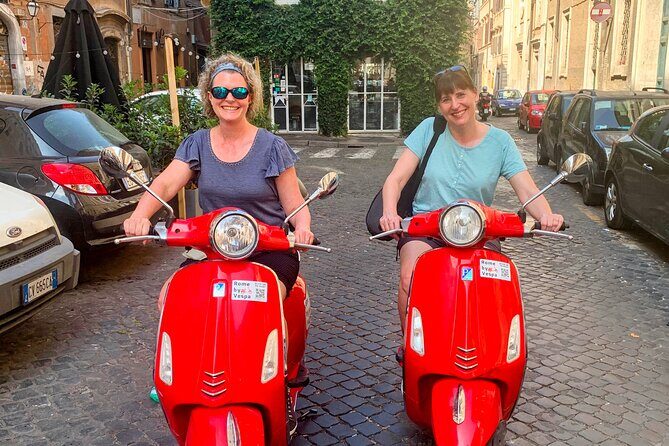
Rome is huge, and classic sightseeing often turns into long walks plus crowded buses plus waiting around. This format cuts through that. In about 2.5 hours, you cover a lot of ground—from the Colosseum area to places like Trevi Fountain, Spanish Steps, Piazza Navona, and the Janiculum viewpoint—while you’re still moving.
The best part is how the guide times the stops. You get short moments at each landmark to look up close and hear the point of it, not just a photo-op. And because you’re on a Vespa, you’re not stuck at the edge of town watching the city go by.
You can also read our reviews of more guided tours in Rome



Meeting point, helmets, and what you’re signing up for
You’ll meet at Via della Madonna dei Monti, 57, 00184 Roma and the tour ends back there. You’re near public transportation, and you’ll get a mobile ticket, so you’re not hunting for a paper voucher in the street.
Safety is treated like a real part of the experience. Helmets are provided, and there’s basic insurance for drivers and passengers. For self-drive, there’s also a pre-ride briefing on the route and safety protocols, plus a comfort check/test ride before you join the traffic flow.
Then comes the detail that matters: a 500€ refundable deposit per Vespa is required the day of the tour. It’s meant to cover potential damage, and it’s fully refundable when the Vespa is returned in proper condition. If you’re traveling with a tight plan for payments, this is the one thing to prepare for early.
The price question: what you’re really paying for
At $120.68 per person, this isn’t a budget “get on a bus” kind of tour. You are paying for several things at once: a licensed guide, the Vespa itself (125cc) for the full ride time, helmets and basic insurance, plus a setup that keeps walking short and movement fast.
Here’s the value math that makes sense for a lot of visitors:
- If you hate spending half a day stuck in transit and lines, the time savings can be huge.
- If you want context at the big sights, you’re paying for the guide’s explanations and pacing.
- If you can self-drive, you get a hands-on way to move through areas that buses can’t easily reproduce.
If you want a slow, in-depth tour of monuments, this isn’t that. The stops are short. Think “best-of Rome ride with stories,” not “every room and every artifact.”
Colosseum first: the story and the photo moment
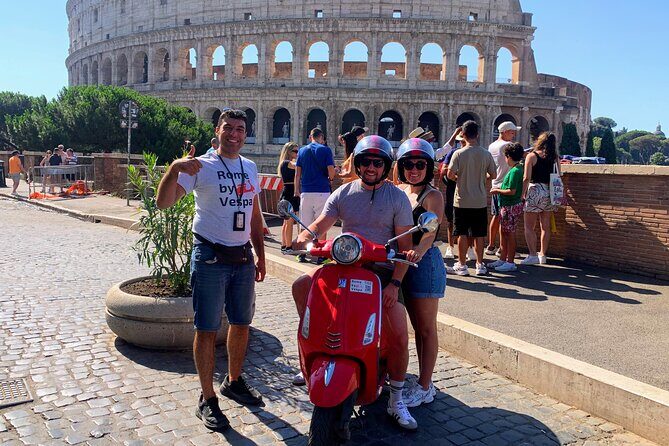
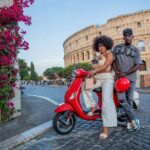
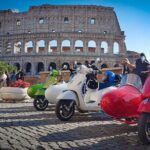
The tour typically starts with the Colosseum. Francesco will help with a quick photo and explain what you’re seeing—so you’re not just staring at stone. The stop is about 10 minutes, and an admission ticket is not included for this stop.
That short stop is a feature, not a bug. It’s enough time to connect the site to its role in Roman public life and understand why people still treat the Colosseum like a bucket-list must. If you want to enter the monument, you’ll need to plan that separately with your own tickets later.
Rione Monti: helmets on, then Rome’s real streets
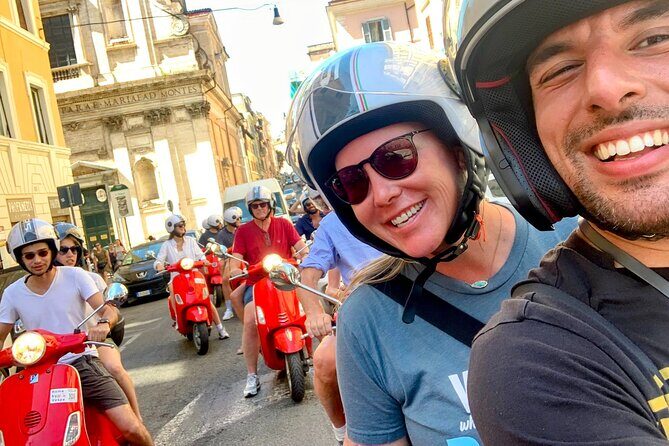
After the first stop, you move into Rione Monti, and this is where the tour turns from landmark viewing into “how Rome actually feels.” At the meeting area, Francesco greets you, hands over helmets, and the Vespa is ready.
If you chose self-drive, the guide makes sure you’re comfortable with the scooter first—so you don’t just get thrown into the traffic mix. Then you’re off, following the route while he guides you to areas you might not find on your own.
This is also the point where I’d tell you to set expectations. You’re riding through cobblestones and tight streets. The fun is the movement and the access. The tradeoff is you’re not looking at every street-level detail for long; you’re riding past quickly, listening, then stopping briefly.
You can also read our reviews of more tours and experiences in Rome

Trevi Fountain: the coin tradition and the big scale
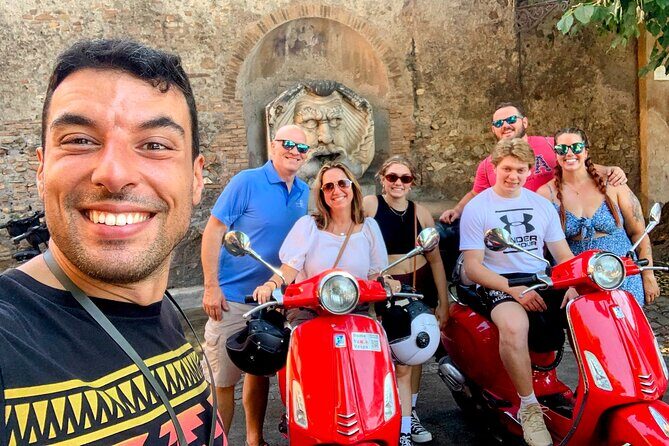
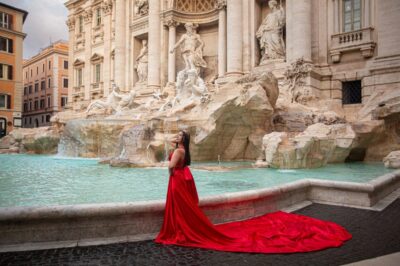
Next up is Trevi Fountain, again with a short 10-minute window. Francesco talks you through what you’re seeing, including the legend behind the coin toss: tossing a coin over your shoulder is said to bring good luck and help ensure you’ll return to Rome one day.
Even if you’ve seen Trevi Fountain in photos, being there while you’re approaching on a Vespa changes the feel. The scale hits you faster, and you’re closer to the details because you’re not just viewing from a far-off corner.
Important practical note: this stop is marked as ticket-free, so you’re not juggling entry logistics here. You’re there to understand the symbol and enjoy the moment.
Spanish Steps, Vittoriano views, and that palace stop
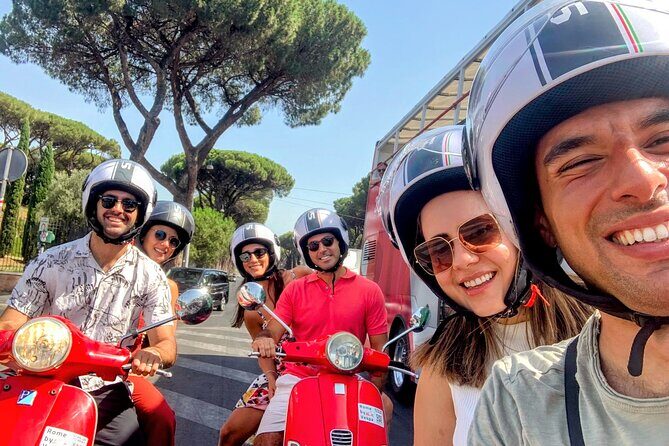
As the ride continues through the city center, you’ll reach the Spanish Steps. The stop is about 10 minutes, and it’s free. From the top, you get a perspective shift over Rome—less “single monument” and more “city overview,” with streets, older buildings, and landmark shapes all layered together.
On the way, you’ll also learn about a palace connected to people like popes, kings, and presidents—this is one of those moments where the guide adds meaning to the architecture. You’ll also get a look at the square associated with Vittorio Emanuele II and the Vittoriano. It’s one of the big national-symbol landmarks you’d miss if you only followed a classic walking route.
These are quick stops, so if you like to read signs and take your time, you may want to circle back later. But as a first pass through central Rome, the variety here is excellent.
Piazza Navona: Bernini’s Four Rivers in the middle of it all
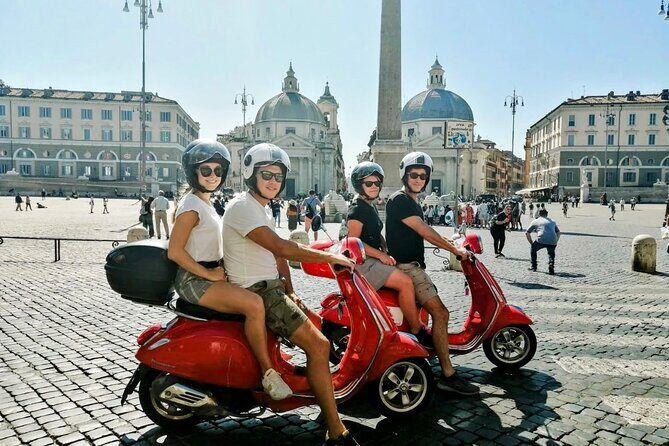
At Piazza Navona, you get one of the most famous squares in the city—built on the site of an ancient Roman stadium. The stop lasts about 15 minutes, with no admission ticket needed.
The focal point is the Fountain of the Four Rivers, designed by Gian Lorenzo Bernini. Francesco points out the four river figures: the Nile, Danube, Ganges, and Rio de la Plata. You can actually see what the symbolism is trying to do when someone explains it in plain language—each figure isn’t just art, it’s part of a message.
This stop is also ideal for photos because the square is open and you can frame the fountain without fighting for position for too long. You’re still on a schedule, but the viewing angle is the kind you want.
Castel Sant’Angelo: from Hadrian’s tomb to papal power
Next comes Castel Sant’Angelo. You’re there for about 10 minutes, and an admission ticket is not included. The guide will connect the site’s timeline: it began as the tomb of Emperor Hadrian in 135 AD, later became a military fortress, and was used as a papal residence and prison before becoming a museum.
This is the kind of stop where the quick explanation makes a difference. Without context, Castel Sant’Angelo can feel like just another big structure. With it, you see why people kept returning to this location—politically and strategically—over and over.
If you want to go inside, you’ll need separate planning. But even as an external viewpoint, this is a strong stop on a ride like this.
Gianicolo viewpoint and the cannon shot tradition
Then the tour climbs to Terrazza del Gianicolo, with a 15-minute stop and no admission ticket needed. This is one of the most rewarding moments of the whole ride because you finally get space to breathe.
The special detail here is the cannon shot tradition. If you book the morning tour at 12:00, Francesco may take you to witness the daily cannon shot on top of the hill. It dates back to the 19th century, originally used to synchronize the city’s clocks.
After you hear the boom, you’re not just watching a performance—you’re watching Rome appear in one wide view. You can see major monuments from the Colosseum to Pantheon to St. Peter’s Basilica, depending on visibility.
Even if you don’t catch the cannon shot, the Janiculum viewpoint still does the job: it turns the tour from “stops” into a sense of place.
Fontanone (Fontana dell’Acqua Paola) and a Vespa photo moment
Nearby you’ll visit the Fontanone, also tied to the Fontana dell’Acqua Paola. It’s described as a panoramic highlight at the top of Janiculum, with wide views that can include the winding Tiber River, the dome of the Pantheon, and the Vittoriano in the distance.
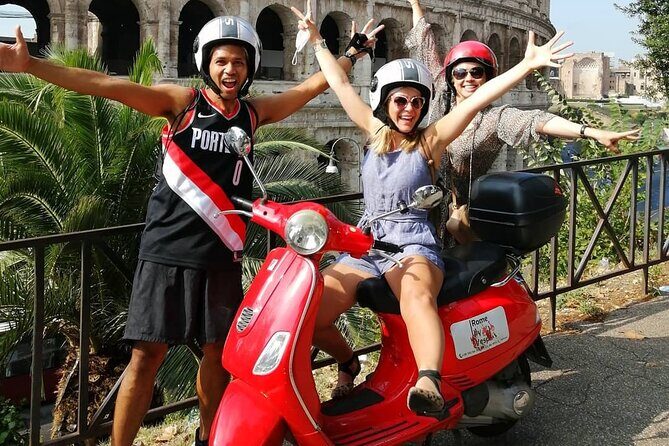
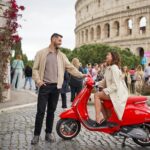
Francesco parks the Vespa, and you get a few minutes to soak in the view. Then he offers to take a picture with your red Vespa in front of the fountain backdrop. It’s a small detail, but it’s the kind of souvenir that feels like it belongs to your day, not a generic tourist photo.
Again: this is short-time viewing. If you want lingering golden-hour time, plan a separate revisit. For a 2.5-hour tour, it’s a smart hit.
Trastevere back streets: the ride that feels like a movie scene
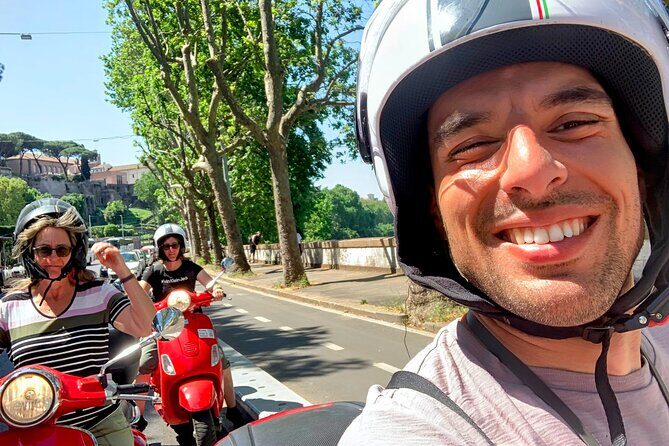
Finally you end in Trastevere, riding through winding streets on cobblestones. The vibe here is different from the monumental stops. You’re moving through a more residential-feeling neighborhood where the pastel facades and flower-filled corners give you that “Rome after the crowds” feeling.
The ride is still guided, but the pacing gives you moments to notice details—street life happening around you, small bursts of color, and the daily rhythm of locals going about their day.
Trastevere is also a great ending because it’s less about checklists and more about atmosphere. When the tour wraps, you’ve seen both Rome’s famous faces and the street textures that make the city feel livable.
What I’d watch out for (so your day stays fun)
This is where you protect your trip.
First: self-drive is not a casual option. The tour explicitly requires prior experience riding a 125cc scooter or motorcycle, plus comfort riding in busy city traffic. It’s also not designed as a riding lesson. If you’re even slightly unsure, choose the option where you ride with a driver and let someone else do the stress work.
Second: you won’t get long visits inside major sites. Colosseum and Castel Sant’Angelo are quick and don’t include admission tickets here. You’ll get stories and context, but not time to roam.
Third: Rome traffic and narrow streets are part of the experience. Even when everything is well-managed, you should expect noise, tight turns, and that constant “heads-up” feeling that comes with riding through central Rome.
Who this tour is best for
This tour makes the most sense if you:
- Want an efficient introduction to central Rome in a short time
- Like being active and seeing the city from street level
- Are comfortable with the idea of short stops and photo windows
- Have at least some motor-scooter experience if you plan to self-drive
It’s also a great choice if you don’t want to spend your whole trip just walking between big attractions. The Vespa format does the heavy lifting.
If you hate traffic, want a slow pace, or are looking for a museum-centered plan, you’ll probably prefer a traditional walking tour with longer timed entry slots.
Should you book the Guided Vespa Tour of Rome?
If you’re the type of traveler who wants the fun version of orientation—fast, guided, and full of iconic stops—book it. Francesco’s role as a licensed guide and the small-group size are the backbone here. You’ll get stories that make the monuments make sense and a ride that lets you experience Rome in motion.
But if you’re a first-time scooter rider, don’t gamble with self-drive. The rules are clear, the traffic is real, and the tour isn’t a lesson. Your best move is choosing the driver option so you can enjoy the route without worrying about balance, speed control, or navigating tight streets.
One last practical note: the tour uses a mobile ticket and offers free cancellation up to 24 hours in advance. That gives you a little cushion if your Rome schedule shifts.
FAQ
How long is the Guided Vespa Tour of Rome?
It’s listed as about 2 hours 30 minutes (around 2.5 hours).
What does the tour cost?
The price is $120.68 per person.
Is the tour in English?
Yes. It’s offered in English.
Can I drive the Vespa myself?
Yes, there is a self-drive option. You must meet the driving requirements listed for safety and group comfort.
Can I ride without driving?
Yes. There’s an option to ride with a driver.
Are helmets included?
Yes. Helmets and basic insurance are included for all drivers, and passengers if any.
Is there a deposit?
Yes. A refundable 500€ deposit per Vespa is required on the day of the tour to cover potential damage.
Do I need an International Driving Permit (IDP)?
For non-EU licenses, a valid IDP is required by Italian law. For U.S. citizens, an IDP issued by AAA is legally required for self-drive.
Are entrance tickets included for the landmarks?
Not always. The Colosseum stop and Castel Sant’Angelo stop are marked as admission not included. Other listed stops are marked as ticket free.
Where does the tour meet and end?
It starts at Via della Madonna dei Monti, 57, 00184 Roma RM, Italy, and it ends back at the meeting point.