REVIEW · AUDIO TOURS
Castel Sant’Angelo E-Ticket & Multilingual Audio Guide
Book on Viator →Operated by Clio Muse Tours · Bookable on Viator
Phone in hand, Rome moves.
This offline audio tour turns Castel Sant’Angelo into a self-paced story—emperors, popes, and even the darker corners of the Roman Inquisition. I like that you get a downloadable guide with an interactive map (so you’re not stuck guessing in stone corridors). I also like the convenience of the electronic entry ticket on your phone. One drawback to know up front: since it’s fully self-guided (no live guide), the audio directions can feel imperfect if visitor flow changes during renovations or if you hit a confusing junction.
The visit runs about 1 hour 30 minutes, and it’s offered in English. You’ll want to arrive about 30 minutes early for security, bring earphones, and make sure your phone is charged. Also, the site has no Wi‑Fi/4G, so you really do need to download everything on Wi‑Fi before you go.
In This Review
- Key highlights worth your attention
- What you’re buying: e-ticket plus an audio walk, not a bus tour
- Before you arrive: download on Wi‑Fi and get the audio ready
- Entering Castel Sant’Angelo: riverbank drama and the Executions Court
- Hadrian’s mausoleum route: the ramp and the urns room
- Paolina Hall: Pope Paul III, frescoes, and a room made to impress
- The terrace and the Tosca effect: Rome’s skyline moment
- Navigation reality check: when audio directions get tricky
- Time planning: 1 hour 30 minutes, but build in breathing room
- Price and value: when $34.94 feels fair
- Who should book this audio tour (and who should skip it)
- Should you book this Castel Sant’Angelo e-ticket and audio guide?
- FAQ
- What’s included in the Castel Sant’Angelo E-Ticket & Multilingual Audio Guide?
- How long is the self-guided audio tour?
- Is there a live guide or meeting point?
- Do I need internet at the castle?
- Do I need headphones?
- Which languages are available?
- What phone types work with the audio tour?
- How much storage do I need on my phone?
- When should I arrive for security?
- Is my Viator Voucher the entry ticket?
- Can I get a refund or change my booking?
Key highlights worth your attention

- Offline audio and map so you avoid roaming charges and can keep moving inside
- Executions Court stories tied to infamous figures like Giordano Bruno
- Hadrian’s Mausoleum route featuring the cylindrical tomb and a 2nd-century brick ramp
- Paolina Hall frescoes linked to Pope Paul III and the Catholic court era
- Sant’Angelo terrace views with a vivid cultural nod to Tosca
- A practical tech checklist: download in advance, use the right phone, and expect stairs/slopes
What you’re buying: e-ticket plus an audio walk, not a bus tour

This experience is really two things bundled together: an adult entry ticket for Castel Sant’Angelo and a self-guided audio tour on your smartphone. There’s no live guide, no meeting point, and no one herding you through rooms. That changes the whole feel of the visit: you control pacing, but you also own the navigation.
The price—$34.94 per person—matters most if you’re the type who hates lines, hates waiting, or wants context without committing to a timed group tour. If you’re comfortable exploring on your own and you like learning while you walk, this can be good value. If you want a guide to correct your route on the spot, you may feel let down.
You can also read our reviews of more tours and experiences in Rome



Before you arrive: download on Wi‑Fi and get the audio ready
This is a place where a small tech mistake can ruin the fun. The audio content is offline, but you must download the ticket and audio tour before you visit because there’s no Wi‑Fi/4G on-site. Bring earphones. Make sure your phone has enough storage—expect about 100–150 MB.
Compatibility matters too:
- Android: version 5.0+
- iOS: newer than models listed as not supported (iPhone 5/5C, older iPod Touch, older iPads, and iPad Mini 1 aren’t supported)
- Windows phones aren’t compatible
Then there’s the ticket reality check. A Viator Voucher is not the entry ticket. Your phone ticket is accepted in digital or printed form, but you also need to go through security, so plan buffer time. Some people run into trouble at the start if the email instructions are hard to find—so I’d read the instructions carefully the day before.
Finally: keep luggage practical. Large backpacks and bulky bags aren’t allowed.
Entering Castel Sant’Angelo: riverbank drama and the Executions Court
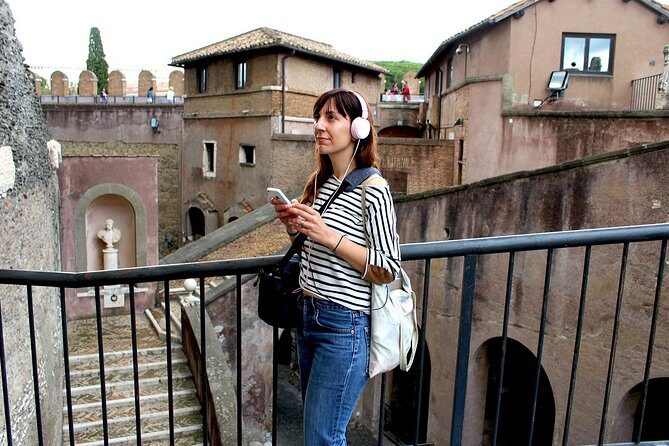
Your tour begins at the main entrance by the Tiber River, then moves into the castle’s open spaces. The first big stop is the Executions Court, where the audio focuses on the brutal days of the Roman Inquisition. One name that comes through strongly is Giordano Bruno—famous, controversial, and unforgettable for anyone who likes real stakes behind the stones.
What I like about starting here is that it gives you an emotional “key” for the place. Castel Sant’Angelo isn’t just pretty walls and views. It was a power machine, and this courtyard makes that clear fast. If you’re the type who rushes, slow down here. The space feels like it’s holding its breath, and the stories land better when you actually stand in the right kind of quiet.
A small consideration: since it’s self-guided, you’re matching your position to what the audio expects. If you don’t hear the next chapter at the right moment, don’t panic. Take a few minutes, glance for visual cues, and keep walking toward the open areas described by the narration.
Hadrian’s mausoleum route: the ramp and the urns room

Next comes the history shift—from punishment to empire. You’ll hear about Castel Sant’Angelo’s early role as a Mausoleum for Roman emperors, with the centerpiece being Hadrian’s cylindrical tomb.
The audio highlights the original 2nd-century brick-walled ramp, which is one of those details that makes the visit feel physically older than the photos. When you climb it, you’re moving through a structure built to last—so even if you’re not a “history person,” it’s a tactile moment.
Then you reach the Room of the Cinerary Urns, where the tour talks about the imperial family urns. This is where I like the audio approach: it turns a room you might otherwise skim into something you can follow. You get a sense of what these chambers meant, not just what they look like.
One practical note: some visitors find that the audio chapter order and the numbering on exhibit signs don’t always line up perfectly. That doesn’t mean the information is wrong—it means you should rely on the bigger landmarks (like the urn-room focus and the ramp) rather than obsessing over matching numbers.
Paolina Hall: Pope Paul III, frescoes, and a room made to impress

After the imperial mausoleum section, the tour takes you into the papal world. The featured stop is Paolina Hall (Sala Paolina), with intricate frescoes and a strong emphasis on the luxury of the space.
This is tied to Pope Paul III, and the audio frames it as a room designed to signal wealth and power. You’re not just looking at decoration—you’re learning why it was placed there and what it was meant to communicate. The narration also points you toward the work of Perino Del Vaga, whose decorative complex you can see wrapping the room in visual storytelling.
If you’re tired from the walking (and at Castel Sant’Angelo, you will walk), Paolina Hall offers a kind of visual landing pad. You can stand, listen, and let your eyes do the work without feeling like you need to sprint to the next thing.
You can also read our reviews of more guided tours in Rome






The terrace and the Tosca effect: Rome’s skyline moment

The final highlight is the Sant’Angelo terrace. This is the part that many people talk about because it’s basically a reward: wide views over the Tiber and Rome’s rooftops.
The audio also makes a cultural connection to Tosca, the famous opera ending where Floria Tosca throws herself from the castle. Whether you know the story or not, the point is clear: this terrace has a dramatic reputation, and the view makes that legend feel grounded.
I’d plan a little time here, not just a quick glance. Take a breath. Watch the river light shift. If you’re photographing, turn your phone camera on and off a couple times to get comfortable; the view is worth it.
Navigation reality check: when audio directions get tricky

A self-guided tour lives or dies on navigation clarity. This one tries to help with an offline map, but the experience you’ll get can vary depending on crowd flow, renovations, and how clearly each space is marked at the time you visit.
Here’s how I’d handle it smartly:
- If the audio chapter seems to be “ahead” of where you are, slow down and reread what the narration cues you toward.
- Don’t rely only on exhibit numbers if you notice mismatch. Use the physical anchor points the audio describes—courtyard, ramp area, urn-room focus, then Paolina Hall, then terrace.
- If you get truly stuck, ask staff for direction. You don’t need to force the route. The castle is the main event, and “getting it right” matters less than “staying calm and moving forward.”
Also, the pace can feel quick if you’re trying to pause, restart, or manage volume on the fly. I’d keep your hands free where possible, and try using simple pause/resume habits rather than juggling menus.
Time planning: 1 hour 30 minutes, but build in breathing room

The tour duration is listed as about 1 hour 30 minutes. That’s a solid estimate if you move at an even pace, hit major stops, and spend roughly a few minutes per highlight.
But Castel Sant’Angelo is not a flat museum. You’ll deal with steps and sloping pathways. If you’re traveling with anyone with limited mobility or if you tire quickly, go slower than the audio suggests and expect to stop for breaks. I found the idea of pacing important because stopping to rest also helps you “catch up” when the audio chapter order doesn’t match the exact feel of the route.
For food planning: there’s a café/restaurant option inside, and some visitors mention a terrace café with views. Keep in mind that food service can end around late afternoon (around 4pm is mentioned), and the menu afterward may be limited. If you want a snack, aim earlier in your visit rather than treating it like an afterthought.
Price and value: when $34.94 feels fair
At $34.94, you’re paying for the entry ticket plus the audio guide delivered digitally. Value here comes from three money-saving advantages:
- No roaming costs because the content is offline
- Convenience because you get an electronic ticket you can show on your phone
- Context because the narration gives you meaning for spaces you might otherwise just pass through
If you’re doing Castel Sant’Angelo during peak season or you hate waiting around, the e-ticket can feel especially worth it. Some people report quick entry and reduced hassle compared with buying on arrival. Still, don’t treat it like magic—security lines exist.
Compare this to other options in Rome:
- A live guide costs more, but they can instantly solve routing confusion.
- A cheaper self-guided approach (guidebooks, free apps) might work if you already know what you’re looking for.
- This option sits in the sweet spot if you want history as you go, plus offline convenience.
Where the price might feel less worth it is if the audio doesn’t launch smoothly on your device or if you’re the kind of person who needs extremely precise “go here, press play now” directions. The castle can also be under change, and that affects matching.
Who should book this audio tour (and who should skip it)
I’d recommend this for you if:
- You like learning while walking
- You prefer controlling your own pace instead of sticking to a group schedule
- You’re comfortable using your phone offline and handling basic app steps
- You want the big highlights—Inquisition courtyard, Hadrian’s tomb story, Paolina frescoes, terrace views
I’d hesitate if:
- You absolutely hate phone-based tours
- You’re visiting with strict timing and can’t risk audio setup hiccups
- You need step-by-step navigation with zero chance of confusion (self-guided always carries some risk)
- Your phone doesn’t meet the compatibility requirements
For many people, the biggest win is not just the content—it’s the ability to walk through the castle in a way that feels personal. You can linger at the terrace without feeling guilty, or pause in Paolina Hall to actually look.
Should you book this Castel Sant’Angelo e-ticket and audio guide?
Yes—if you’re game for self-guided, offline learning and you’re willing to do the small tech prep (download on Wi‑Fi, charge your phone, bring earphones). The payoff is strong: the mix of brutal courtyard storytelling, imperial architecture via Hadrian’s tomb route, papal fresco drama in Paolina Hall, and the terrace view over the Tiber.
Skip or consider a different format if you want a live guide to smooth over navigation surprises, or if you know you’ll struggle with app steps on-site. In that case, you may get more satisfaction from a guided tour where someone can correct your path in real time.
If you’re flexible, patient, and travel light enough for the site rules, this is an enjoyable way to see Castel Sant’Angelo on your schedule—while the audio keeps you oriented and informed.
FAQ
What’s included in the Castel Sant’Angelo E-Ticket & Multilingual Audio Guide?
You get an adult entry ticket for Castel Sant’Angelo plus a self-guided audio tour on your smartphone (Android & iOS). The tour includes offline content, including text, audio narration, and maps.
How long is the self-guided audio tour?
It’s listed at about 1 hour 30 minutes (approx.).
Is there a live guide or meeting point?
No. It’s self-guided, and there is no live guide provided, and no meeting point.
Do I need internet at the castle?
No. The audio and map are offline, but you must download the ticket and audio while on Wi‑Fi before your visit because there’s no Wi‑Fi/4G on-site.
Do I need headphones?
Yes. You’ll need earphones to listen to the audio tour.
Which languages are available?
The tour is offered in multiple languages, and English is specifically included.
What phone types work with the audio tour?
You need an Android (version 5.0 and later) or iOS smartphone. It is not compatible with Windows phones, and certain older iPhone/iPod/iPad models listed in the info are also not supported.
How much storage do I need on my phone?
You’ll need storage space of about 100–150 MB.
When should I arrive for security?
You should arrive about 30 minutes in advance to go through the security check-in. Late arrivals won’t be accommodated.
Is my Viator Voucher the entry ticket?
No. The Viator Voucher is not your entry ticket and is not accepted at the entrance.
Can I get a refund or change my booking?
No. The experience is non-refundable and can’t be changed for any reason.