REVIEW · ROMAN FORUM TOURS
Rome Roman Forum, Palatine Hill Tour Exclusive Full Pass
Book on Viator →Operated by Tour In Rome by Tour in the City · Bookable on Viator
Rome gets easier when you skip the lines. This exclusive full pass gives you skip-the-line access to major sites like the Roman Forum and Palatine Hill, plus Trajan’s Forum and the Colonna Traiana. What I like most is you can pair a short, live guide moment with a multilingual audio guide app (English included) so you can move at your pace instead of waiting for everyone to catch up. One catch: the experience can involve some standing around in the sun while audio and the group logistics do their thing, so you’ll want to manage heat and keep an eye on where you’re meant to go next.
Think of this as a tight Roman power loop through the heart of ancient Rome, running about 2 hours 40 minutes to 3 hours with a small group (up to 50). You’ll also get an exterior look at the Colosseum, but the Colosseum ticket is not included—so if you want to go inside, you’ll need a separate ticket.
In This Review
- Key Highlights You’ll Actually Feel
- Skip-the-Line Value for the Roman Forum and Palatine Hill
- What You’re Getting (and the One Big Omission)
- Stop 1: Trajan’s Forum and the Logic of Imperial Planning
- Colonna Traiana: “Read” the Wars in a Spiral Scroll
- Roman Forum: Where Politics, Law, and Religion Converged
- Palatine Hill: Augustus-Era Power and an Elite’s View of Rome
- Domus Tiberiana: First Imperial Residence Energy
- Arch of Constantine: A Triumphal Shortcut Between Eras
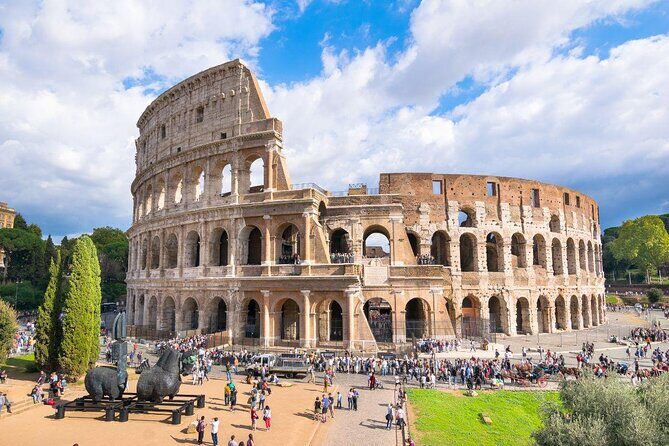
- Colosseum Exterior: Big Views Without the Ticket
- Using the Audio App Without Getting Off Track
- Timing, Heat, and Why Pace Matters Here
- What to Bring (So Security Doesn’t Slow You Down)
- Who This Tour Suits Best
- Should You Book This Exclusive Full Pass?
- FAQ
- How long is the Roman Forum, Palatine Hill tour with this full pass?
- Which sites are included with skip-the-line access?
- Is the Colosseum ticket included?
- What languages are available for the audio guide?
- Do I need a smartphone for the audio app?
- What ID do I need for entry?
- Can I cancel for a refund?
Key Highlights You’ll Actually Feel
- Real skip-the-line tickets for Trajan’s Forum, Roman Forum, and Palatine Hill, plus related included entries
- Self audio guided app with 44 points of interest, letting you slow down or speed up
- Trajan’s Forum + Colonna Traiana back-to-back, so the campaign story makes more sense
- Palatine Hill viewpoint of the empire-in-miniature, from Augustus-era power to earlier elite homes
- A Colosseum exterior pass that keeps the main focus on the Forum area without adding a second ticket hunt
Skip-the-Line Value for the Roman Forum and Palatine Hill
Let’s talk value first, because Rome ticket lines can turn a “quick stop” into a half-day project. This pass is built around cutting that pain: you get skip-the-line tickets for the Roman Forum, Palatine Hill, and key linked areas like Trajan’s Forum. For $54.81 per person, the math works best if you care about seeing multiple big sites in one stretch and you don’t want to gamble on line length.
The other value piece is how the experience is set up: you’re not locked into a long, slow chant of facts. The tour includes audio guidance through an app, with an emphasis on letting you discover details you might otherwise miss, like the layout cues and monuments that connect visually across the Forum area.
The Colosseum part is more like a bonus. The guide shows you the best-preserved outside view areas, but the Colosseum ticket isn’t included. If your main goal is interior access, plan for that separately.
You can also read our reviews of more tours and experiences in Rome.



What You’re Getting (and the One Big Omission)
Here’s what’s supported by the pass:
- Skip-the-line tickets for Trajan’s Forum, Roman Forum, and Palatine Hill
- Admission included for the main stops inside that complex area (Trajan’s Forum segments, Colonna Traiana, Roman Forum, Palatine Hill, and Domus Tiberiana)
- A multilingual audio guide in English plus several other languages (English, Spanish, Italian, Chinese, and also German/French per the included audio option)
- A self-guided tour app with unlimited access for the duration of your stay, using a smartphone
Here’s what is not included:
- Colosseum admission/tickets. The service includes an exterior tour of the Colosseum, and you’ll end near Piazza del Colosseo.
This omission matters because the Colosseum is one of the few places where “see it from outside” feels different from “walk inside.” If you’re the type who likes to stand where gladiators stood (or at least where Romans watched), you’ll want to budget time for a separate Colosseum ticket.
Stop 1: Trajan’s Forum and the Logic of Imperial Planning
Your walk starts with Trajan’s Forum, which is where you get an immediate taste of how Roman power translated into architecture. Trajan’s project wasn’t a simple upgrade. It was carved into the landscape by cutting into the Quirinale and Campidoglio slopes and connecting them with a mountain saddle.
What I like about this start is that it frames the rest of your day. You’re not just seeing random ruins. You’re seeing how the Romans staged space for politics, ceremony, and spectacle.
You’ll hear that excavation work likely began under Domitian and continued through Trajan after Domitian’s death. The forum was financed with the booty from Trajan’s Dacian campaigns, including the military events dated 101–102 and 105–106 AD, ending with the defeat and submission of the Dacians and the death of their king Decebalus. If you’ve ever wondered why certain monuments feel so aggressively “official,” it’s because they were funded by victories and designed to broadcast those victories.
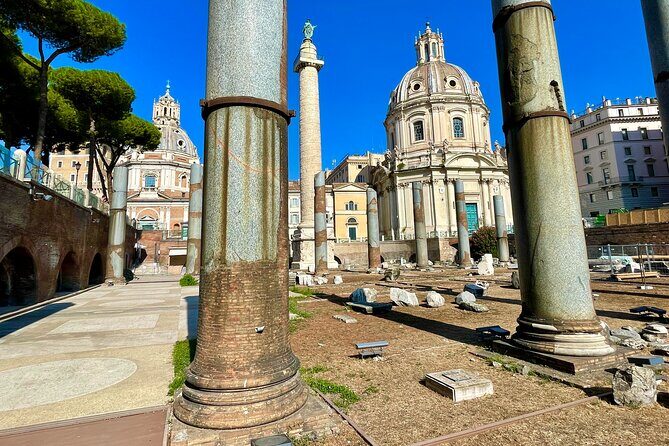
Also worth clocking: the plan is more complex than earlier forums. It features a vast square flanked by porticoes with exedras, and it’s dominated on one side by the Basilica Ulpia, with the Trajan’s Column behind it. That spatial relationship is exactly why it’s smart to visit Trajan’s Column soon after.
Colonna Traiana: “Read” the Wars in a Spiral Scroll
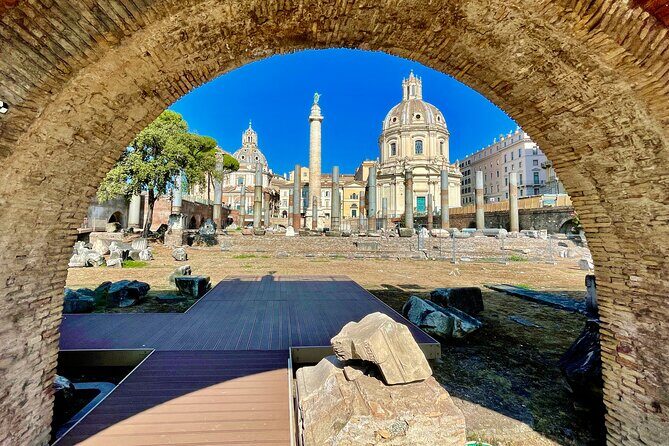
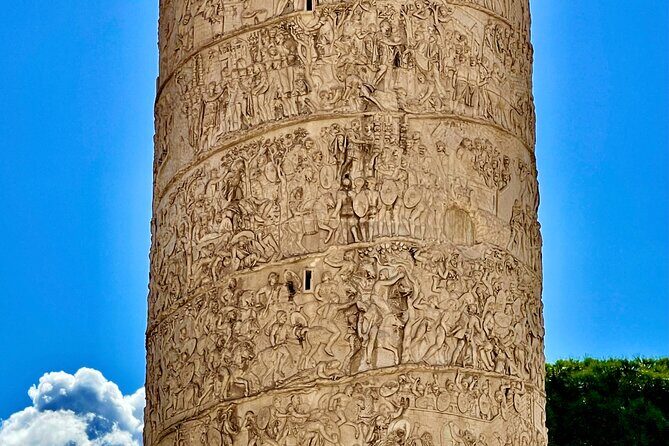
Then you shift to the Colonna Traiana, and this is where the audio guide can really pay off. Trajan’s Column doesn’t just sit there for decoration. It narrates the two Dacian campaigns through carved images, tied to Trajan’s reign (98–117 AD). The column was inaugurated in 112 AD and set in a courtyard bounded by the monumental entrance to the Forum, the Basilica Ulpia, and two libraries to the east and west.
The mechanics are fascinating:
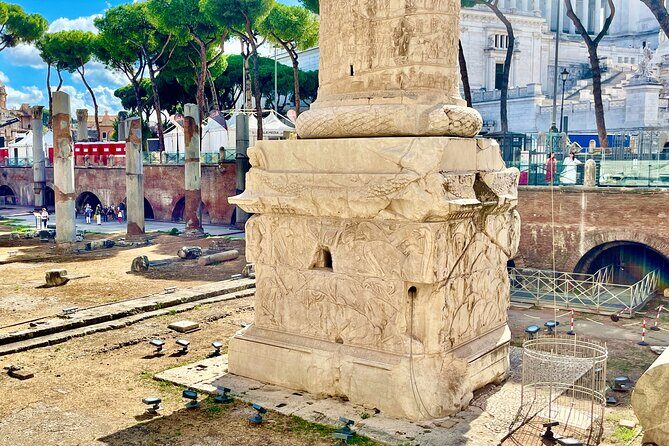
- The column rests on a base decorated with reliefs showing stacks of weapons.
- The shaft is about 30 meters high (100 Roman feet), made of 17 colossal rocks of white Carrara marble.
- Inside is a spiral staircase with 185 steps leading upward.
- The frieze winds around the shaft like a scroll, about 200 meters long in total, with thousands of figures (the scenes include around 2,500 characters).
Even if you don’t climb, you can still get the message. The point is that Rome turned history into a visible story you could walk around. With the app, you can follow the themes as you move, instead of trying to memorize everything while you’re squinting at stone.
Roman Forum: Where Politics, Law, and Religion Converged
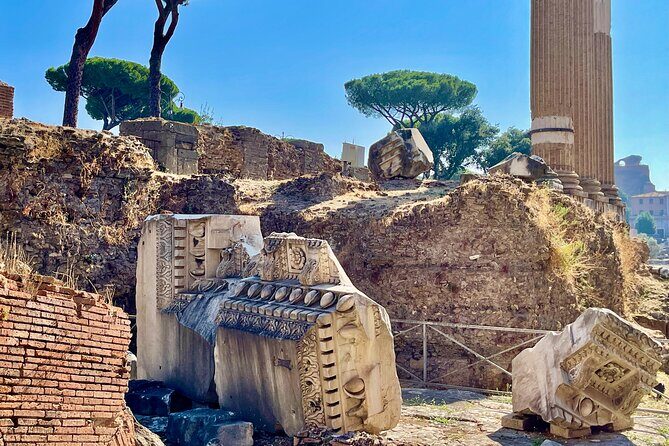
Next comes the big one: the Roman Forum. It sits in low ground between the Palatine and Capitoline hills, and it was the center for public meetings and law courts in republican times. It also hosted gladiatorial combat and had shops and open-air markets running alongside the big ceremonial spaces.
Under the empire, the forum’s role shifted. It became a center for religious and secular spectacles and ceremonies, with many of the city’s imposing temples and monuments.
This stop is where the ruins can feel like a pile unless you understand what you’re looking at. The audio guidance helps because it ties each surviving structure to the forum’s roles. Among the major sites you’ll encounter in this area are the Temple of Castor and Pollux, the Temple of the Deified Caesar, the Mamertine Prison, the Curia (senate house), the Temple of Saturn, the Temple of Vesta, and the Temple of Romulus. You’ll also see major triumphal markers like the Arch of Titus and the Arch of Septimius Severus, plus the Cloaca Maxima.
One practical thought: this is a place where you’ll do best if you pick a few anchors and linger. If you try to “speed-run everything” in 45 minutes, you’ll miss the connections. Use the app points of interest like stepping stones. Follow one theme (law and government, temples and ritual, or conquest and commemoration) and you’ll understand more than you’d expect.



Palatine Hill: Augustus-Era Power and an Elite’s View of Rome
Palatine Hill is where Rome turns from public square into private power. The hill is described as the centremost of the Seven Hills and one of the oldest parts of Rome, sometimes called the first nucleus of the Roman Empire. Today it’s largely an open-air museum, with the Palatine Museum holding finds from excavations on the hill and from other ancient sites.
What makes it special is the story of who lived here and why. Imperial palaces started on this hill with Augustus, and before imperial times it was mostly occupied by the homes of the rich. That shift tells you something: Rome didn’t only expand outward; it also consolidated status in specific spaces.
You’ll also hear the hill’s geography in a very Roman way: it originally had two summits separated by a depression. The higher part is called Palatium, while the other summit is named Germalus (or Cermalus). Using old city-planning references, the perimeter enclosed about 63 acres (25 hectares), and later catalogues list a larger scope of 131 acres (53 hectares).
If you want a “why am I here” payoff, Palatine gives it. You’re standing where emperors built statements. You’re also getting a sense of how visibility and proximity to the Forum mattered.
Domus Tiberiana: First Imperial Residence Energy
The tour also includes Domus Tiberiana, described as the first true imperial residence. The story starts in the 1st century AD, when the Julio-Claudian power structure consolidated. The private home of Tiberius Claudius Nero (father of the future emperor Nero) began transforming after the devastating fire of 64 AD into something closer to an imperial palace.
This stop matters because it shifts the perspective from “public Rome” to “private Rome.” You’ll hear that the domus was used by notable figures: Germanicus, Claudius, and Caligula. Caligula is noted as having been killed in a cryptoporticus of the domus in 41 AD.
If you’re the type who likes to understand how control worked beyond ceremonies, this is one of the more rewarding segments. It’s also a good pause in the route because you’re dealing with a different scale of imagination: fewer outdoor “walk-through monuments,” more sense of daily imperial space.
Arch of Constantine: A Triumphal Shortcut Between Eras
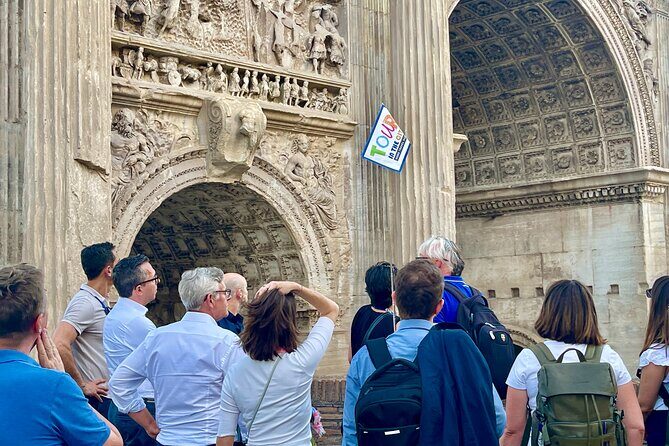
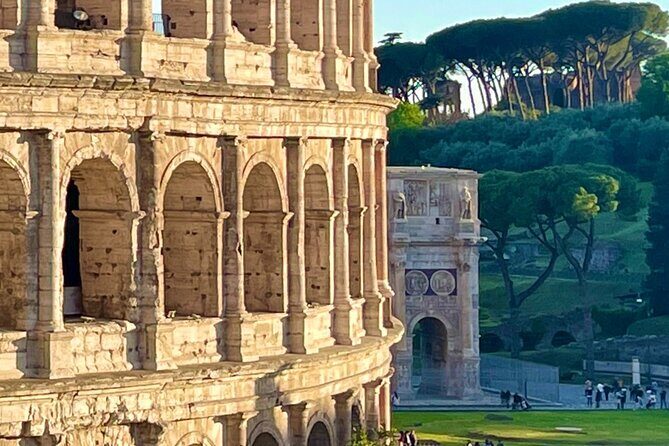
After the Forum and Palatine focus, you’ll pass by the Arch of Constantine. It’s a triumphal arch dedicated to Constantine the Great, commissioned by the Roman Senate to commemorate his victory over Maxentius at the Battle of Milvian Bridge in AD 312. It was dedicated in 315.
This arch is a big deal not just because of its dimensions, but because it sits on the Via Triumphalis, the route taken by victorious commanders entering the city in triumphal procession. The arch spans that historic path between the Colosseum and Palatine Hill.
Key details you’ll hear:
- It has three bays: one central arch and two lateral arches.
- Construction uses brick-faced concrete riveted in marble.
- Sculptural decoration includes reliefs and statues taken from earlier triumphal monuments dedicated to Trajan, Hadrian, and Marcus Aurelius.
That reuse is the human angle in all that marble. Rome wasn’t always starting from scratch. It borrowed prestige. When you look at the arch with that in mind, it stops being just a photo spot and becomes a timeline of who wanted to look powerful after the fact.
Colosseum Exterior: Big Views Without the Ticket
You’ll finish the route with an exterior look at the Colosseum area. The tour description makes clear this is outside, not Colosseum entry. Your guide will show you the best-preserved part of the exterior and tell stories about sea battles and gladiator combats and animal fights.
For context, the Colosseum was called the Flavian Amphitheatre in ancient times, and it was listed as a UNESCO World Heritage Site as part of Rome’s historical center, with other related extraterritorial zones. It was also included among the New Seven Wonders in July 2007.
If you haven’t planned your Colosseum ticket yet, treat this segment as a “preview with momentum.” You’ll get oriented to the scale and angles, and then you can decide whether you want to spend the extra time and money to go inside separately.
Using the Audio App Without Getting Off Track
This is a tour where the app is not optional in the experience’s design. You download the self audio guided tour app and use it to follow 44 points of interest. Audio languages include English and multiple others, and you can keep listening as long as the tour’s features stay available to you.
Here’s what I think is the smartest way to use it:
- Don’t try to do every audio point. Pick the ones that match what you’re seeing right then.
- When you’re unsure of your next step, pause the walk and use the app cues to get your bearings fast.
- If you start feeling like the pre-recorded guidance is hard to line up with the physical space, slow down. You’ll get more out of 2 clear points than 6 half-followed ones.
A practical note: for the self audio guided option, smartphones must be of the latest generation, with no older than 2020. If you’re using an older phone, you may have trouble downloading or running the app as intended.
Timing, Heat, and Why Pace Matters Here
You’re doing a lot of “big Rome” in under three hours. That usually means:
- Short photo stops
- Enough time to read a few key explanations
- Some waiting as a group moves through ticketed entry areas and security
One consideration that can shape your comfort is heat and sun exposure. Even with a guide talking, there can be periods where you’re standing while the group settles and the audio points line up. Bring water if it’s a warm day, and plan to wear breathable clothing and sunscreen. Rome’s ruins don’t care about your schedule, but you can at least make the schedule easier on yourself.
Also note: the tour includes screening. You’ll need to provide a valid passport or ID document that matches the name used at booking for entry to the Roman Forum and Colosseum. For your own sanity, double-check the spelling on your booking and bring the same ID you listed.
What to Bring (So Security Doesn’t Slow You Down)
Because this is a ticketed, security-screened experience, travel light. The Roman Forum has a strict list of forbidden items, including bottles and glasses containers, alcoholic beverages, aerosols, backpacks, bulky bags, and camping items. You can bring medium and small backpacks, but they’re subject to screening and must be checked with metal detectors and inspected.
If you want a smooth start, bring a small day bag you’re comfortable carrying through security. Avoid anything that might trigger a “nope” at the gate, because there’s no award for arguing your way into ancient history.
Who This Tour Suits Best
This pass is a strong match if:
- You want multiple Forum-area sites without fighting lines
- You like audio guidance and self-paced wandering once you’re oriented
- You want the story thread of Trajan’s campaigns and how that propaganda turned into monuments
- You’re comfortable moving fairly quickly across the ancient core (2h40–3h)
It may not be the best choice if you want lots of deep, slow “sit down and explain everything” time, because the structure is built for efficient site coverage and using the app.
If you’re traveling solo, the group format still works well because the audio lets you slow down where you care and move when you don’t.
Should You Book This Exclusive Full Pass?
I’d book this if your priority is efficiency and seeing the Forum complex in a single run. The skip-the-line tickets for Trajan’s Forum, Roman Forum, and Palatine Hill are the big value driver, and the audio app model is well suited to this area where visual connections matter.
I’d think twice if you’re only interested in the Colosseum interior. This tour is exterior there, and you’ll still need a separate Colosseum ticket for entry. And if you know you struggle with self-guided audio or you hate waiting in sun, you may find the experience a bit more rigid than a fully private guided tour.
FAQ
How long is the Roman Forum, Palatine Hill tour with this full pass?
It runs about 2 hours 40 minutes to 3 hours.
Which sites are included with skip-the-line access?
Skip-the-line tickets are included for Trajan’s Forum, Roman Forum, and Palatine Hill. Related entries for the tour stops are also marked as admission included.
Is the Colosseum ticket included?
No. The tour includes an exterior tour of the Colosseum, and Colosseum admission is not included.
What languages are available for the audio guide?
The audio guide app supports multiple languages including English, Spanish, Italian, and Chinese, plus other options listed as German and French.
Do I need a smartphone for the audio app?
Yes, for the self audio guided option you need a smartphone to download the app, and it must be no older than 2020.
What ID do I need for entry?
You must present a valid passport or ID document that matches the name and date of birth provided at booking. Security may prevent entry if the details don’t match.
Can I cancel for a refund?
Yes. You can cancel up to 24 hours in advance for a full refund.
If you’d like, tell me your travel month and whether you plan to add a Colosseum interior ticket, and I’ll help you stitch together a smart day plan around this pass.