REVIEW · CATACOMBS TOURS
Rome: Crypts, Catacombs and Skeletons Underground Tour
Book on GetYourGuide →Operated by TICKETSTATION SRL · Bookable on GetYourGuide
Bones aren’t usually your first stop in Rome. This 3-hour underground tour strings together 3,000 years of Roman life beneath the streets, from bone-lined crypts to ancient waterworks.
What I like is how hands-on it feels: you’re guided through three separate underground stops with admission handled, and you get an English live guide plus English audio. I also like the mix of topics—fun macabre (yes, skeletons), but also practical Roman engineering with the aqueduct connection to the Trevi Fountain.
One thing to plan around: it’s not suitable for anyone with claustrophobia or mobility impairments, since you’ll be underground and moving between sites.
In This Review
- Key highlights you’ll care about
- Finding Your Guide at Fontana del Tritone
- The Capuchin Friars Crypt: Skeletons as Art, Not Just Shock
- Photo rule to know
- A practical drawback
- Roman Aqueducts Underfoot: The Acqua Vergine to Trevi Fountain
- What to listen for
- Comfort tip
- A 10th-Century Church on Older Temple Remains
- Why this layer matters
- The Exorcism Crypt: 12th-Century History With Human Remains
- Photo rules again
- How to get the most out of it
- Ancient Prisons and Saint Nicola’s Legend
- What this ending does well
- Price and Value: Is $147.27 for 3 Hours Fair?
- What You’ll Be Doing During the 3 Hours
- Who This Tour Suits (and Who Should Skip It)
- Practical Tips: Shoes, Comfort, and Photography Inside
- Should You Book This Rome Underground Crypt Tour?
- FAQ
- How long is the Rome Underground Tour?
- What sites will I visit on this tour?
- Is there an English guide?
- Are tickets or admission fees included?
- Is hotel pickup or drop-off included?
- Is food and drinks included?
- Where do I meet the guide?
- Will the tour end back at the same meeting point?
- Can I take photos inside the sites?
- Is this tour suitable for everyone?
Key highlights you’ll care about
- 4,000-skeleton Crypt of the Capuchin Friars: eerie, detailed, and historically framed
- Acqua Vergine aqueduct link to Trevi Fountain: Roman water tech still matters
- A church above older temple remains: you see layers of Rome built over time
- A crypt tied to 12th-century exorcisms: dark history with physical evidence
- Saint Nicola’s prison legend: a final stop that leans into story and local tradition
Finding Your Guide at Fontana del Tritone
Your tour starts near the surface, in a place most people recognize: the Fontana del Tritone. Look for the staff member wearing a red and white hat standing in front of the fountain. That simple detail matters, because it keeps the start smooth—no long searching, no waiting around with the wrong group.
The tour ends right back at the same meeting point, so you’re not forced into an awkward self-transfer through Rome’s streets after you’ve spent three hours underground.
Bring comfortable shoes. Underground sites usually mean uneven flooring, stairs or ramps, and slow walking. Comfortable clothes help too, since “underground” doesn’t always mean comfortable temperature.
You can also read our reviews of more tours and experiences in Rome.



The Capuchin Friars Crypt: Skeletons as Art, Not Just Shock
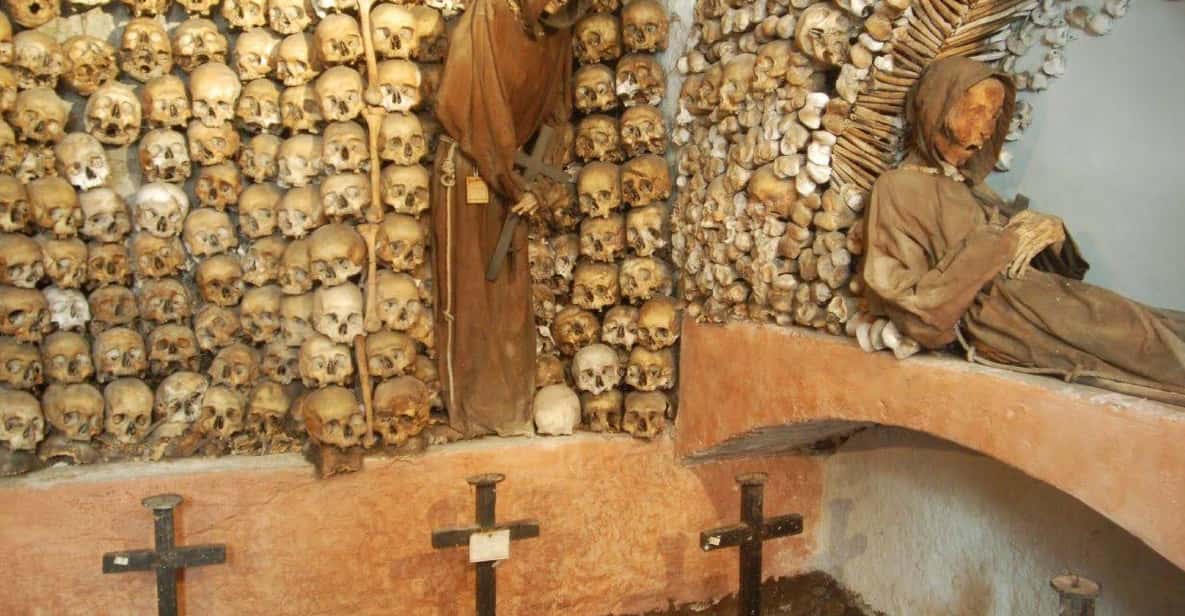
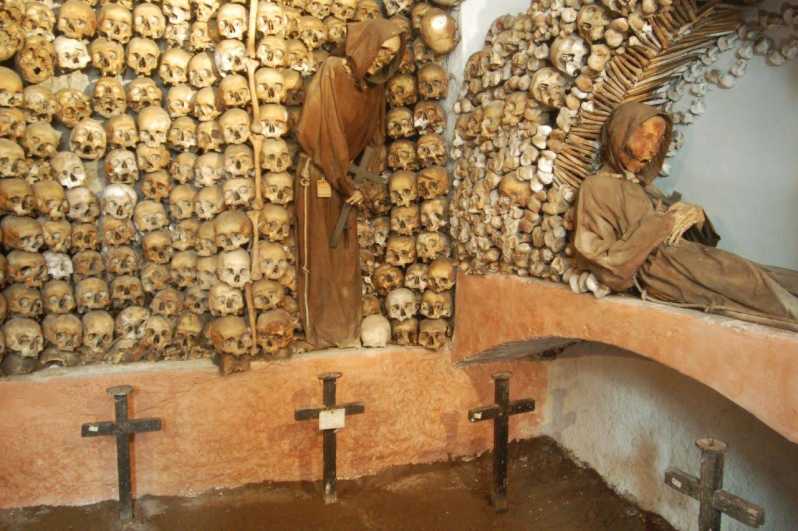
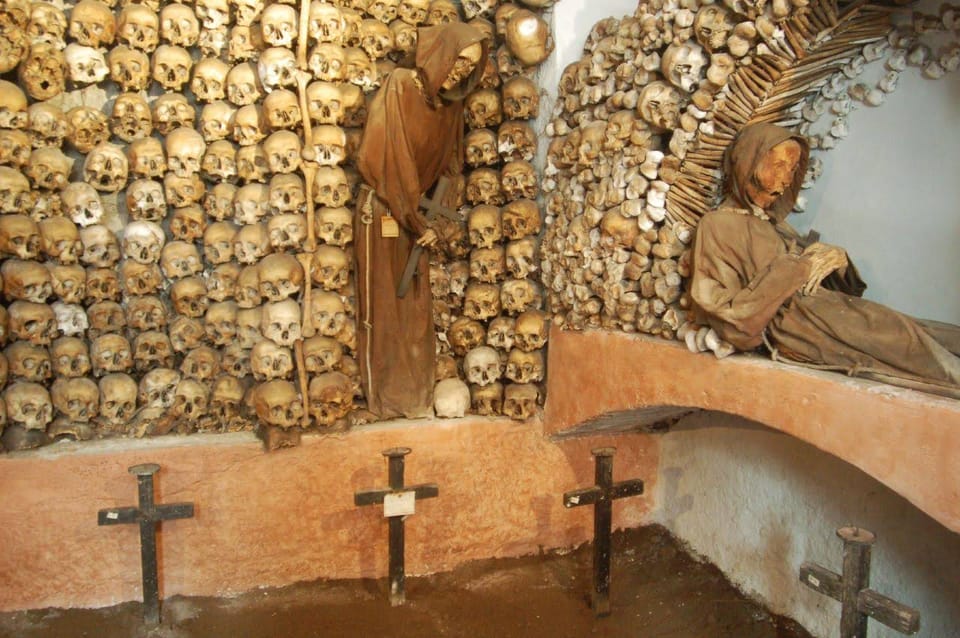
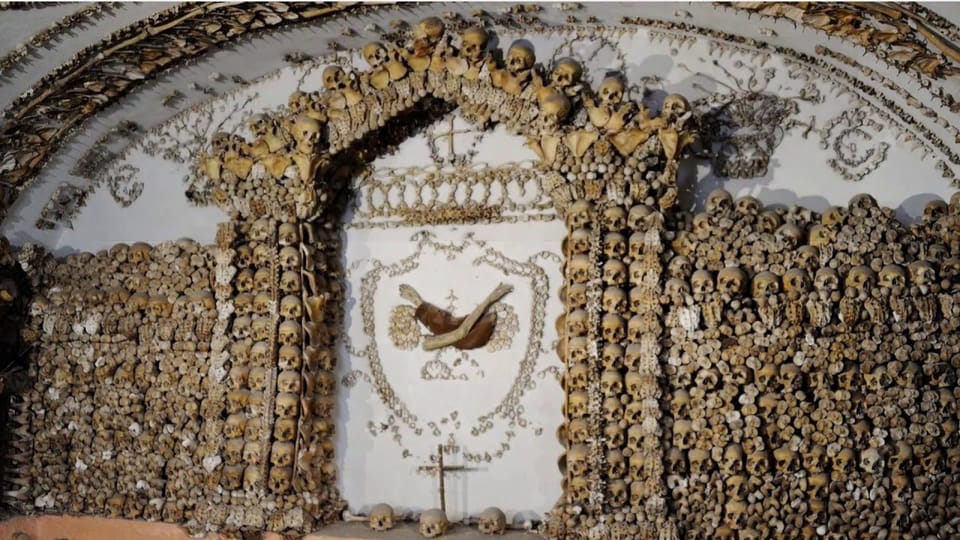
The tour begins with the Crypt of the Capuchin Friars, the famous cemetery made from human remains. The big headline is the number: about 4,000 friars. But what makes this stop memorable is how it’s presented—less like a Halloween stunt, more like a historical structure that says something about the time and the people who made it.
You’ll walk through the crypt with your guide and learn what you’re looking at, including the construction of the site and how the remains are arranged as part of the crypt’s visual language. It can be genuinely fascinating for adults and even for kids who don’t mind spooky facts. (Just know that some visitors have a stronger emotional reaction here than they expect.)
Photo rule to know
Photography inside the crypt is not allowed, so use this stop for slow looking and listening. If you’re the type who always takes pictures, plan to rely on your memory and the guide’s explanations instead.
A practical drawback
This is where some people feel the most uncomfortable—either from the theme or the enclosed feeling. If you’re even slightly on the fence with claustrophobia, take that seriously before you book.
Roman Aqueducts Underfoot: The Acqua Vergine to Trevi Fountain
Next you’ll shift from bone-and-brass curiosity to Rome’s practical genius: water. The tour heads to underground aqueduct areas linked to the Acqua Vergine, the same aqueduct system that feeds the Trevi Fountain today.
This stop has a neat perspective trick built in. You’re underground, but you’re seeing something that’s still working above ground. The guide explains how aqueducts fueled the ancient city—water meant life, sanitation, fountains, and daily survival. In other words: this isn’t just ancient plumbing trivia. It’s the reason Rome could grow the way it did.
You’ll also learn that the aqueduct section you visit lies beneath a commercial center. That contrast is part of the experience: modern streets and commerce sitting right over infrastructure that was critical centuries ago. It makes you look at the city differently afterward.



What to listen for
Pay attention to how the guide explains water distribution and the role of aqueduct systems in daily Roman life. The explanations give meaning to what looks like stonework and arches at first glance.
Comfort tip
You’ll likely be moving between sections underground, so keep your pace steady and watch your footing. This tour is short—only 3 hours total—so there isn’t much time to rush or lag behind.
A 10th-Century Church on Older Temple Remains
After the aqueduct stop, the tone shifts again—still underground, but now you’re looking at layers of belief and architecture. The tour takes you to a church constructed in the 10th century, built above the remains of three temples from the 1st century B.C.
That layering is a key idea in Rome: one era uses what came before. Here, the older temples were located in what served as the center of a Roman fruit and vegetable market dating back to the 4th century B.C. Yes, a market. Not just statues and ceremonies—actual food trade in the same ground that later supported temples, and then later supported a church.
This stop works well because you aren’t only seeing a structure. You’re mentally stacking timelines: market → temples → church → crypt spaces below. If you like connecting dots, this is a good one.
Why this layer matters
It’s easy to think of Rome as a set of famous monuments. This stop reminds you Rome kept changing, and the city reused its own foundations—sometimes literally. That gives the underground spaces a bigger context than the skull-and-bones headlines.
The Exorcism Crypt: 12th-Century History With Human Remains
Now you go deeper into the darker corner of the tour: a crypt linked to exorcisms during the 12th century. The tour description is direct—this crypt is littered with ancient fragments of human bone, including remnants tied to that history.
This is not a stop designed for people who want light entertainment. You’re hearing about practices, beliefs, and the physical evidence that remains. The guide’s storytelling helps keep it from feeling like random shock.
Photo rules again
Like other underground sites on this route, photography isn’t always allowed. The key rule to remember is simple: you’ll be notified when photos are allowed and when they aren’t at each stop. So don’t assume your phone camera will work for every single location.
How to get the most out of it
Try to switch gears here. Instead of thinking only about the macabre visual, listen for what the guide explains about why the crypt existed and how it fits into the larger story of the area. The best tours make you curious without turning the topic into a circus.
Ancient Prisons and Saint Nicola’s Legend
The final stop brings you to ancient prisons, tied to legend about Saint Nicola being imprisoned there. It’s the last underground layer of the tour, and it lands with a different flavor than the skeletons or the water.
Legends can be tricky in travel. The value of this stop isn’t that it proves every detail of history—it’s that it connects place to story. You’re standing somewhere that the local tradition ties to Saint Nicola, and your guide uses that connection to wrap up the underground journey with a final narrative thread.
What this ending does well
Ending with prisons makes the tour feel complete. You’ve seen:
- death and remains in crypt space,
- life-support systems through aqueduct engineering,
- religious layers through church-and-temple history,
- and now confinement and legend.
It’s a good arc for a short tour.
Price and Value: Is $147.27 for 3 Hours Fair?
At $147.27 per person, this tour is priced like a premium guided experience—because you’re paying for access plus interpretation, not just entry into a single sight.
Here’s why the value can make sense:
- You get a live English guide doing three underground stops, with context that helps you understand what you’re seeing.
- Admission fees for the sites are included.
- You also have an English audio guide included, which helps when passages get technical or crowded.
- The tour is only 3 hours, which means you can fit it easily into a tight Rome schedule.
Where value can feel weaker is if you hate guided tours or if you prefer solo pacing over structured storytelling. Underground crypts are also not for everyone, so your personal comfort level matters.
Overall, I’d treat the price as reasonable if you’re the type who enjoys guided explanations and you want a concentrated “Roman underground” sampler in one evening block.
What You’ll Be Doing During the 3 Hours
This is a walking-focused underground tour. You’ll meet at Fontana del Tritone, then move from stop to stop on a set route. The pacing is designed for a short window, so expect brief segments of movement and longer moments for listening and looking.
Across the tour you’ll experience different kinds of underground spaces:
- an ossuary-style crypt,
- aqueduct tunnels and underground aqueduct structures,
- a church context that connects surface layers to what’s below,
- a crypt tied to exorcism history,
- and finally prisons connected to Saint Nicola’s legend.
Also remember: it’s not suitable for wheelchair users, people with mobility impairments, pregnant women, or anyone who has claustrophobia. If you fall into any of those groups, skip this one and look for a different Roman underground experience that better fits your needs.
Who This Tour Suits (and Who Should Skip It)
This tour is a strong match if you:
- want a focused look at Rome underground in one 3-hour block,
- like guided storytelling more than reading signs alone,
- enjoy history that’s unusual—bones, water, and layered architecture,
- and you don’t mind that the vibe is dark at times.
It’s a poor match if you:
- get anxious in enclosed spaces,
- need step-free access,
- feel uncomfortable around human remains topics,
- or you’re looking for a relaxing, scenic walk.
If you’re comfortable with the premise, this tour can change how you understand Rome above ground, too. The aqueduct-to-Trevi link alone makes it worth it for anyone who’s ever stood at the fountain wondering where the water came from.
Practical Tips: Shoes, Comfort, and Photography Inside
Here’s how to keep it smooth:
- Wear comfortable shoes. Underground flooring can be tricky.
- Dress for comfortable clothes. You’ll be outdoors briefly and underground for the bulk of the time.
- Leave your camera assumptions at home. Photography is not allowed inside at some or all stops, and you’ll be told when it’s permitted.
- Go in with your expectations set: some stops are designed to feel eerie, not pleasant.
The good news is the tour is structured and short. You won’t feel like you’re spending half a day in underground gloom. It’s intense, but time-limited.
Should You Book This Rome Underground Crypt Tour?
Book it if you want a concentrated Roman underground experience that mixes Crypt of the Capuchin Friars, the Acqua Vergine aqueduct connection to Trevi Fountain, and underground church-and-crypt layers—all with an English guide and admission handled.
Skip it if you’re claustrophobic, have mobility limitations, or you simply don’t want human remains themes. Also skip if you dislike guided tours and prefer quiet self-paced sightseeing.
If you’re visiting Rome and you want more than the usual surface hits, this tour gives you a different kind of memory: bone-lined rooms, working water infrastructure, and underground spaces that explain how the city functioned and believed—long before smartphones and street signs.
FAQ
How long is the Rome Underground Tour?
The tour lasts 3 hours.
What sites will I visit on this tour?
You’ll visit three underground sites: the Crypt of the Capuchin Friars, underground aqueduct areas including the Acqua Vergine, and a church area with a crypt linked to exorcisms, plus ancient prisons associated with Saint Nicola’s legend.
Is there an English guide?
Yes. The live tour guide is in English, and an English audio guide is included.
Are tickets or admission fees included?
Yes. Admission fees are included as part of the tour.
Is hotel pickup or drop-off included?
No. Hotel pickup and drop-off are not included.
Is food and drinks included?
No. Food and drinks are not included.
Where do I meet the guide?
Meet in front of the Fontana del Tritone. The staff member wears a red and white hat.
Will the tour end back at the same meeting point?
Yes. The activity ends back at the meeting point.
Can I take photos inside the sites?
Photography is not allowed inside. You’ll be notified when photos are or aren’t allowed at each stop.
Is this tour suitable for everyone?
No. It is not suitable for pregnant women, people with mobility impairments, people with claustrophobia, or wheelchair users.