REVIEW · COLOSSEUM TOURS
Rome: Colosseum Gladiator’s Arena and Roman Forum Group Tour
Book on GetYourGuide →Operated by Tour in the City - Travel Agency Rome - · Bookable on GetYourGuide
Walking into the arena feels almost unreal. This small-group guided tour gets you into the Colosseum with fast-track access and a special entrance linked to the gladiator route, then continues with a guided walk through the Roman Forum and up Palatine Hill. It’s one of the rare ways to see these places with enough context that the stones start talking.
I especially like the arena-floor perspective—you get a view straight above the underground areas where so much stagecraft happened. I also like the story-driven pacing: combat tales, Roman emperors in gladiator mode, and then a smooth shift into the Forum and where emperors lived on Palatine Hill.
The main consideration is practical: even with skip-the-line entry, you still pass metal detectors and should expect a security check that can take 20–30 minutes, plus there’s moderate walking and stairs. Also, it’s not suitable for wheelchair users or people with mobility impairments.
In This Review
- Key things that make this tour worth it
- Entering The Colosseum: what the guided arena access actually changes
- Meeting at Piazza di San Clemente: small logistics, big payoff
- The gladiator entrance at Porta Libitinaria: the moment it feels different
- On the arena floor: seeing the undergrounds from a whole new angle
- Gladiator combat stories and Roman emperor theatrics
- The Roman Forum walk: why the next hour matters
- Palatine Hill: seeing where emperors lived (and why it’s worth the climb)
- Pace and timing: what 2.5 hours feels like in real life
- Price and value: why about $27 can actually make sense
- Who this tour is best for (and who should skip it)
- Practical tips to make your Colosseum day go smoothly
- Should you book this Colosseum + Forum + Palatine tour?
- FAQ
- How long is the Rome Colosseum Gladiator’s Arena and Roman Forum group tour?
- Where does the tour start and end?
- Does this tour include skip-the-line entry?
- Will I be on the arena floor?
- What’s included in the price?
- What do I need to bring for the security check?
- What items are not allowed inside?
- Is this tour suitable for wheelchair users or mobility impairments?
Key things that make this tour worth it
- Gladiator-access entry (Porta Libitinaria) for a more special feel than the usual front door
- Arena floor time with a direct view above the undergrounds
- Roman Forum + Palatine Hill included so you don’t just leave with Colosseum photos
- First and second rings during the guided Colosseum portion
- Headsets to keep the guide’s narration clear in a noisy, busy site
- Small group size (max 25) for a calmer visit than most bus-style tours
Entering The Colosseum: what the guided arena access actually changes
This is the kind of tour that matters most at the moment you stop being a spectator and start moving through the same spaces as the show. The Colosseum is famous, sure—but without context it’s easy to see it as a big ruin and move on. With a guide, you notice how it was engineered for crowds, pacing, and spectacle.
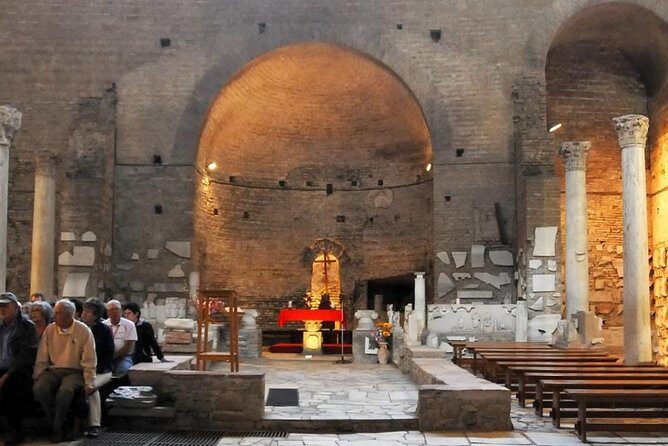
You’ll start your 2.5-hour experience in the Piazza di San Clemente, meeting in front of Basilica San Clemente. The team meets you with a signboard that says Tour in the City. From there, the Colosseum portion is about getting you in fast and placing you where the stories make sense: on the arena level, looking up into the structure rather than just down at it.
The tour’s design is also about crowd control. Your route and timing are set up to help you avoid the worst lines, which is huge at the Colosseum. Even so, plan for the security checkpoint. Metal detectors are part of the reality here, and the time can stretch to 20–30 minutes on some days.
You can also read our reviews of more tours and experiences in Rome.



Meeting at Piazza di San Clemente: small logistics, big payoff
The meeting point is simple, but it’s not at the Colosseum itself. You’ll gather at Piazza di San Clemente, in front of Basilica San Clemente. That matters because you can arrive earlier, get oriented, and avoid scrambling when you’re already hot and wearing comfortable-shoe regret.
Bring a passport or ID card for the security check. That’s not optional. Also bring sunscreen if you’re going in daytime—this area is open, and the walking adds up.
A few “don’t bring it” items can save you stress at the entrance:
- no luggage or large bags
- no backpacks or suitcases
- only small bags are possible (the Colosseum doesn’t offer a bag check)
If you’re used to traveling light, you’re good. If you like a daypack, it’s worth planning for a smaller bag or leaving extra items behind.
The gladiator entrance at Porta Libitinaria: the moment it feels different
Here’s where this tour earns its reputation. Instead of the standard public entry, the guided experience includes special access from the gladiator’s entrance connected to the Porta Libitinaria route. That detail isn’t just a fun fact. It changes your first impressions of the Colosseum because it’s framed as an arrival to a role, not a check-in to a museum.
When you enter, you’re not stuck outside with everyone else. You get inside the Colosseum and move into the arena area, where gladiators actually performed. The guide also helps you understand the flow of movement and the scale of the spaces, which makes the Colosseum feel like a built machine rather than a pile of stone.
One of the most praised parts of the experience is how quickly the group gets through compared with the usual long queues. Several guides are mentioned in feedback for making that time count—like Sam, Serena, Maximus, Fernando, Stephano, Paulo, and others—often with entertaining, clear narration and good rhythm for photos.
On the arena floor: seeing the undergrounds from a whole new angle
The biggest “wow” isn’t just standing in the arena. It’s standing in the arena with an explanation—and then noticing what you can see from that exact position.
From the arena floor, you get a view directly above the undergrounds. That’s a key detail. Those lower spaces are where a lot of the show logistics lived: staging, movement, and preparation. From above, you start to understand why the building worked the way it did and how the action could move without the crowd breaking focus.
You’ll also get guided access across the Colosseum’s first and second rings. This matters because the perspective changes your read of the structure. At ring level, you can understand how Romans designed for visibility and crowd management—how they built upward and outward to keep thousands within the same visual story.
If you want the Colosseum to feel real, this is the day to do it. The tour description even frames the experience as feeling like a gladiator during the Ludus Gladiatorius concept—meaning the guide tries to connect you to the experience instead of listing facts.
Gladiator combat stories and Roman emperor theatrics
The tour doesn’t just point at ruins and move on. Your guide tells combat stories and explains how the spectacle worked—who fought, what the atmosphere was like, and why audiences came back for that kind of brutality.
You’ll also hear about “fool emperors” who played out gladiator fantasies by fighting against wild beasts. The wording in the tour materials is dramatic, but the underlying idea is the same: power and performance were linked, and the Colosseum was a stage for emperors to be seen in public mythmaking.
This is also where the guides mentioned in feedback shine. People repeatedly highlight how guides keep attention with humor and energy—Maura, Roberta, Linnea, Zenda, and others show up in the names. One review notes reconstruction images shown via an iPad during the walk. Even if your guide uses different visuals, the goal stays the same: help you picture what the Colosseum looked like when it was working.



The Roman Forum walk: why the next hour matters
After the Colosseum, you head into the Roman Forum portion of the tour with a guided walk of about one hour. This step is important because it turns the Colosseum from an isolated icon into part of the bigger Roman story.
The Roman Forum is where politics, status, and public life intersected. Seeing the Colosseum first gives you the spectacle side. Then the Forum gives you the governance and everyday power structure behind it. It’s the kind of pairing that makes your photos more meaningful later, because you’ll remember what kind of society could build and stage something like this.
One thing to note: this part is still a walking tour, so your comfort shoes matter. The Forum areas are uneven in places and you’ll be moving at a steady group pace with a live guide.
Palatine Hill: seeing where emperors lived (and why it’s worth the climb)
Palatine Hill is about where elite life concentrated—specifically, the tour focuses on showing where Roman emperors lived. You’ll get about 45 minutes here with the guide.
This is a good match after the Forum because you get a clean storyline:
- the Colosseum: public spectacle and crowd emotion
- the Forum: public power and social life
- Palatine Hill: the private-to-semi-private spaces where rulers lived and controlled influence
Palatine Hill also helps you understand the geography. From the right angles, you can feel how the city’s power sat in place—how the view, elevation, and surrounding space supported status. Even if you’re not a history expert, the guide’s framing makes the hill click.
Pace and timing: what 2.5 hours feels like in real life
The total experience is about 2.5 hours, and the tour is carefully segmented:
- Colosseum guided time: about 75 minutes
- Roman Forum guided time: about 1 hour
- Palatine Hill guided time: about 45 minutes
Because the schedule is structured, you’re less likely to lose time to decision-making. You also get a group that stays together, with headsets included so you can hear the guide even when the group is moving through busy areas.
The group size is capped at 25 persons, which helps. It’s not a one-on-one private tour, but it’s also not a cattle-car situation. That matters at the Colosseum, where everyone wants the same photo angles and the same walk paths.
The tour ends back at the original meeting point at Piazza di San Clemente. That’s a convenience if you’re continuing elsewhere in the neighborhood after you’ve seen the big three: Colosseum, Forum, and Palatine Hill.
Price and value: why about $27 can actually make sense
At around $27 per person, this tour is priced low for what you get, mainly because three expensive-feeling pieces are bundled together:
- Colosseum entry with fast-track access
- Special access tied to the gladiator entrance route
- Guided time at the Roman Forum and Palatine Hill, with headsets
A standard Colosseum ticket plus your time spent figuring things out on your own can easily become frustrating, especially when queues eat your morning or afternoon. This tour’s value is that it compresses the logistics and adds interpretation—so you spend your limited visit time actually understanding what you’re looking at.
In plain terms: if you’d rather pay a bit and cut the confusion, this is a smart buy. If you’re the type who enjoys self-guided wandering with audio and zero structure, you might prefer a different format.
Who this tour is best for (and who should skip it)
This tour is a strong fit if you want:
- arena-floor access and a guided take on what you see there
- a quick but organized look at Colosseum + Forum + Palatine Hill
- an energetic English guide experience with headsets and a small group
It’s also great for first-time Rome visitors who feel overwhelmed by how many ticket options exist for the Colosseum. One common theme in feedback is relief: the guide and set meeting point reduce the mental overhead.
Who should skip or reconsider:
- If you have mobility limitations, the tour is not suitable for wheelchair users and people with mobility impairments.
- If you hate walking and stairs, be cautious. There’s moderate walking and the Colosseum involves stair sections.
- If you need a fully quiet, self-paced visit, a guided group route might feel too structured.
Practical tips to make your Colosseum day go smoothly
A few small things can make the difference between a smooth experience and a stressful one.
First: arrive with a calm “security first” mindset. Even with fast-track entry, you’ll go through metal detectors and should expect a 20–30 minute wait to clear security.
Second: travel light. No backpacks or large bags. The Colosseum doesn’t provide bag check, so anything too big can become an issue.
Third: bring comfortable shoes and sunscreen. The itinerary involves a moderate amount of walking across multiple areas.
Fourth: skip selfie sticks. They’re not allowed inside the Colosseum for security reasons.
Finally: plan for heat. The Colosseum can be unforgiving in bright sun. Feedback includes an example of a guide actively managing cooling breaks by moving the group between outside and inside sections. Your guide can’t control the weather, but you’ll likely feel the benefits of a guide who paces the group thoughtfully.
Should you book this Colosseum + Forum + Palatine tour?
If your top priorities are arena access, a guided explanation that turns spectacle into context, and a short tour that still hits the Roman core, I’d book it. The special gladiator entrance, time on the arena floor with views above the undergrounds, and the follow-up at the Roman Forum and Palatine Hill create a visit that feels complete rather than rushed.
If you’re sensitive to crowds, you’ll likely appreciate the crowd-management approach. If you’re worried about audio clarity, headsets are included, and at least one note suggests audio can vary—so being ready with your own earphones won’t hurt.
Skip it if mobility is an issue, or if you want a slow, independent day. For most people, though, this is a strong “big hitters in one outing” tour: structured, guided, and built around the parts of the Colosseum that are hardest to appreciate without help.
FAQ
How long is the Rome Colosseum Gladiator’s Arena and Roman Forum group tour?
It lasts about 2.5 hours, with the Colosseum visit guided for about 75 minutes, followed by the Roman Forum (about 1 hour) and Palatine Hill (about 45 minutes). Starting times vary, so check availability.
Where does the tour start and end?
You meet at Piazza di San Clemente, in front of Basilica San Clemente, where staff hold a signboard reading Tour in the City. The tour ends back at the same meeting point.
Does this tour include skip-the-line entry?
Yes. It includes fast-track entrance and separate access, including special entry linked to the gladiator entrance.
Will I be on the arena floor?
Yes. The experience includes entering the Colosseum and visiting the arena, including a view directly above the undergrounds.
What’s included in the price?
The tour includes a professional English-speaking guide, fast-track entrance with special gladiator access, Colosseum ticket, Roman Forum and Palatine Hill access with guidance, and headsets.
What do I need to bring for the security check?
Bring a passport or ID card. You’ll also want comfortable shoes and sunscreen.
What items are not allowed inside?
Pets are not allowed. Luggage or large bags are not allowed, and backpacks or suitcases cannot be brought in. Only small bags are possible, and there is no bag check at the Colosseum. Selfie sticks cannot be used inside.
Is this tour suitable for wheelchair users or mobility impairments?
No. The tour is not suitable for people with mobility impairments and it is not suitable for wheelchair users.