REVIEW · CATACOMBS TOURS
Rome Colosseum & Catacombs Underground Tours & Transfer
Book on Viator →Operated by Tour In Rome by Tour in the City · Bookable on Viator
Rome makes you walk through time. This half-day plan strings together Rome’s most iconic sights above ground, then drops you under Via Appia Antica for an underground look at early Christian burial life. I especially like the small-group feel and the chance to hear stories from an archaeology-minded guide as you go.
I also like that the big ticket items are handled for you: Colosseum reservation + entry are included, along with catacomb tickets and round-trip transport. That means less time figuring out logistics and more time focusing on the actual archaeology.
One consideration: the day is active. The tour is not recommended for walking impairment, and the Colosseum entry process can still cause delays even when you’re pre-booked.
In This Review
- Key highlights worth planning for
- A 5-hour Rome plan: Colosseum above, catacombs below
- Meeting near Via della Polveriera: how to avoid a shaky start
- Entering the Colosseum with a reserved time slot
- Roman Forum stops that actually help you picture ancient Rome
- Palatine Hill: frescoes, legends, and the best view logic
- Appia Antica and the catacombs transfer: the air-conditioned reset
- Choosing which catacombs you’ll see: San Callisto, San Sebastiano, or Santa Domitilla
- Circus Maximus, Baths of Caracalla, and the Arch of Constantine quick hits
- Price and logistics: what you pay for and what you get
- Who this tour suits best (and who should plan differently)
- Should you book this Colosseum and Catacombs tour?
- FAQ
- What is included in the tour price?
- Which catacombs will I visit?
- How long is the tour and how long do the main stops last?
- Is the tour suitable if I have difficulty walking?
- What do I need to bring for entry into the Colosseum and Roman Forum?
- Are there rules about what I can bring or do at the Colosseum and catacombs?
Key highlights worth planning for
- Small-group guiding for Colosseum, Roman Forum, and Palatine Hill so you’re not stuck in a giant crowd
- Catacomb tickets and round-trip transfer included, with the ride led by a professional driver
- Catacombs vary by day (San Calisto, San Sebastiano, or Santa Domitilla)
- Temperature stays cool underground (around 60°F / high moisture), so plan for damp-cool air
- Security is strict at the Colosseum: no large bags, and everything goes through screening
- A few extra big sites by the route including Circus Maximus, Baths of Caracalla, and the Arch of Constantine
A 5-hour Rome plan: Colosseum above, catacombs below
This is a fast-but-focused way to hit several headline sights in one go. You start with the Colosseum and the Roman core of ancient government and myth-making, then shift to the quieter, darker world of burial tunnels on the edge of the city.
The payoff is that the story of Rome doesn’t stop at statues. You see the public theater of power above ground, then you learn how people lived, prayed, and remembered the dead below ground. It’s a smart structure if you like your sightseeing with context, not just photo stops.
The schedule is built around a guided Colosseum/Forum/Palatine block, then a break, then the Appia Antica outing. Expect the order of stops to vary, and expect a possible 20–30 minute swing due to operational timing.
You can also read our reviews of more tours and experiences in Rome



Meeting near Via della Polveriera: how to avoid a shaky start
Your day is anchored by a meeting point at the operator’s office on Via della Polveriera, and there’s a rule that matters: you must be there 30 minutes before departure. That early buffer is there for headcounts and organizing your group before you head into the Colosseum area.
It’s also a good moment to double-check your paperwork. The entry rules are name-specific: you must bring a valid passport or ID that matches the full names provided at booking. If your voucher doesn’t match, entry can be denied.
This isn’t the kind of tour where you can saunter in right on time. If you’re the type who gets lost in Rome when you blink, plan to arrive early. You’ll enjoy the tour more when you’re not speed-walking with a backpack and a question mark.
Entering the Colosseum with a reserved time slot

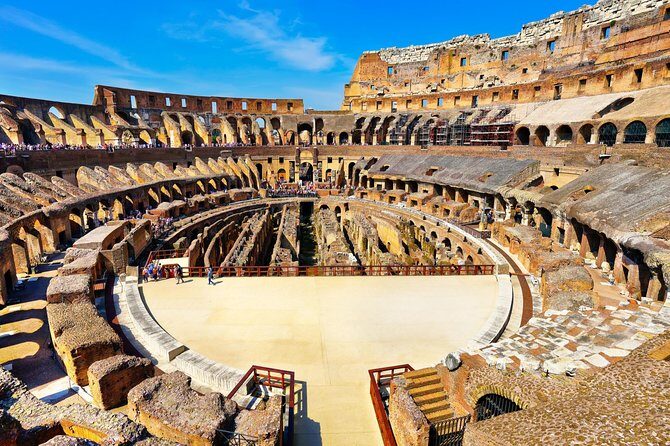
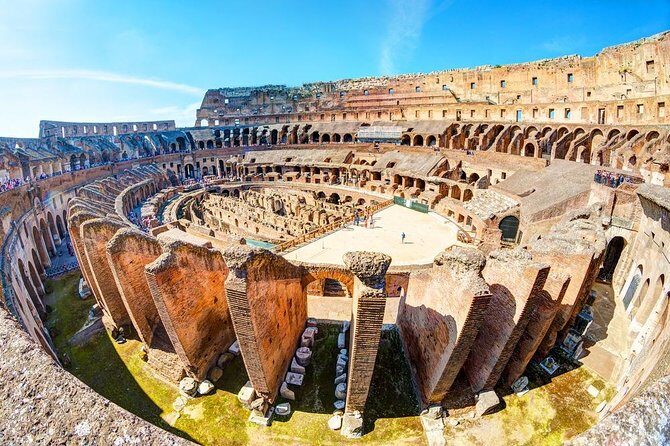
The Colosseum part is the engine of the tour. You get about 1 hour 30 minutes there with guided time that’s meant to make the building feel understandable, not just huge.
Pre-booked entry helps, but it’s still the Colosseum. The site can allow up to 3,000 people at once, and crowds can still create delays. So treat your Colosseum slot as a best-effort start time, not a guarantee of zero waiting.
Plan for security screening. You’ll need to place items (including your phone) into a bag/backpack or tray for the X-ray. The list of forbidden items is strict: no bottles/glasses containers, no alcoholic beverages or aerosols, and no large backpacks or bulky luggage. Medium or small backpacks are allowed, but they’ll be X-rayed and may be opened and visually inspected.
One more practical note: don’t count on a full explore-everywhere experience. The tour is timed. Some visitors feel it can feel like a lot to absorb in one pass, and the pacing can feel quicker than you might want if you love lingering.
Roman Forum stops that actually help you picture ancient Rome
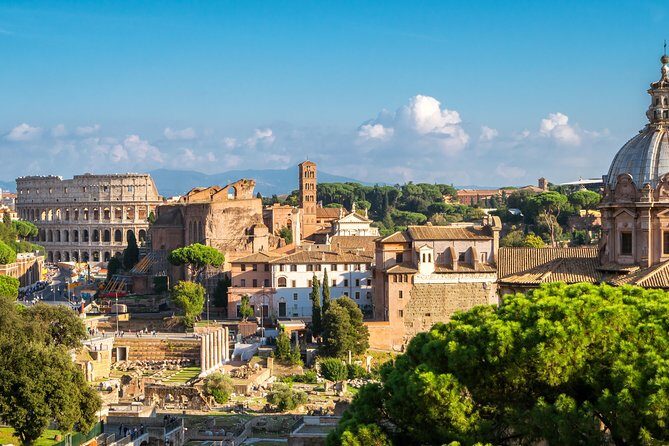
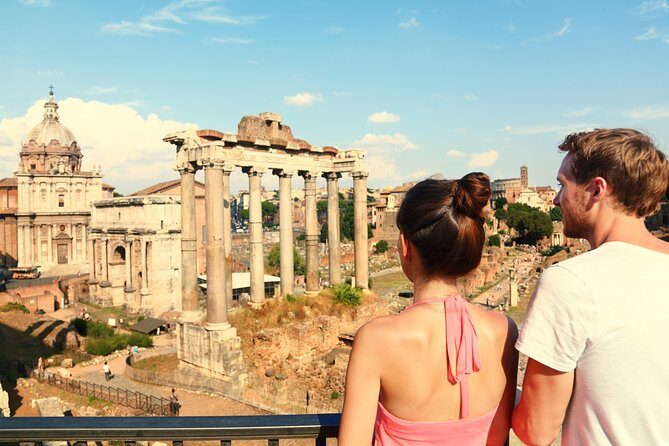
After the Colosseum, you move to the Roman Forum area for about 45 minutes, with guided coverage of key ruins and ceremonial spaces. This is where the tour can help the most, because the Forum is scattered. Without guidance, it’s easy to see rocks and miss the plot.
You’ll pass sights tied to power and ceremony, including the Temple of Julius Caesar, the Arch of Titus, the House of the Vestal Virgins, the Senate House, and the Basilica of Maxentius. The route also includes the Sacred Way, described as the triumphal road where centurions of Caesar marched after campaigns.
This part is most valuable if you like a clear storyline. The best moments are when the guide connects what you’re looking at to what it meant. You end up with a mental map, not just a checklist.
If you prefer slow museum-style pacing, the Forum time can feel short. But for many people, the timing works well because you’re still moving forward in the same theme: politics, myth, and public ritual.
Palatine Hill: frescoes, legends, and the best view logic
Palatine Hill runs about 45 minutes in the guided section. It’s the kind of stop that rewards you for paying attention, because it’s tied to both early settlement and imperial-era glamour.
You’ll explore the idea of an older settlement dating back to the 9th century BC, then you’ll learn about standout sites like the House of Augustus and the Hippodrome, an elliptical sunken garden associated with Domitian’s palace complex. There are also views that help you understand the layout of the Forum valley—seeing the geography makes the ruins easier to interpret.
You’ll also hear the legend of Romulus and Remus, the brothers raised by a wolf who fought for control. It’s a good story break that keeps the tour from becoming only stone facts.
After this, you get a 1-hour break, then you come back to the office at 1:45 pm to start the Appia Antica leg. That break matters if you want a chance to reset before the underground portion and the longer drive.






Appia Antica and the catacombs transfer: the air-conditioned reset
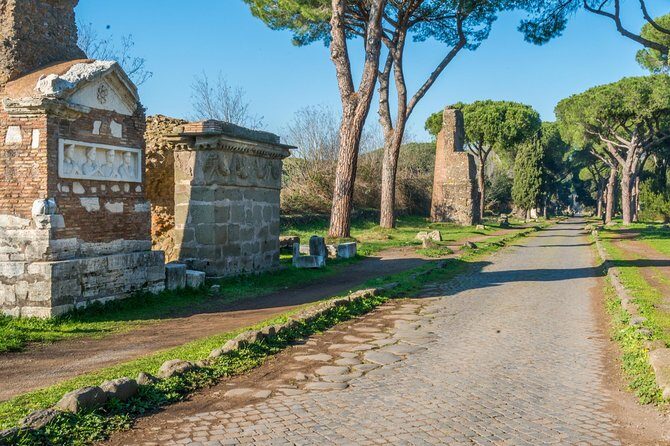
The jump from central Rome to the Appia Antica area feels like a tone change. You’ll ride by minivan in an air-conditioned vehicle, passing through the approach toward the Aurelian Walls and into the archaeological green space along the old road system.
The transfer block is about 2 hours (including the overall catacomb outing structure). In practice, that usually means you get enough time to settle after the walking-heavy ancient core and still arrive with time for your underground visit.
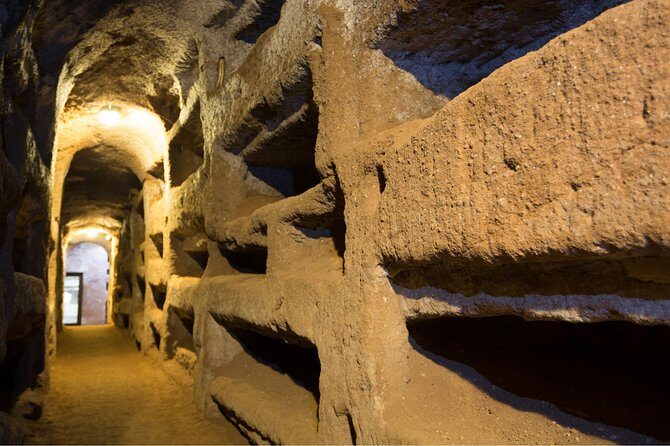
Underground conditions are specific: the catacombs are around 60°F with high moisture. You don’t need a parka, but you should dress for cool damp air so you’re not cold and stiff during the walkways.
Also remember the catacombs rules are no-jokes serious. You can’t visit on your own, you can’t stray from your group, and you can’t cross gates into routes that are closed to the public. Touching exhibits is forbidden, and removing objects is strictly not allowed.
Choosing which catacombs you’ll see: San Callisto, San Sebastiano, or Santa Domitilla
Here’s how it works on this tour: the specific catacombs you visit change depending on the day. The options include San Calisto, San Sebastiano, or Santa Domitilla.
If your day lines up with San Calisto, you’ll learn why that place is so central to the story of early Christian Rome. It’s believed to have been created under the direction of Pope Zephyrinus and expanded under Callixtus I, who later became Pope Callixtus I and was himself entombed within the complex. The crypt fell into disuse as relics were translated to churches inside the city, with major waves of translations over centuries. The catacomb was rediscovered in 1854 by Italian archaeologist Giovanni Battista de Rossi.
You’ll also get the kind of underground details that make catacombs memorable: frescoes, crypts with inscriptions carved into the walls, niches with remains of skeletons, mausoleums and sarcophagi, and small chapels still used for religious rites.
One important restriction that affects your experience: photography and video aren’t allowed inside the catacombs. If you rely on your camera to process a visit, you may find that frustrating, but it also keeps the atmosphere quieter.
Your catacomb guided time is about 1 hour.
Circus Maximus, Baths of Caracalla, and the Arch of Constantine quick hits
This tour also includes a few extra ancient landmarks connected to Rome’s entertainment and monumental building culture.
You’ll see the Circus Maximus, the enormous ancient chariot-racing stadium between the Aventine and Palatine hills. It was the first and largest stadium in ancient Rome, with a capacity cited at over 150,000 spectators. Today it’s a public park, so you still get a sense of scale without the roar.
You’ll also get a look at the Baths of Caracalla. These were the city’s second largest public baths, built in the early 3rd century during the reigns of Septimius Severus and Caracalla. They operated until the 530s and then fell into ruin, but you’ll learn how they influenced later building design. The ruins are a tourist attraction, so even if you don’t go deep, you get a sense of why these thermae mattered.
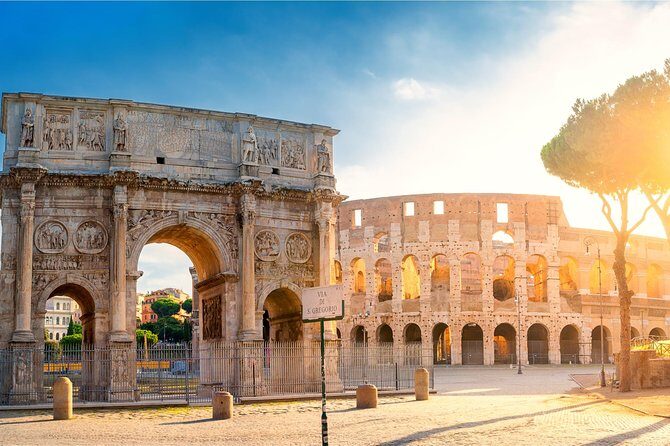
And you’ll stop at the Arch of Constantine, which is free and takes about 5 minutes in the tour flow. It commemorates Constantine the Great’s victory over Maxentius at the Battle of the Milvian Bridge in AD 312. It’s the largest Roman triumphal arch, and it sits in a prime position between the Colosseum and Palatine Hill.
These stops won’t replace the big guided blocks, but they help you round out the day’s theme: public spectacle, imperial power, and civic ritual.
Price and logistics: what you pay for and what you get
At $227.58 per person, this tour looks pricey at first glance. But a lot of the cost is doing real work for you.
You’re getting:
- Guided time for the Colosseum, Roman Forum, and Palatine Hill
- Underground catacomb admission and a guided visit
- Round-trip transfer to the catacombs area
- A Colosseum ticket valued at €18 and a reservation fee valued at €2 (listed separately)
That’s a practical value package. The biggest reason I’d consider paying for this style of tour is time. Getting into the Colosseum in high season is hard, and reserving entry isn’t a luxury. It’s a stress reducer.
The trade-off is you are paying for efficiency, not for a slow stroll through every corner. If you love long unstructured wandering, you might find the pacing less satisfying. If you want a guided “Rome in one afternoon” plan that’s already bundled with tickets and transport, this pricing starts to make sense.
Who this tour suits best (and who should plan differently)
This is best for you if:
- You want a guided route through Colosseum + Forum + Palatine Hill rather than piecing it together yourself
- You’re curious about early Christian burial practices underground and want a guided catacomb experience
- You prefer small-group structure (max 25) and a manageable schedule
It’s not a great fit if:
- You have walking limitations. The tour is not accessible for walker users and is not recommended for walking impairment.
- You hate strict rules. Security screening at the Colosseum is real, and the catacombs forbid touching and straying.
- You want lots of photo/video freedom underground. Catacombs don’t allow it.
One helpful tip: pack light and plan for the security check. A medium backpack is okay, but it still has to comply with the restrictions and be screened.
Should you book this Colosseum and Catacombs tour?
Yes, if you want a smart, bundled day that covers the major headline sites without making you manage tickets and timing yourself. The biggest wins are the reserved Colosseum entry, the guided interpretation of the Forum and Palatine Hill, and the catacombs visit with included tickets and transfer.
I’d book it with care if you’re sensitive to pace. Some people feel the Colosseum portion can feel busy and a bit rushed, especially in crowded periods. If your ideal Rome day is slow and spacious, you might prefer breaking this into two separate visits.
Bottom line: book this when you want an organized, guided hit of Rome’s ancient center plus the underground world of the catacombs, with transport handled and the key admissions included.
FAQ
What is included in the tour price?
The tour includes the guided Colosseum, Roman Forum, and Palatine Hill visit; a guided catacombs tour; round-trip transfer to the catacombs by minivan; catacombs admission tickets; and the Colosseum entrance ticket plus the Colosseum reservation fee. Food and drinks are not included.
Which catacombs will I visit?
The specific catacombs can change depending on the day. The listed options are San Calisto, San Sebastiano, or Santa Domitilla.
How long is the tour and how long do the main stops last?
The tour is about 5 hours. The Colosseum stop is about 1 hour 30 minutes, the Roman Forum about 45 minutes, and Palatine Hill about 45 minutes. The catacombs visit is about 1 hour, with the Appia Antica transfer block listed as 2 hours overall.
Is the tour suitable if I have difficulty walking?
No. The activity is not recommended for travelers with walking impairment, and it is not accessible for walker users.
What do I need to bring for entry into the Colosseum and Roman Forum?
You must bring a valid passport or ID document that matches the full names provided when booking. You also need to present a voucher with all travelers’ full names before entry.
Are there rules about what I can bring or do at the Colosseum and catacombs?
Yes. At the Colosseum you go through security screening and you must follow the forbidden item rules (no large backpacks/bulky bags, no bottles/glasses containers, no aerosols, and other listed restrictions). In the catacombs, you cannot visit on your own, stray from your group, touch exhibits, or remove any objects/material.