REVIEW · NAPLES
Private Walking Tour through the Historical City of Herculaneum
Book on Viator →Operated by Guide Centre Sorrento · Bookable on Viator
Some places feel frozen in time.
Herculaneum is one of them, and a private walk helps you understand what you’re actually looking at instead of just staring at ruins. I love the relaxed pacing (you don’t feel rushed), and I also love how the route hits the park’s top highlights in a smart order. One thing to consider: the tour price does not include the Archaeological Park entrance ticket, so you’ll add €16 on site (free under 18 with document).
This is also a good way to see more than the “big obvious” sights. With an archaeology expert guide, you get context and details for houses, mosaics, frescoes, and even small finds in the museum stops. The possible drawback is simple: it’s a short walk, so if you want to spend extra time wandering on your own, plan a bit of extra time beyond the 2-hour tour.
If you want a better visit, start with a tour like this.
You’ll meet at the Archaeological Park entrance in Ercolano and finish back where you started, with a route designed to keep you moving through the parts that are easiest to understand on foot. The guide’s approach is clear from the many 5-star comments tied to guides like Martina, Carmine, Francesca, Annalisa, Ernesto, and Alessandro, who consistently get mentioned for patient explanations and strong English.
In This Review
- Key things you’ll notice on this private Herculaneum walk
- Why Herculaneum feels different from Pompeii on the ground
- Price and tickets: what you really pay for a 2-hour private tour
- How the meeting point keeps things simple in Ercolano
- Stop by stop: how the route reads like Roman life
- Terme del Foro: the Roman bath system you can actually understand
- Partem Domus lignea (Casa del Tramezzo di Legno): charred wood furniture
- Casa di Nettuno e Anfitrite: mosaics that make sense up close
- Casa dei Cervi: the deer house and its polychrome marble
- Casa Sannitica: pictorial decoration in first Pompeian style
- Salone della Barca di Ercolano: the charred Roman boat museum stop
- College of the Augustales: mythological frescoes in a public temple
- Casa del Salone Nero: the black hall and fresco conservation
- Antiquarium di Ercolano: everyday objects, jewelry, and charred wood furnishings
- What you’ll learn about Herculaneum’s layout and preservation
- The guides make or break your Herculaneum visit
- Timing and comfort: small prep that pays off
- Who this private tour suits best
- Should you book? My take
- FAQ
- How long is the private walking tour?
- How much is the tour, and what about the entrance fee?
- Is this tour private?
- What language is the tour offered in?
- Where do we meet for the tour?
- Is there a mobile ticket?
- What is included in the price?
- What should I bring or wear?
- Is it okay for everyone to join?
Key things you’ll notice on this private Herculaneum walk
- Private guide + you set the pace: the tour is built around stopping often enough to ask questions and process what you’re seeing.
- The park ticket is separate: you’ll still plan for the €16 admission fee per person for the archaeological area.
- Herculaneum’s “Roman day life” is easier to read: baths, houses, mosaics, frescoes, and everyday objects connect in a way that feels more human than a checklist.
- You’re not just looking at walls: charred-wood furniture and a charred boat give the site a rare, tangible punch.
- The guide matters: many standout comments praise guides who tie Herculaneum and Pompeii together so the eruption-era story lands.
- Comfort items help: bring sunglasses/hat and wear comfortable walking shoes, especially on bright or warm days.
Why Herculaneum feels different from Pompeii on the ground
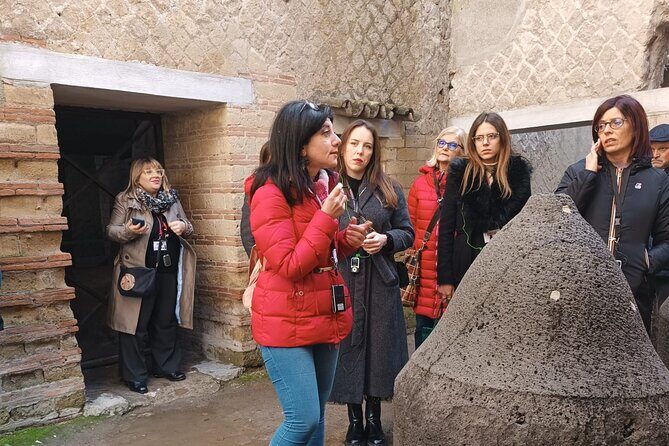
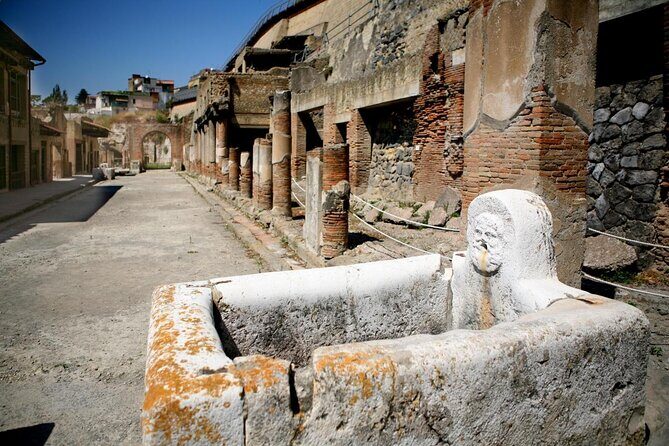
Herculaneum is smaller and more walkable than many visitors expect, and that’s a big reason this tour works so well. You can actually slow down at key rooms and mosaics without turning the visit into a sprint.
The private format also changes the experience. Instead of hearing generic explanations for a crowd, you get targeted storytelling that helps you notice details like room function in the baths or what a mosaic panel is telling you. People often come in thinking they’ll just see ruins; they leave with a clearer picture of how Roman spaces were arranged.
You can also read our reviews of more walking tours in Naples


Price and tickets: what you really pay for a 2-hour private tour
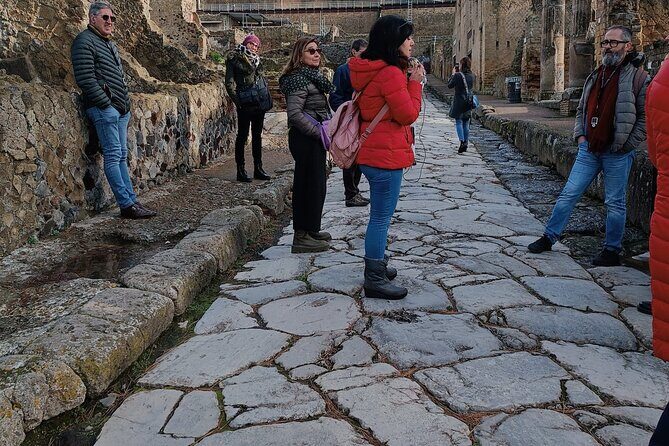
The tour is listed at $102.12 per person and runs about 2 hours. What you pay for up front includes a licensed archaeology guide, taxes, and the private tour format, plus use of a mobile ticket.
The separate part is the Archaeological Park of Herculaneum entrance ticket at €16 per person (and free under 18 with document). In other words, your real “all-in” cost is the tour price plus that park admission for adults.
Is it worth it? If you’re the kind of traveler who likes to understand before you photograph, yes. The guide time is the difference between seeing rooms and actually interpreting them—especially at stops where the details matter, like fresco themes or the layout of bath rooms.
How the meeting point keeps things simple in Ercolano
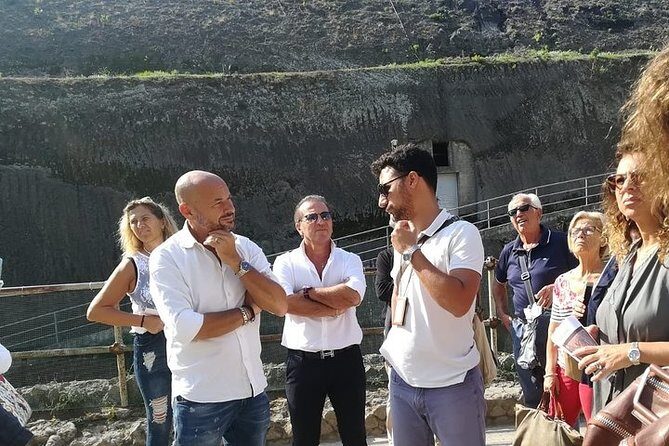
You meet at the Archaeological Park of Herculaneum, Corso Resina, 187, 80056 Ercolano NA, Italy. The tour ends back at the same meeting point, so you’re not left scrambling for your next plan right after the tour.
This matters when you’re short on time. You can connect the rest of your day—either another museum visit or a meal—without figuring out a second pickup location. And since the site is near public transportation, you have options if you’re not driving.
Stop by stop: how the route reads like Roman life
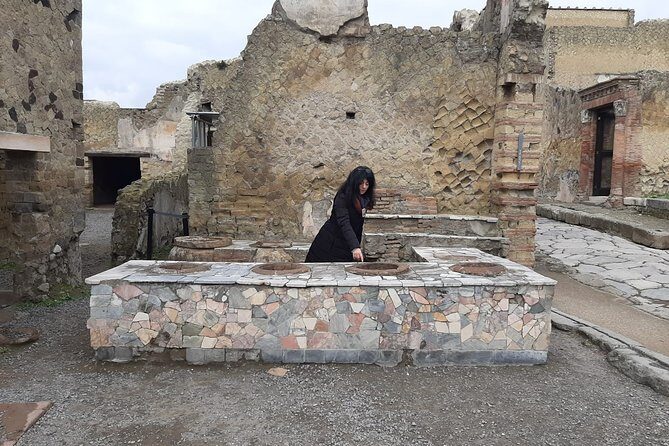
The itinerary is built around a clear story. You start with baths (public routine), then move through some of the best-preserved homes (private life), and finish with a small museum moment and a couple of temple/ritual spaces (religion and civic culture).
Each stop is intentionally short—often around 10 to 15 minutes—so you stay focused on what the guide wants you to see. That pacing is a big plus in a site where “wandering” can become easy to do, but harder to interpret.
Terme del Foro: the Roman bath system you can actually understand
You begin at Terme del Foro, where you can see a well-preserved Roman thermal setup. The highlight here is how the system is laid out: you can follow the sequence through the space used for changing, warm baths, and warm-warm bathing areas.
This is one of those stops where a guide genuinely improves the visit. Without context, you might just see rooms. With context, you can understand how the building functioned in daily life.
One practical tip: baths can still feel warm even when the site isn’t blasting sun, so plan for comfort and water, and wear shoes with traction.
You can also read our reviews of more city tours in Naples



Partem Domus lignea (Casa del Tramezzo di Legno): charred wood furniture
Next is one of the best-preserved houses, Partem Domus lignea, known for charred wood furniture. This stop is memorable because it’s not only architectural. The story has physical objects in it—furniture and wooden elements that survived in a way you don’t usually expect in an open-air archaeological park.
The value here is perspective. Herculaneum doesn’t just show what a building looked like; it helps you picture what people used inside it, down to furnishings.
Casa di Nettuno e Anfitrite: mosaics that make sense up close
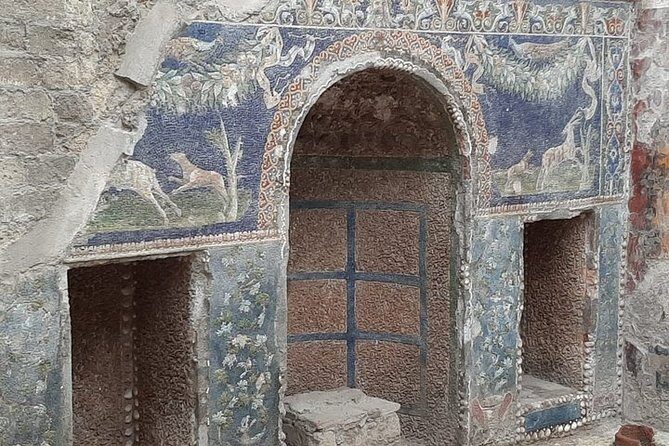
At Casa di Nettuno e Anfitrite, look for the mosaic work connected to Neptune and Amphitrite. The tour description frames it as one of the most beautiful mosaics across Vesuvian sites, and that tracks with why guides keep pushing people to pay attention here.
A mosaic is easy to treat like decoration. In a guided format, you learn to see composition and symbolism, not just color. If you love art details, this is a solid anchor stop.
Drawback to keep in mind: mosaics attract attention fast, and this stop is only about 15 minutes. If you’re a slow observer, you’ll want to be ready to focus your questions quickly so you don’t miss other rooms.
Casa dei Cervi: the deer house and its polychrome marble
Then comes Casa dei Cervi, the deer house. The tour highlights its panoramic situation between the Gulf of Naples and Capri, plus its polychrome marble.
Even if the view is your personal priority, don’t skip the interior interpretation. A good guide helps you connect the decorative choices to the house’s status and the way rooms were meant to impress.
If you’re visiting on a windy day, you might get a draft. If you’re visiting on a hot day, expect the house to feel cooler than the outside air, but still bring sun protection.
Casa Sannitica: pictorial decoration in first Pompeian style
Next is Casa Sannitica, described as one of the oldest houses at Herculaneum and noted for pictorial decoration in the first Pompeian style.
This is the kind of stop where a guide turns “painted walls” into something you can read. You’ll learn what the style means and why the decoration is important in understanding Roman interior taste.
Time check: the stop is around 10 minutes, so it’s not a deep gallery visit. Use that time for the questions you’d otherwise save for the next place.
Salone della Barca di Ercolano: the charred Roman boat museum stop
The route shifts to a smaller museum moment with Salone della Barca di Ercolano, where you can see an ancient charred Roman boat and other finds. This is outside the main archaeological area, which is helpful because it gives your eyes a different kind of experience after walking through open ruins.
If you like objects that tell a story, this stop tends to land well. It’s not just how the city looked; it’s what people brought into daily life.
If you’re sensitive to indoor museum lighting, it’s usually manageable, but still plan to slow down and look at the display cases rather than rushing the room.
College of the Augustales: mythological frescoes in a public temple
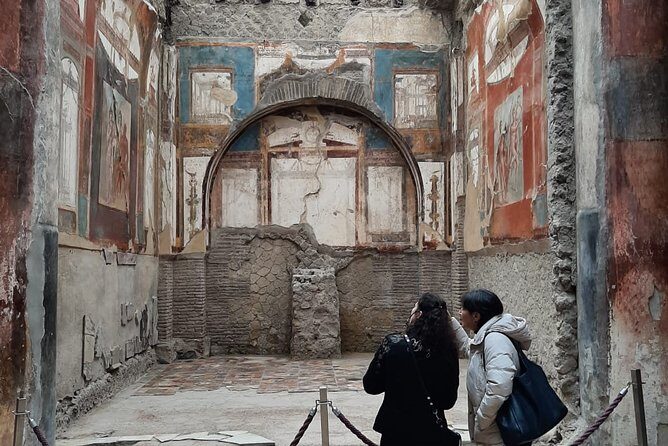
At College of the Augustales, you visit one of the few public temples excavated that you can actually visit, with mythological frescoes called out as a key feature.
This is an important “switch” in the tour because it changes the setting from private domestic spaces to a civic/public religious context. It helps connect how religion and status were practiced and displayed.
The short stop length means you’ll want to focus on the most important fresco details the guide points out, not every fragment at once.
Casa del Salone Nero: the black hall and fresco conservation
Next is Casa del Salone Nero, the house of the black hall. The tour description notes it overlooks the main street of Herculaneum and points to a Vitruvian model, with special attention on the conservation state of its frescoes.
This is one of those stops where “condition” becomes part of the story. When frescoes are preserved well, you can see what the painting was trying to do in the space, and you can understand why the room’s design mattered.
If your goal is photography, bring patience. The rooms can be tight and you’ll likely share space with other visitors in the park.
Antiquarium di Ercolano: everyday objects, jewelry, and charred wood furnishings
Finally, you can visit the Antiquarium di Ercolano at your discretion. This is a museum stop that includes both permanent and temporary exhibitions, with unique finds like jewelry, everyday objects, and charred wood furnishings.
Even if you’re not a museum person, this stop can be a strong “wrap-up.” It helps you connect what you saw outside with the objects that turn ruins into lived-in life. And because it’s optional, it gives you flexibility if your group wants more time inside or wants to leave right after the main route.
What you’ll learn about Herculaneum’s layout and preservation
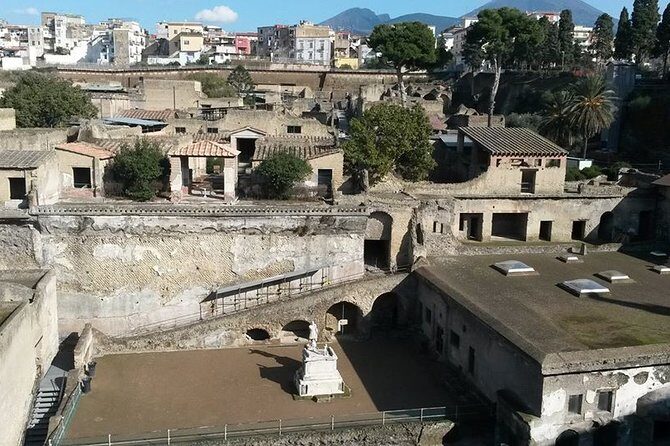
A major theme you’ll feel during this tour is that Herculaneum wasn’t uncovered in full. The tour framing notes that only part of the ancient city has been excavated, with much still buried underground. So the parts you do see tend to matter more, and they’re often private homes from the imperial age in different types.
This helps the visit click. You’re not watching a whole city being revealed block by block. You’re walking through selected rooms that were preserved and excavated in a way that lets you compare house layouts and decoration styles.
The guides make or break your Herculaneum visit
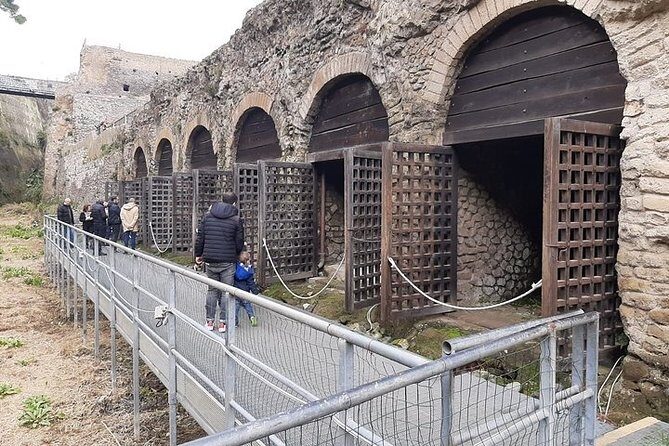
What stands out most in real-world comments is how consistently the guides get praised for explaining what you’re seeing and for keeping the tour comfortable.
I’ve seen names like Martina, Carmine, Francesca, Annalisa, Ernesto, Alessandro, and Luciano highlighted for strong English and for being patient when family members need extra time. Some guides also tailor the route to help walkers who move slower, and others are praised for coordinating with transportation plans after the tour.
That matters because Herculaneum is a place where you’ll want to ask questions. If your guide can explain why a bath room worked the way it did, why a mosaic mattered, or how a temple fresco fits the story, you’ll get more out of every minute.
Timing and comfort: small prep that pays off
The tour is short, and you’ll be outside a lot. The tour suggestion is practical: bring sunglasses, a hat, comfortable clothing, and comfortable shoes.
On hot days, you’ll feel the sun early. On cooler days, plan for uneven surfaces and some shade. Also, if you’re visiting in a group that includes kids, elderly family, or anyone using a stroller, wear good shoes and be ready for frequent pauses so everyone can process what’s happening.
Who this private tour suits best
This tour is a strong fit if you:
- want a 2-hour, high-focus visit instead of a long self-guided wander
- care about understanding art and architecture details like mosaics and frescoes
- prefer a private setting with an expert guide who can adjust to your pace
It’s also a good choice if you only have one day around Naples and you’re debating Herculaneum versus Pompeii. This tour format is designed for clarity and context, and it includes explicit comparison themes some guides use to connect the bigger story of the area.
Should you book? My take
Book this private tour if you want more than photos. If you like your travel with explanation—how spaces worked, what decoration signaled, and why certain objects matter—this is a very efficient use of time.
Skip it or rethink your plan if you already know the site deeply and you really want long, independent wandering with no structure. In a short 2-hour window, you’ll have to trust the guide’s focus, and you won’t get the kind of free time you might want.
For most visitors, this is a smart way to see Herculaneum at a human pace, with the kind of attention that makes the site’s details land.
FAQ
How long is the private walking tour?
It lasts about 2 hours.
How much is the tour, and what about the entrance fee?
The tour is $102.12 per person. The Archaeological Park of Herculaneum entrance ticket is €16 per person (free under 18 with document).
Is this tour private?
Yes. It’s a private tour, so only your group participates.
What language is the tour offered in?
The tour is offered in English.
Where do we meet for the tour?
You meet at the Archaeological Park of Herculaneum, Corso Resina, 187, 80056 Ercolano NA, Italy. The tour ends back at the meeting point.
Is there a mobile ticket?
Yes, the experience includes a mobile ticket.
What is included in the price?
Included are a licensed tour guide expert in archaeology, the private tour, and taxes.
What should I bring or wear?
The recommendation is sunglasses, a hat, comfortable clothing, and comfortable shoes.
Is it okay for everyone to join?
The experience notes that most travelers can participate, and service animals are allowed.