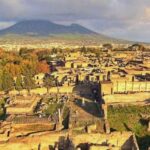
REVIEW · NAPLES
Pompeii and Herculaneum day trip
Book on Viator →Operated by A DRIVE INTO THE BLUE · Bookable on Viator
Pompeii and Herculaneum in one day is a knockout. The big win here is the private driver from Naples, so you’re not stuck waiting on a bus schedule. I also like the option to add a professional ruins guide at Pompeii-style stops, which helps turn the stones into real daily life.
The main consideration is cost creep: the headline price is only part of the story. You’ll also need to budget entry fees (Porta Marina and the main ruins/monuments ticket add-ons), plus lunch on your own.
In This Review
- Key things I’d pin to the top
- Naples to Pompeii and Herculaneum: how the day stays sane
- The first gate you’ll walk through: Porta Marina meeting point and Pompeii’s opening stretch
- Pompeii’s civic heartbeat: Foro di Pompei and Via dell’Abbondanza
- Foro di Pompei (Civil Forum)
- Via dell’Abbondanza (Street of Abundance)
- Theatre life, public baths, and that street-level look
- Teatro Grande area
- Stabian Baths (Terme Stabiane)
- Houses that show you status: Casa del Menandro and Lifestyles
- Casa del Menandro (rich house focus)
- Lupanar (the brothel)
- Pompeii’s small museum stop: Antiquarium
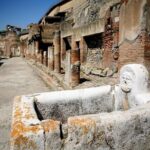
- Why Herculaneum hits different: Parco Acheologico di Ercolano
- Herculaneum interior moments: houses, main street, and public buildings
- House of the Hotel
- House of the Wooden Sacellum (wooden tramezzo detail)
- Decumano Massimo (main street)
- College of the Augustales
- Suburban Baths
- Antiquarium di Ercolano
- Price and value: what $429.69 buys (and what doesn’t)
- How to get the most out of your day (without turning it into a chore)
- Should you book this Pompeii and Herculaneum day trip?
- FAQ
- How long is the Pompeii and Herculaneum day trip from Naples?
- What’s the pickup like for this tour?
- Is this tour private or shared?
- Are entrance fees included in the price?
- Is there a guide included?
- What does the transportation include?
- Is lunch included?
- What ticket format do I receive?
- Do I need to wear a mask during the car ride?
Key things I’d pin to the top
- Private pickup in Naples: straight from your accommodation when the car can reach it, otherwise the closest accessible spot
- Two sites with different vibes: Pompeii’s bigger, flashier ruins plus Herculaneum’s smaller, better-preserved feel
- Optional ruins guiding: choose the guide option if you want someone to steer you through the maze of streets and buildings
- Time-efficient stop design: the day is packed with short-but-meaningful looks at major areas and houses
- A vehicle with comfort built in: air-conditioned transport and bottled water for the ride
- Family-friendly pacing: the best guide moments usually come from adding stories that work for kids too
Naples to Pompeii and Herculaneum: how the day stays sane
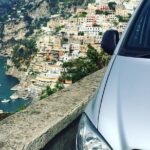
This is a one-day hit of two UNESCO-level Roman cities, designed to feel manageable. The format is simple: you get round-trip transportation from Naples (including Naples hotels, ports, train station, or airport pickup/drop-off), then you spend the day on your feet inside the sites.
What really matters to your comfort is the timing and flexibility. With a private driver, you can move at the pace of your group—stop when you spot a photo angle, linger if something catches your eye, and skip a stop if the walking or crowd energy is too much. The day is still busy, but it doesn’t feel like a factory line.
Also, this tour runs in English, and you’re traveling in a vehicle with air-conditioning and bottled water. That sounds basic, but on a warm Italian day it keeps the day from feeling like a slog before you even reach the ruins.
One more detail: it’s a private tour/activity, meaning only your group goes along. That’s a big quality-of-life upgrade versus shared group tours where you’re constantly waiting for a straggler.
You can also read our reviews of more tours and experiences in Naples
The first gate you’ll walk through: Porta Marina meeting point and Pompeii’s opening stretch
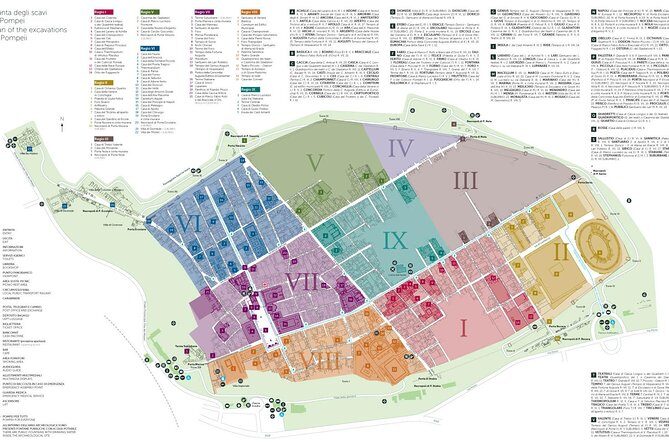
Your day starts at Porta Marina, where you meet a guide after the tickets are handled. The entry fee for Porta Marina is not included, so plan for that purchase ahead of time.
Pompeii’s entrance experience can make or break your mood. If you arrive early and get oriented fast, the whole city feels more legible: gates, streets, and big public buildings start to connect in your head instead of staying as random walls and doorways.
At this first stop, the idea is to get you into the rhythm of Pompeii right away. You’re led into the ruins with someone who can point out what to look for—street layout, building purpose, and what different areas were used for. If you chose the option that includes a professional guide at the ruins, this part is especially valuable, because Pompeii punishes guesswork. A small bit of context turns every corner into a clue.
Possible drawback: because this first portion depends on ticket purchase and the guide’s timing, it’s smart to show up ready to go. If you want a slow start with coffee, build in extra buffer time before pickup.
Pompeii’s civic heartbeat: Foro di Pompei and Via dell’Abbondanza
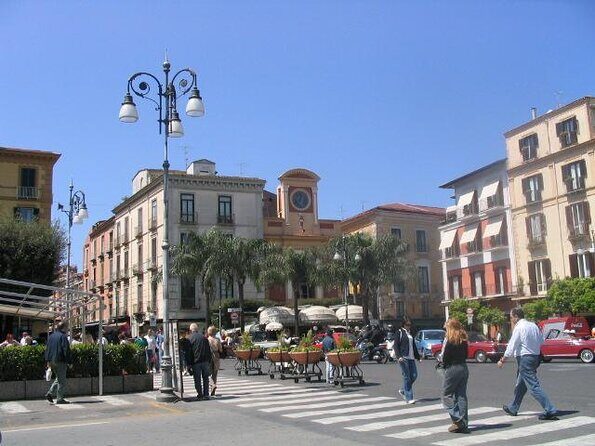
Next you’ll spend short time blocks in two of Pompeii’s key “daily life” zones.
Foro di Pompei (Civil Forum)
This is the city core for administration, justice, markets, and civic worship. Even in a ruin, you can feel how the forum functioned: it’s where people gathered for business and power, not just sightseeing. When your guide frames it this way, it stops being trivia and starts being a map of the city’s social engine.
This stop is quick—think about 10 minutes—so your best move is to look for the big picture rather than try to absorb every carved detail.
Via dell’Abbondanza (Street of Abundance)
Then you shift to one of Pompeii’s prosperous streets. Via dell’Abbondanza is the kind of place that helps you understand how money and commerce looked in Roman life: a main thoroughfare where shops and activity would have flowed.
This is where your group benefits from the private format. If you want to step in and out for photos, you can. If you’d rather keep momentum, you can walk through with fewer detours.


Theatre life, public baths, and that street-level look
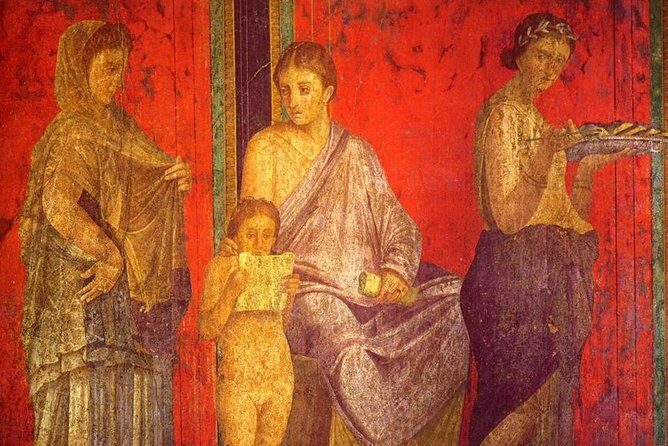
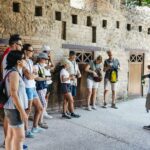
Pompeii isn’t only grand houses. It also shows you how people spent leisure time and washed up—often in very public ways.
Teatro Grande area
You’ll get time around the theatre zone, including the Large Theatre, the Odeon (small theatre), and the Quadriporticum. In a city this size, entertainment wasn’t a separate universe—it was a social hub. This stop helps you picture Pompeii as a place where public events brought strangers together.
Quick heads-up: theatre areas can get visually busy with ruins in every direction. If you have the guided option, ask your guide to point out what each structure was for, so you’re not just admiring “cool old stuff.”
Stabian Baths (Terme Stabiane)
A Roman bathing complex isn’t just bathrooms. It’s a social system: exercise, conversation, relaxation, and business chatter. Stabian Baths are the oldest and largest of Pompeii’s public baths, so they’re a strong stop for understanding how central bathing was to everyday life.
This is a short stop, but it’s the kind where you can learn something quickly—how the buildings were arranged, what public areas would have looked like, and why people built these spaces so prominently.
Houses that show you status: Casa del Menandro and Lifestyles
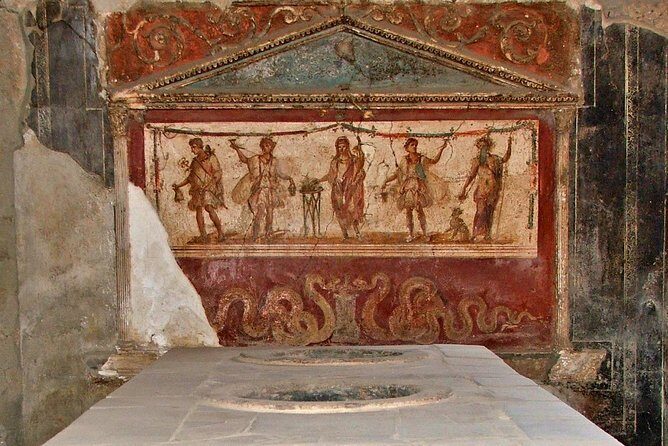
Pompeii’s houses can be shocking in the best way. A home like Casa del Menandro gives you a sense of wealth and taste—especially because it’s described as one of the richest houses in Pompeii for architecture, decoration, and contents, covering about 1,800 square metres.
A short house stop is still worth it, because it’s less about reading every room and more about understanding the concept: private domestic life, social display, and how homes connected to the street.
Casa del Menandro (rich house focus)
The biggest value here is perspective. When you’ve seen the forum and the prosperous street, then you walk past a luxurious house, you start to see how different classes lived side by side in the same city footprint.
Lupanar (the brothel)
Then comes a very specific stop: the Lupanar, the purpose-built brothel, known for erotic wall paintings. This can be uncomfortable for some visitors, but it’s also historically specific. It shows you the realities of urban life, including the places where people paid for services.
If you’re traveling with kids, I’d think about your comfort level and the group tone. The best guides can handle it in a way that stays factual and age-appropriate, and the tour style here can work for families when the guide adapts to the group.
Pompeii’s small museum stop: Antiquarium
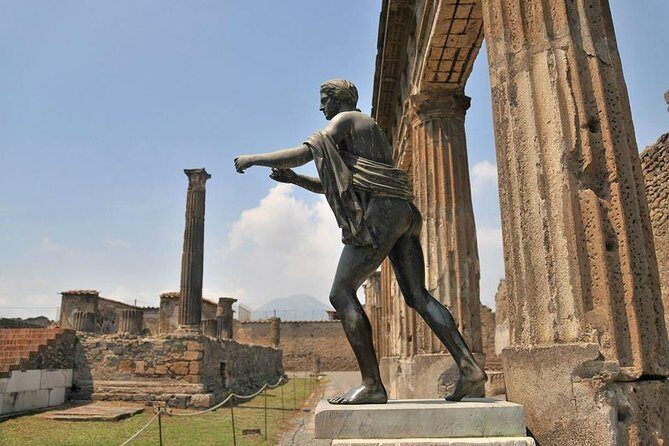
You’ll also have a visit to Pompeii’s Antiquarium, a museum-like stop designed to give you a broader context beyond what you see outside. You can see archaeological discoveries representing daily life, casts of victims from the Mount Vesuvius eruption, and exhibits showing Pompeii’s settlement history before it became a thriving Roman city.
This is a strong “pause” in the middle of the day. Ruins can become a visual blur if you only walk and photograph. A museum stop gives your brain a reset button and a few story anchors you can carry forward into Herculaneum.
Why Herculaneum hits different: Parco Acheologico di Ercolano
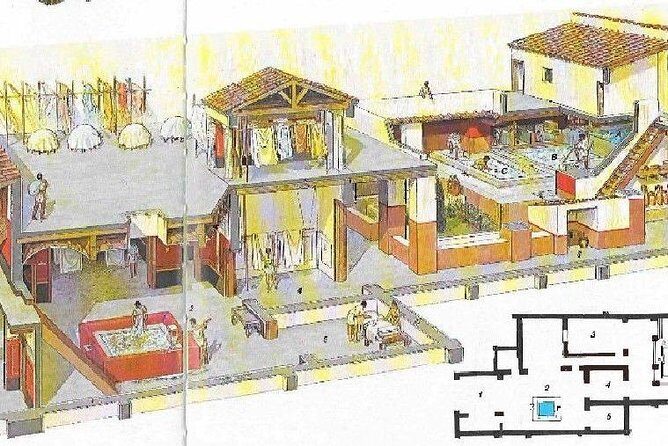
After Pompeii, your tour shifts to Herculaneum in Parco Acheologico di Ercolano. The entry fee for Herculaneum is not included, so include it in your budget.
Here’s the core reason Herculaneum often feels more intense. It’s smaller and less famous than Pompeii, but better preserved due to the volcanic materials that covered the town. Pompeii’s drama is huge-scale and street-network chaos. Herculaneum’s drama is more intimate. The city looks like it was interrupted, not just erased.
You’ll also learn (or be reminded) that Herculaneum was destroyed and buried by lava and mud during the Mount Vesuvius eruption in AD 79, alongside Pompeii, Stabiae, and Oplontis. It’s a UNESCO World Heritage Site, listed in 1997.
Herculaneum interior moments: houses, main street, and public buildings
Herculaneum’s stop list is designed to give you a guided tour of “how the city worked,” without turning the day into one long crawl.
House of the Hotel
You’ll see a large house for wealthy residents, called the House of the Hotel in this tour flow. Even in a brief visit, it helps connect Herculaneum’s architecture to the social class it housed.
House of the Wooden Sacellum (wooden tramezzo detail)
This stop is where you get a very specific, human detail. The house dates to the pre-Roman age around the 1st century BC. The standout moment described is a wooden partition/door (a kind of folding door) that was charred from the eruption, plus bronze rings where lamps were rested.
This kind of detail is why a ruins guide can matter. Without context, it’s easy to stare at a wall. With context, you’re picturing how a room functioned and what residents did in that space.
Decumano Massimo (main street)
Then you’re back outside on the main street—Decumano Massimo. A street stop might sound boring, but it’s how you reorient. When you understand where the main artery runs, the smaller buildings and houses make more sense.
College of the Augustales
Next is the College of the Augustales, built at the end of the 1st century BC (around 14 BC) in the Augustan period. It was financed by two brothers and included an inauguration banquet described in an epigraph.
Even if the stop is short, it adds a layer: this wasn’t just homes and shops. It was organized civic and religious life tied to the ruling era.
Suburban Baths
Then you’ll see the suburban bathhouse, another reminder that public bathing wasn’t a side activity. It was part of daily rhythm.
Antiquarium di Ercolano
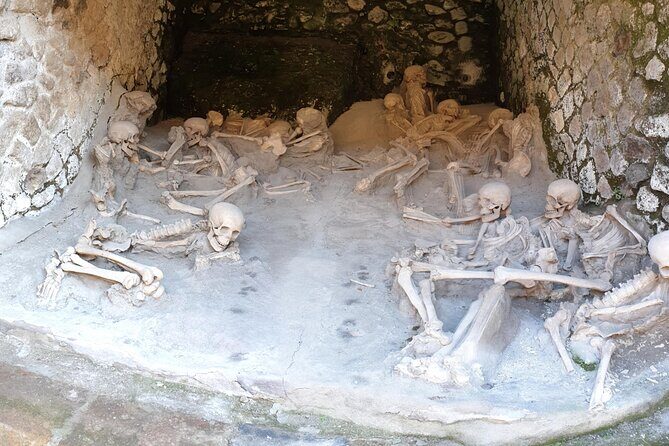
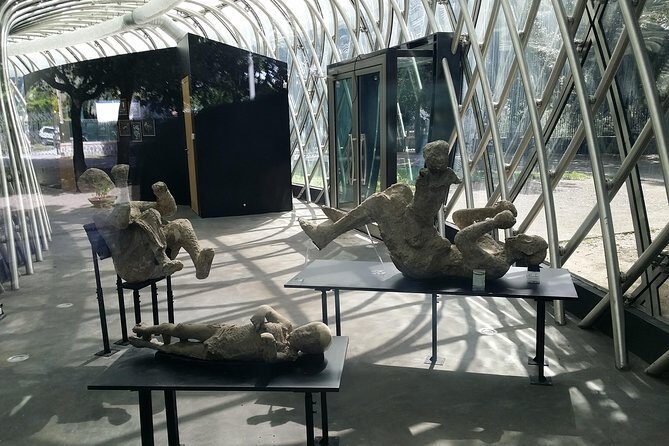
Finish with the Antiquarium di Ercolano, a museum stop with an amazing collection of objects found next to the skeletons. This is emotional, and it can be intense. It’s also one of the clearest ways to connect what you walked through outside with what the eruption literally left behind.
If you’re sensitive to heavy scenes, it’s worth mentally preparing for that part of the day. The rest of the tour sets up the story; this museum brings it to the surface.
Price and value: what $429.69 buys (and what doesn’t)
At $429.69 per person, you’re paying for logistics and quality, not just entrance to two archaeological parks.
Included features that drive the value:
- Private transportation in an air-conditioned vehicle
- Hotel/port/train station/airport pickup and drop-off across Naples
- Bottled water
- A private group
- Mobile ticket support
- English-speaking operation
- Professional guide at ruins if you select the guide option
What isn’t included:
- Lunch (you’ll need to plan for your own meal)
- Access fees for monuments/ruins (listed as €34.00 per booking)
- Porta Marina entrance fee (€18 per person)
- Herculaneum main site entrance fee (not included)
So the real cost is: your tour price plus the admission add-ons, plus lunch. Once you add those entry fees, the trip becomes more comparable to other high-quality private formats.
Is it worth it? For me, this type of day trip pays off if you want:
- A smooth Naples-to-ruins transfer without stress
- Flexibility to match walking pace and attention span
- A guide who can explain the “why” behind what you’re seeing
If you’re the type who enjoys reading maps and facts on your own, you might spend less by doing a self-guided approach. But if you want your day to run cleanly and feel “explained,” this price can make sense.
How to get the most out of your day (without turning it into a chore)
Pompeii is huge. Even when you cover only the highlights, you’ll still do a lot of walking and absorbing in a short time.
Here’s how I’d plan your mindset and your packing:
- Wear shoes you can trust for uneven stone.
- Bring water habits. Bottled water is provided, but you’ll still want to sip.
- Keep your phone power topped up for photos, but don’t spend all your time filming.
- If you care about crowd levels, try to use the start time effectively. One strong tip from a guide experience in this area is timing the first site when it opens, because it changes how tolerable Pompeii feels.
Small note on health rules: the tour states that, under Italian law at the time of travel, you must wear a mouth mask when traveling in a private vehicle.
Also, pets are addressed only in one way here: service animals are allowed. If you’re traveling with a different kind of animal, you’d want to check before booking.
Should you book this Pompeii and Herculaneum day trip?
Book it if you want a private, flexible day that links Pompeii’s major civic and street-life areas with Herculaneum’s more preserved, more intimate feel. This is especially a good fit when you value interpretation—someone helping you connect the forum to the houses, the baths to daily life, and the museums to what the eruption left behind.
Skip it or compare alternatives if:
- You dislike the idea of paying extra for multiple admission fees
- You want a long, slow museum-focused visit (this is more “see key parts fast”)
- Your group can’t handle heavy moments at the Antiquarium di Ercolano, where objects are shown next to skeletons
One practical final tip: because this is private pickup, double-check that your contact details are correct and that you know where the car can meet you. That’s the difference between a smooth start and an avoidable headache.
If you get the guide option, you’ll likely get the best experience—especially for families, mixed ages, or anyone who benefits from someone steering attention to the right details.
FAQ
How long is the Pompeii and Herculaneum day trip from Naples?
It runs about 6 to 7 hours.
What’s the pickup like for this tour?
Pickup is offered from Naples hotels, ports, train station, or airport. If streets allow, pickup can be straight from your accommodation; otherwise, it goes to the nearest accessible spot for the car.
Is this tour private or shared?
It’s a private tour/activity, so only your group participates.
Are entrance fees included in the price?
No. Access fees to ruins and monuments are listed as €34.00 per booking, Porta Marina is €18.00 per person, and the main Herculaneum site entry is not included. Some individual listed stops are marked free or included, but you should plan for the non-included site fees.
Is there a guide included?
A professional guide at the ruins is included only if you choose the option that includes the guide. The tour operates in English.
What does the transportation include?
You get air-conditioned vehicle service and private transportation, plus bottled water.
Is lunch included?
No, lunch is not included.
What ticket format do I receive?
You get a mobile ticket.
Do I need to wear a mask during the car ride?
The tour notes that, according to current Italian laws, passengers must wear a mouth mask when traveling on a private vehicle.