REVIEW · NAPLES
Central Naples Bike Tour
Book on Viator →Operated by Biketour Napoli · Bookable on Viator
Naples by bike is pure momentum. I like that this tour links the big squares and landmark churches with real street-level motion, so you feel like you are moving through the city, not just looking at it. My favorite part is the traffic-smart guiding, which keeps you calm as you weave through crowded streets, and I also love the Posillipo and sea-side perspectives you can only really get this way. One consideration: the ride can feel like a workout on a regular bike, especially if you skip the e-bike option and hit the hills.
The route mixes world-famous scenery with the kind of local detail you miss on foot: the ancient street grid (the Decumani and cardini), the Spanish Quarter area, and the long stretch of waterfront that Naples locals actually use. You’ll stop often—then bike between stops just long enough to keep the story flowing.
At $64.10 for about 3 hours, it is solid value if you want guided history plus fast, efficient sightseeing without the stress of figuring out traffic or parking. Expect a small group (up to 20), helmets included, and a guide who talks—sometimes a lot—so you get context, not just directions.
In This Review
- Key Things You’ll Notice On This Central Naples Ride
- Why This Naples Bike Tour Feels Different From Walking
- Starting Point at Bicycle House: Quick Reality Check Before You Ride
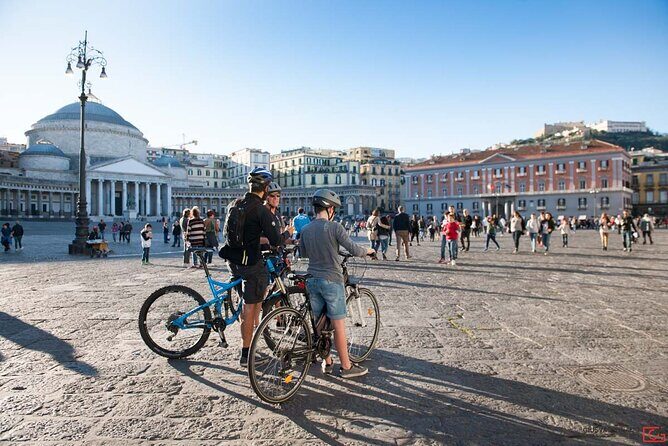
- Piazza del Plebiscito: The Big Square That Sets the Stage
- Castel dell’Ovo and Megaride Legends: One Castle, Many Eras
- Palazzo Reale: Royal Power in Spanish, Austrian, Bourbon, and Savoy Hands
- Gesù Nuovo: Baroque Theater in Marble and Light
- Cycling Through Naples’ Ancient Street Grid: Decumani and Cardini
- Via Toledo and the Spanish Quarter: Street Life You Can Feel
- Lungomare Caracciolo: The Waterfront That Changes Your Pace
- Piazza del Municipio and Archaeology Underfoot
- Traffic, Hills, and Bike Choice: What to Plan For
- Value Check: Is $64.10 a Smart Buy?
- Who This Tour Fits Best
- Should You Book the Central Naples Bike Tour?
- FAQ
- How long is the Central Naples Bike Tour?
- How much does it cost?
- What is included in the tour price?
- Is food included?
- Where does the tour start and end?
- Do I need to book an e-bike in advance?
- Is the tour offered in English?
- How big are the groups?
- What is the cancellation policy if the weather is bad?
Key Things You’ll Notice On This Central Naples Ride

- Safety first in chaotic streets: guides focus on how to move with traffic, not just where to point the camera
- Baroque and royal stops in quick hits: Palazzo Reale and Gesù Nuovo are big visual payoffs for the time spent
- Sea + viewpoints, not just old stone: the waterfront and hill-area views change how Naples feels
- Ancient city grid explained on the move: the Decumani and cardini turn modern streets into a living map
- E-bike can be the comfort upgrade: multiple guides push it as the easiest way to handle hills and distance
Why This Naples Bike Tour Feels Different From Walking
Naples can be loud and crowded. A bike tour is not a magic spell that makes the city quiet—but it does change how you experience the noise. Instead of stopping every few minutes, you cover ground while still getting frequent story stops, so your afternoon feels efficient without feeling rushed.
I especially like that you get a real mix: formal landmarks like Piazza del Plebiscito and Palazzo Reale, plus dramatic architecture like Gesù Nuovo, plus the sea-facing vibe of Lungomare Caracciolo. It is the kind of combination that makes Naples click. One moment you’re reading the city’s layers; the next moment you’re gliding along the waterfront.
The other big plus is the guide’s job: handling navigation and guiding you safely through tight spots. In the best versions of this tour, that skill is obvious fast. People rave about guides who keep the group together and help you cross busy areas without panic.
You can also read our reviews of more cycling tours in Naples


Starting Point at Bicycle House: Quick Reality Check Before You Ride
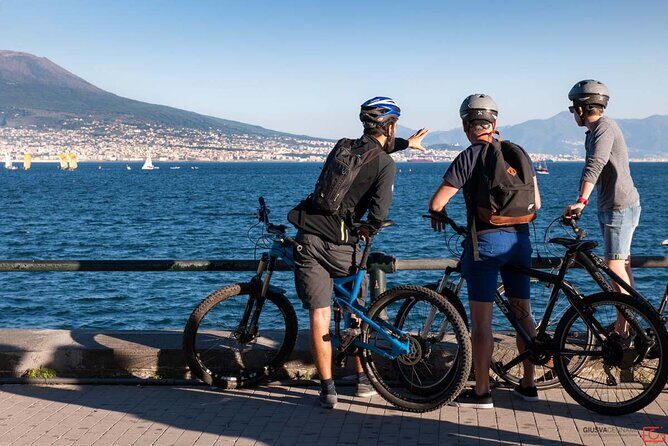
You meet at Bicycle House at Galleria Principe di Napoli, 27/28, 80135 Napoli. The tour runs about 3 hours, and it ends back at the meeting point.
This matters for two reasons.
First, the early part of Naples cycling can feel intense—busy streets and lots of pedestrians. Even if you are comfortable on a bike, you’ll want a calm mindset at the beginning. Several people highlight that once you get away from the most congested starting zone, the ride feels smoother.
Second, you’ll want to be ready for a ride that is practical, not leisurely. The included helmet is provided, but some reviews mention that equipment condition can vary (old helmets, occasional bike mechanical issues). The bikes are generally fine if you get a quick check before you roll.
Piazza del Plebiscito: The Big Square That Sets the Stage
Your first stop is Piazza del Plebiscito, one of Naples’s most important squares. This is a great kickoff because it is tied into both the historical center and the routes that lead toward the sea.
In about 10 minutes, you get a taste of Naples’s scale and power. This square is the kind of place where you can feel the city’s role as a port and capital—big, formal, and designed for public life. If you only saw Naples from side streets, you might not understand how grand the city can look when it decides to go monumental.
Practical note: it’s a stop, not a museum visit, so bring your eyes. You’re collecting visual anchors for what comes next.
Castel dell’Ovo and Megaride Legends: One Castle, Many Eras
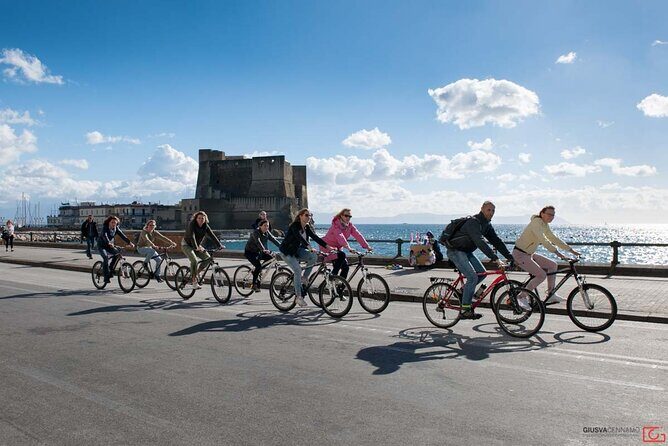
Next up is Castel dell’Ovo, on the island of Megaride. You get more than a photo stop here. This place carries layers of Naples myth and power.
The tour description connects it to a legend about Parthenope, the mermaid whose story says her body washed ashore here. Then it shifts into the long timeline: ancient settlement beginnings, wealthy Roman-era residence building associated with Lucullus, monastic life, military use, and later castle construction under the Normans and the Angevin era. Even the prison role comes up, including imprisonment of Romulus Augustulus and other political prisoners from later movements.
This stop runs about 20 minutes and is free to enter. The payoff is that you learn how one shoreline location can keep getting re-purposed. Naples loves re-use—of walls, buildings, and the meaning of places.
If you’re prone to getting bored by “just another castle,” this one helps because the story keeps moving through different eras, not just one reign.
Palazzo Reale: Royal Power in Spanish, Austrian, Bourbon, and Savoy Hands
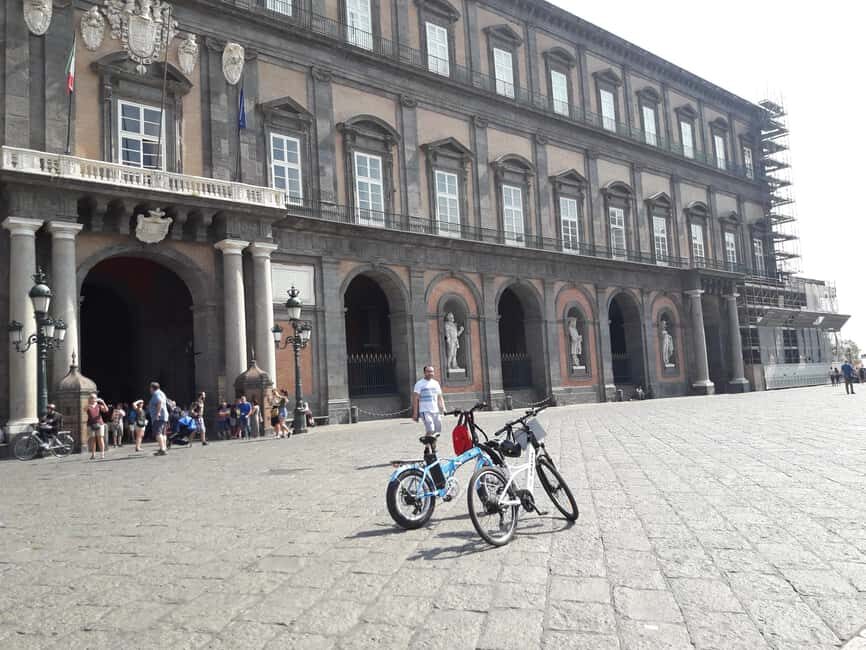
Your third stop is Palazzo Reale (the Royal Palace of Naples). Here you’ll see how a city on the Mediterranean keeps switching rulers—and how the palace stays central.
What you’re looking at is connected to early 1600s Spanish occupation plans, with design credited to Domenico Fontaine. The building then grows through later centuries, with decoration and expansion in the 18th and 19th centuries.
This stop also gives you a clean, historical timeline: the palace serves as a seat of monarchical power in Naples and southern Italy from roughly 1600 to 1946, moving through Spanish, Austrian, Bourbon, and Savoy eras. There are even statues added to the facade representing founders and notable sovereigns tied to the dynasties.
Time here is short—about 5 minutes—so treat it like a “see the face” stop. You’re not reading every detail today. The value is learning what the palace represents, then riding on with that in your head.



Gesù Nuovo: Baroque Theater in Marble and Light
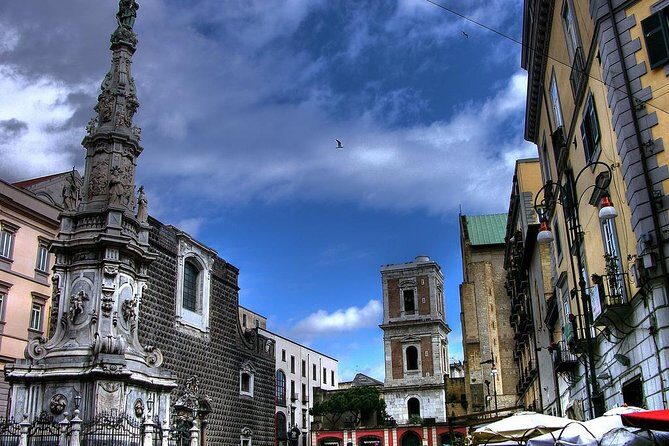
Then comes one of the most visually satisfying stops: Chiesa del Gesù Nuovo in Piazza del Gesù.
This church is famous for its Baroque design, including a distinctive facade with diamond-shaped stonework and a richly decorated interior using marble. The story here is also a quick lesson in how Naples re-uses important sites: it began as a palace (built in 1470 for Roberto Sanseverino) and later became a Jesuit church in the 1580s.
You also get a sense of scale in the architecture: a plan described as a Greek cross, with a central dome and four smaller side domes. The interior decoration includes illusion-style uses of colored marble, plus details like fresco work by major Neapolitan artists such as Francesco Solimena.
Again, time is tight—about 5 minutes. But short stops work here because the church is visually loud. If you like design, you’ll feel it right away.
Cycling Through Naples’ Ancient Street Grid: Decumani and Cardini
After the church stops, the tour shifts from “single building” sightseeing into understanding the city plan. You’ll ride along the historic east-west backbone of ancient Neapolis, described as the main Decumanus Maggiore, intersected by north-south cardini.
The key idea: modern streets often trace that old grid. So you start seeing Naples like a map with a history underneath it—San Pietro a Maiella on one end, cross-road connections like via San Gregorio Armeno, then through areas around Via Duomo and toward the former courthouse area (Tribunale).
This is where the tour becomes more than a checklist. You learn why the city’s layout feels the way it does—why some streets feel like they lead somewhere important, and why other lanes feel like they were designed for movement, not random wandering.
If you like “how cities work,” this part is worth paying attention to, because it changes how you’ll walk later.
Via Toledo and the Spanish Quarter: Street Life You Can Feel
Next, the tour points you toward Via Toledo, described as a lively main road with stores and civil and religious buildings. This area includes the Spanish Quarter, a neighborhood built in the early 1500s by Viceroy Pedro Álvarez de Toledo.
Even without getting stuck inside a museum, this stretch helps you understand Naples as a living city. You see where locals shop, where the daily rhythm shows up, and how the street grid shapes movement and crowd flow.
One thing I’d watch here: keep your focus on the guide’s cues and group spacing. It is easy to stare at shop windows or side-street activity—right when traffic conditions demand your attention.
Lungomare Caracciolo: The Waterfront That Changes Your Pace
Then you get a big mood shift: Lungomare Caracciolo, Naples’s waterfront promenade. This part is named after Via Caracciolo, and it runs along the sea with plenty of landmarks along the way.
The route connects areas like Villa Comunale and Riviera di Chiaia, and it can pass by points including Santa Lucia, Borgo Marinaio with its small port feel, and the general area of Castel dell’Ovo. It also reaches toward the Posillipo ascent, bringing you up from the water-side view toward higher ground.
This is where you get something bikes do well: you maintain forward motion while the scenery keeps rolling past. It can feel easier to breathe after you’ve been in dense streets.
It is also one of the best parts for photos, but don’t forget: your bike is part of the viewing system. Keep your speed controlled and don’t stop suddenly.
Piazza del Municipio and Archaeology Underfoot
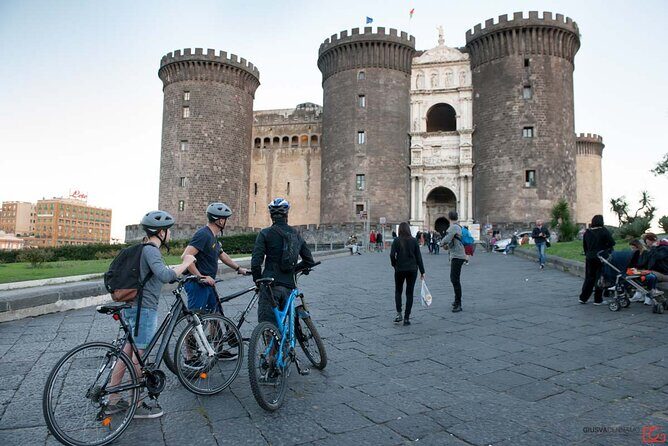
The last big stop is Piazza del Municipio, one of Europe’s larger squares. You get its role in city life—close to spots like the marina area, Maschio Angioino, San Giacomo palace, the town hall, and a connection to Via Toledo.
But the most interesting detail here is what’s under the square. During construction of Metro Line 1 and Line 6, excavations uncovered around 3000 archaeological finds, spanning Roman times to 19th-century structures. The tour highlights amphorae, ships, caravels, and ancient walls, plus a Roman citadel and spa complex.
This is the kind of stop that makes Naples feel real. You’re not just looking at the past from a distance—you’re looking at a present-day city where layers keep getting uncovered.
Your time here is about 10 minutes, and the entrance is free.
Traffic, Hills, and Bike Choice: What to Plan For
Here’s the honest practical take.
1) Expect real city traffic at the start. People specifically praise guides who handle it well and keep the group safe. If you’re nervous, tell yourself you’re in good hands, but still ride defensively. Stay aware and follow the guide’s cues.
2) Posillipo hills can be the make-or-break factor. Several people recommend upgrading to an e-bike because without it, regular bikes can feel like training. If you are not a regular cyclist—or if you hate arriving sweaty—consider paying the e-bike extra fee when you’re there.
3) Equipment quality can vary. A few reviews mention helmets not looking new and occasional bike issues like a brake not working well or seats needing adjustments. Before you start rolling, take 30 seconds to check your brakes and seat tightness.
Also, note the ride is about 3 hours. Some reviews frame it as more effort than a slow sightseeing spin. If you want a gentle glide, you might find the pace a bit physical.
Value Check: Is $64.10 a Smart Buy?
For $64.10 per person, you get:
- a local guide
- bicycle + helmet
- 1 bottle of water
That alone is pretty good, especially in a city where guided walking tours can pile up and where you still have to solve the logistics of getting across town.
The value gets even better if you care about doing several top sights in a short window—Piazza del Plebiscito, Castel dell’Ovo, Palazzo Reale, Gesù Nuovo, plus the waterfront and core streets. This is where biking wins: time saved without cutting out the context.
Two ways to spend smarter:
- If hills are a worry, plan to try the e-bike upgrade rather than suffering through it.
- Wear something comfortable. You do not want bike-chafing issues to take over your day.
Who This Tour Fits Best
I’d put this tour in your “yes” pile if you:
- want a guided ride that covers a lot of Naples quickly
- like history tied to specific places, not just generic talk
- are comfortable riding in crowds and mixed street conditions
- want viewpoints, especially around the bay and waterfront
I’d think twice if you:
- feel intimidated by heavy traffic and dense pedestrian zones
- are expecting a slow, easy pace with minimal effort
- rely on perfect equipment and get frustrated if you need minor adjustments
Should You Book the Central Naples Bike Tour?
If you want Naples in one afternoon—squares, baroque churches, royal palace power, ancient street logic, and sea-air views—this is a strong choice. The best guides (people named Paco, Joseph, Tino, Achille, Claudio, Luca, Patricia, Brigida, and Andrea in feedback) consistently show a pattern: they guide you safely, explain what you’re seeing, and help you move through the city rather than fight it.
Book it if you can ride with confidence and you’re okay with the idea that regular bikes may feel hard on hills. If you’re on the edge, pick the e-bike option. Naples cycling is not for timid legs—but with the right guide and bike choice, it’s one of the most efficient, enjoyable ways to see the city.
FAQ
How long is the Central Naples Bike Tour?
It runs for about 3 hours.
How much does it cost?
The price is $64.10 per person.
What is included in the tour price?
You get a local guide, use of a bicycle and helmet, and 1 bottle of water.
Is food included?
No. Food and drinks are not included.
Where does the tour start and end?
It starts at Bicycle House, Galleria Principe di Napoli, 27/28, 80135 Napoli, and it ends back at the same meeting point.
Do I need to book an e-bike in advance?
The tour offers e-bikes for an extra fee, and the payment is handled on site. The regular bike is included.
Is the tour offered in English?
Yes, it is offered in English, and it may be operated by a multi-lingual guide.
How big are the groups?
There is a maximum of 20 travelers per tour.
What is the cancellation policy if the weather is bad?
You can cancel up to 24 hours in advance for a full refund. The experience requires good weather, and if it is canceled due to poor weather, you’ll be offered a different date or a full refund.