REVIEW · ROME
Rome: The Original Fiat 500 Self-Drive Tour
Book on Viator →Operated by Rome 500 exp. · Bookable on Viator
Rome is better at 20 miles an hour.
This self-drive Fiat 500 tour turns the city into a moving photo set, with a vintage candy-colored Cinquecento and scheduled stops that keep things easy to follow. I especially love the soft-top open-air feel and the mix of big names plus smaller spots you’d miss on foot. The main drawback to plan for: the cars are manual transmission, so if you do not have real experience, the company can refuse the drive.
You meet in central Rome, get a safety briefing, and roll out as a convoy behind your guide’s car. You’ll cover a lot of classic landmarks in one morning while also threading through quieter roads that bigger vehicles can struggle to reach.
In This Review
- Key things to know before you go
- A Candy-Colored Fiat 500 makes Rome feel personal
- Manual driving in Rome: fun if you practice a bit
- Where you start at Palazzo Manfredi and how the tour flows
- Terme di Caracalla to the Aventine Keyhole: big sights with quick wins
- Circus Maximus and Janiculum Terrace: the Rome postcard moments
- Porta San Paolo, the pyramid, and the hill of broken vases
- Trastevere in a Fiat 500: where the narrow streets do the talking
- Porta San Sebastiano and the value of a 3-hour overview
- Should you book the Fiat 500 self-drive tour?
- FAQ
- Is the tour self-drive, and can I drive the Fiat 500?
- Is the Fiat 500 automatic?
- What is the tour duration?
- What does the tour cost?
- Where do we meet and where does it end?
- What language is the tour in?
- What is included in the price?
- What is not included?
- How many people are in the group?
- What age limits apply?
- Are there height and weight limits for passengers?
Key things to know before you go
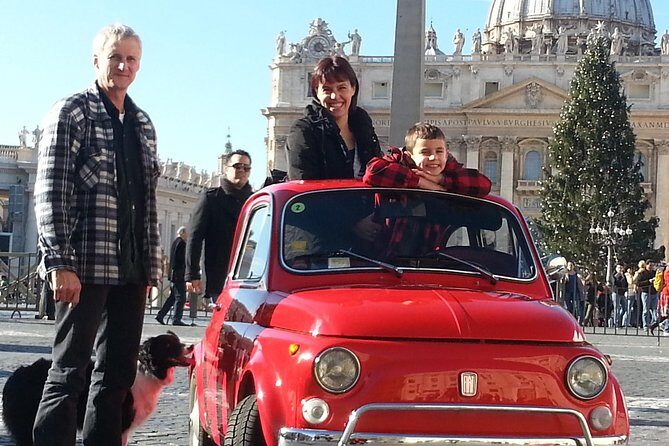
- Small-group style: up to 10 people, and you may be split into separate Fiats for larger groups.
- Open-top experience: the roof is made for sun and fresh air during the drive.
- Manual car requirement: drivers need to be 18+ with a valid EU license or an International Driving Permit.
- Photo-ready stops: frequent breaks for photos and videos, including a free phone-camera photo shoot.
- Sweet spot itinerary: major ruins and viewpoints plus classic Roman neighborhoods like Trastevere.
- Comfort limits matter: the car is small, so there are height and weight limits for passengers.
A Candy-Colored Fiat 500 makes Rome feel personal
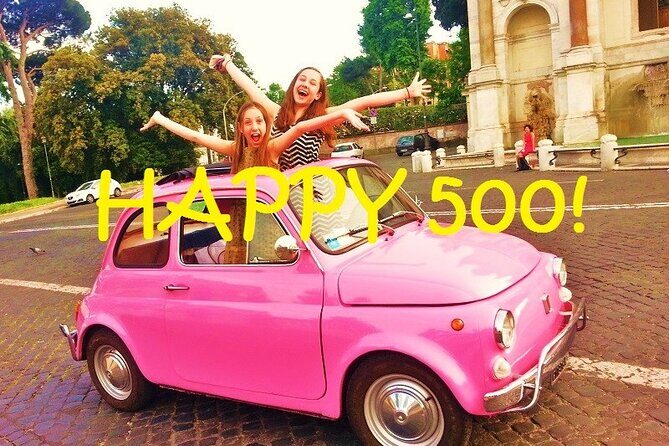
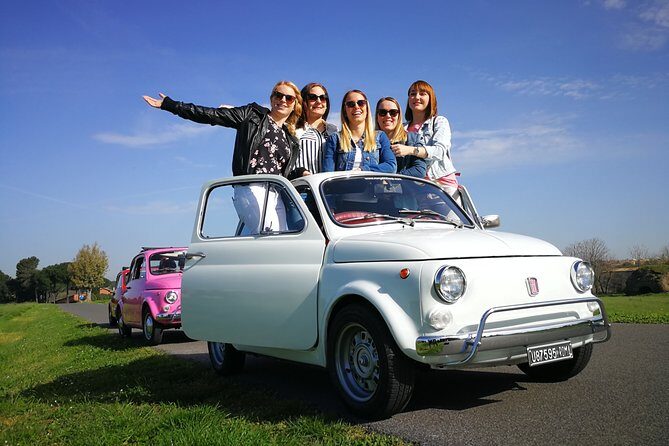
The magic here is not just that you see Rome’s icons. It is how you see them: from behind the wheel of a 1950s-era-style Fiat 500, in a slow, scoot-along rhythm that matches the city. You get sun, street sounds, and quick looks into places that feel almost too narrow for cars that size.
This is also built around momentum. Your guide leads, you follow, and you hit a sequence of stops with short time windows that keep energy high. You get enough time to frame a shot, listen to the story, and move on without spending the whole day in long lines or waiting around.
And yes, you will get photographed. This is one of those tours where lots of people notice the pink Fiat vibe. The route goes through neighborhoods and viewpoints where it is normal to pause and take in what is around you, not just rush past it.
You can also read our reviews of more tours and experiences in Rome.



Manual driving in Rome: fun if you practice a bit
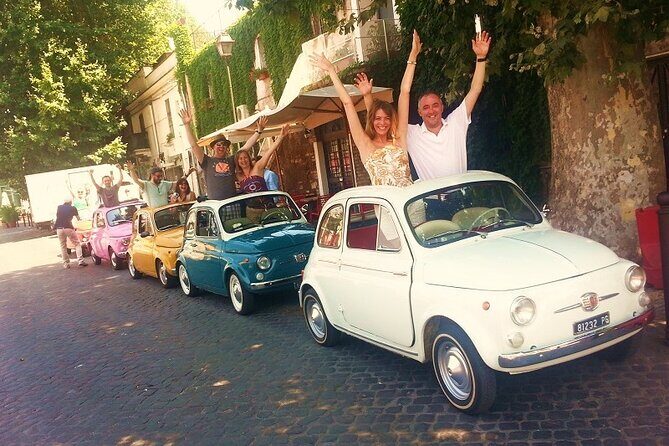
Here is the real fork in the road: the Fiat 500s in this tour are manual, not automatic. If you already drive stick, you will probably find it exhilarating rather than stressful. If you do not, it can quickly stop being a dream car and start being a white-knuckle lesson.
Before you drive, there is a safety briefing that covers how to handle the manual controls. If you need to rent in the moment, plan for patience and slower coordination at the start. This matters because the company reserves the right to refuse renting the car if you do not have enough manual experience, with no refund if they do.
Also think about comfort and fit. The car has strict limits: passenger weight must be under 220 pounds (100 kg) and you must be 6.2 feet (1.9 meters) or shorter. If you are close to those limits, it is worth taking seriously. A small car can be fine for a 3-hour adventure, but it is not a place to assume you will stretch out like in a modern rental.
Finally, if you are worried about insurance: I saw one rider mention they were asked for an extra fee for full cover right before starting. That is not in the core inclusions list, so I would check insurance terms clearly before you commit on the day.
Where you start at Palazzo Manfredi and how the tour flows
The meeting point is Palazzo Manfredi, Via Labicana 125, 00184 Roma. The tour ends back at the same starting spot, which makes the whole plan simpler if you are already near central Rome.
You meet your guide, then you are paired with your Fiat 500, with the tour paced in a convoy style. The guide’s car goes first, and you follow along quieter routes where the Fiats can fit. At each stop, you get brief but useful context, plus time to grab photos and short videos.
The schedule keeps rolling. Most stops are around 10 to 20 minutes, which is long enough for a couple of angles and listening to the main points. It also means you should come ready with your must-take shots in mind. If you want the best photos, you will get them by being ready at stop time, not by expecting a long walk between highlights.
At the end, the tour returns to the starting point. There is also a chance for gelato or coffee later on, but that part is own expense.
Terme di Caracalla to the Aventine Keyhole: big sights with quick wins
You start with Terme di Caracalla, one of Rome’s huge ancient bath complexes. What makes this stop hit is the scale and the variety: it is described as big as about 15 football pitches, and it functioned as a major health center with cold and hot baths plus spaces that sound almost like a modern campus. You might hear about Greek and Roman libraries, gyms, a theatre, seminar rooms, and even gardens and fountains.
Then you shift to photo territory with Buco della Serratura, the famous keyhole view. The keyhole twist is the point: you look through it and can see three countries lined up in the distance. The tour leans into the photo moment here. It is a great stop for a selfie-style shot from your Fiat, because the keyhole setup naturally frames the scene.
Right after that, you continue through Parco Savello, another classic setting for keyhole views and viewpoints. The value here is practical: you are getting a standout angle that is tied to Rome’s geography, and you are doing it without turning the day into a long hike.
One small consideration: because time at each stop is short, you should decide ahead of time whether you want to prioritize photos, listening, or a quick look around. The guide stories are the best payoff, so I’d aim for a balance.
Circus Maximus and Janiculum Terrace: the Rome postcard moments

Next up is Circo Massimo, the huge ancient chariot-racing venue. It is presented with some useful context: it was built about 400 years before the Colosseum, and it could hold around 250,000 spectators for races. You also get the modern connection that it is sometimes used for rock concerts, which helps anchor why the space still matters.
Even if you have seen images of the Circus before, the stop works because you understand what kind of crowds and energy the place was built for. It is not just a ruin to look at; it is an arena-type space with an atmosphere you can imagine.
After that, you go to Piazzale Giuseppe Garibaldi, the Janiculum terrace area. This is one of those Rome viewpoints where the guide can help you orient quickly. From here, the tour highlights a wide sweep: you can see the Colosseum, Pantheon, Altare della Patria, and about 100 church domes.
Photo tip: bring your camera settings ready. Viewpoints are bright, and you do not want to waste your best minutes fiddling with settings. The stop time is fixed, so you need a plan for shots. Take one wide establishing photo first, then switch to tighter compositions after you know where key landmarks sit.



Porta San Paolo, the pyramid, and the hill of broken vases
The tour keeps surprising you by mixing famous landmarks with quirky Roman details.
At Porta San Paolo, you get the story of an Egyptian-style pyramid in Rome. The description is specific: it is the 4th biggest ancient Egyptian Pyramid in Rome, built around 18 BCE, and it was meant to be the tomb of Gaius Cestius, described as a wealthy and eccentric figure. Even if you never heard this before, it is an easy way to understand why Rome feels like it collects eras instead of replacing them.
Then you head to Via Galvani, famous for the hill of broken vases. This stop is delightfully odd in the best way. The idea is that Romans made an artificial hill using pieces of vessels used to transport goods like olive oil, fish sauce, and wine. Over time, what began as a dump of broken pottery became a hill about 40 meters high with a circumference around 700 meters, and the estimate is that the hill involved terracottas from roughly 50 million vases.
This is a great stop for two reasons. First, it gives you a mental image that sticks. Second, it teaches you how to read Rome beyond the obvious monuments. It is not just marble and arches; it is also infrastructure, waste, and everyday materials turned into geography.
Trastevere in a Fiat 500: where the narrow streets do the talking
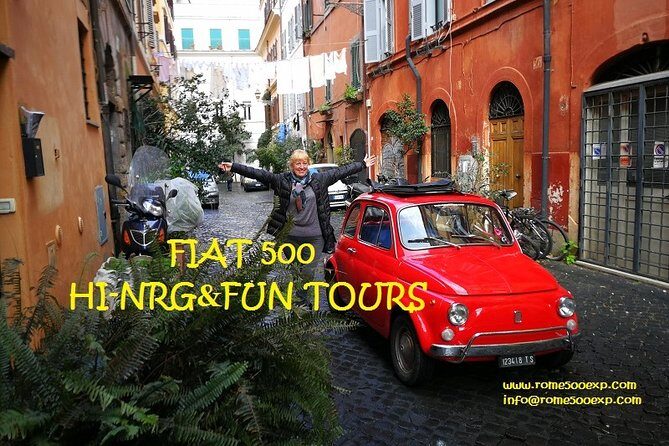
One of the most fun segments is Trastevere, a neighborhood that makes sense for a car like this. The tour’s pitch is clear: you can whiz through tiny Roman streets where a bigger car simply would not work the same way.
Trastevere is also where the Fiat’s “character” turns into entertainment. People notice you, and the route naturally creates short moments to slow down for photos, even if the tour is moving efficiently. The mix of narrow lanes and lively street life makes for great video footage, especially if you keep your phone steady while you are passing archways and walls.
Keep expectations realistic: this is a driving experience first, not a walking food crawl. If you want to linger in cafés, shops, or side streets for a long time, you will have to choose a spot and keep an eye on the convoy timing.
And speaking of timing, do not underestimate how quickly 3 hours can feel. You will be in motion, then off for short stops, then back in motion again. That fast rhythm is part of the tour’s value. It is why the highlights stack up.
Porta San Sebastiano and the value of a 3-hour overview
The final major listed stop is Porta San Sebastiano. The name alone is a strong anchor for Roman gate architecture, and the stop gives you a last chance for photos and a short guide story before the tour returns to where you started.
Now the practical question: is the price worth it? At $211.72 per person for about 3 hours, you are paying for a package that includes a professional guide, a vintage Fiat 500, a coffee drink (one espresso or cappuccino per participant), and free photo shooting using your own phone or camera. You are also paying for convenience: you do not have to plan the route between scattered viewpoints and mini-sights.
What you do not get is food beyond the coffee. Gelato or coffee later is own expense. Also, if you do not have manual experience, you may find the tour’s main selling point becomes a headache, or you may end up unable to drive at all.
So I see this as best value for people who want:
- a compact, memorable route that strings together classic Rome and smaller details
- a car-driven perspective that you cannot get from public transit or walking tours
- the kind of experience where your guide handles timing while you focus on enjoying the ride
If you are the type who hates traffic stress, double-check your comfort level with driving in a busy city. If you are excited to drive a manual in narrow streets, this is the kind of tour that can become a highlight story you tell for years.
Should you book the Fiat 500 self-drive tour?
Book it if you want Rome with motion and personality. This tour is built for people who like cars, like photo stops, and enjoy learning landmarks through a route plan instead of wandering for hours. The small-group format and convoy style help you feel guided without feeling herded.
Skip (or at least think twice) if any of these are true: you cannot drive a manual with confidence, you expect a large modern-car level of comfort, you are sensitive to being in a very small vehicle, or you want a long walking tour where you linger for half a day at one site.
If you are in the middle, I’d still give it a strong look. Guides like Alexis, Francesco, Marco, and Mike are repeatedly praised in the provided feedback for keeping things friendly, patient, and focused on making the driving part manageable. That kind of guide attention matters when you are trying something new behind the wheel.
FAQ
Is the tour self-drive, and can I drive the Fiat 500?
The tour includes use of a vintage Fiat 500. Anyone driving must be at least 18 years old and have a valid European Union driving license or an International Driving Permit.
Is the Fiat 500 automatic?
No. The car uses a manual stick/clutch. Drivers must have sufficient experience, and the company can refuse renting the car if they decide you do not.
What is the tour duration?
It is about 3 hours.
What does the tour cost?
The listed price is $211.72 per person.
Where do we meet and where does it end?
You meet at Palazzo Manfredi, Via Labicana 125, 00184 Roma, Italy. The tour ends back at the meeting point.
What language is the tour in?
The tour is offered in English.
What is included in the price?
Included are a professional guide, use of a vintage Fiat 500, one espresso or cappuccino per participant, and free photo shooting with your cellphone or camera.
What is not included?
Hotel pickup and drop-off are not included. Food and drinks besides the included coffee are not included.
How many people are in the group?
It is described as a small-group experience limited to 10 people, and you may be split into separate Fiats. The maximum is listed as 30 travelers for the activity.
What age limits apply?
Children must be at least 5 years old. The driver must be at least 18 years old.
Are there height and weight limits for passengers?
Yes. Due to the size of the car, it is not suitable for passengers over 220 pounds (100 kg) or taller than 6.2 feet (1.9 meters).