REVIEW · NAPLES
Pompeii private tour from Naples. The best choice for cruisers
Book on Viator →Operated by Nino Pezzullo · Bookable on Viator
Pompeii hits different when you have a plan. This private 5-hour trip from Naples lines up the best-preserved corners of the ancient city, with tickets handled and a route that keeps you moving (without feeling rushed). It’s designed with cruisers in mind: you meet at Stazione Marittima, get a smooth transfer in a Peugeot 3008, then finish right back where you started.
I love the cruiser-friendly logistics: the meeting point is close to the port area, and the tour ends back at the same place. I also like the highlights density—you visit major sites like the Forum, the big theatre and amphitheatre, and standout houses such as the House of the Faun and House of the Vettii, all in one outing.
One possible drawback: Pompeii is spread out and you’ll be walking on uneven ancient ground. The stop times are short for a reason, so if you want a slow museum-style crawl, you may feel the pace is brisk.
In This Review
- Key things that make this Pompeii day work
- Why this Pompeii tour is built for cruisers (and not just day-trippers)
- Meeting at Stazione Marittima and getting to Pompeii without stress
- The route, stop by stop: what you’ll see and why it matters
- Porta Marina and the city entrance that sets the tone
- The Forum: Pompeii’s daily-life power center
- Sanctuary of Apollo: faith with local roots
- Macellum: the market scene (including fish details)
- Suburban Baths: private comfort and public-style messaging
- Casa del Fauno: wealth you can read from the street
- Teatro Grande: spectacle built for drama
- Anfiteatro Romano: the oldest Roman-world amphitheatre
- Via dell’Abbondanza: Pompeii’s main shopping street
- Casa dei Vettii: prosperity, decoration, and a god-leaning theme
- Panificio di Popidio Prisco: bread production in a real bakery
- Basilica: justice and business under one roof
- Pace, tickets, and guide style: what you should expect in real time
- How long is long enough in Pompeii?
- Price and value: is $216.27 per person actually worth it?
- Who should book this Pompeii private tour?
- Booking call: should you choose this private Pompeii day?
- FAQ
- How long is the Pompeii private tour from Naples?
- What price should I expect per person?
- Is this tour private or shared?
- Where do we meet for the tour?
- What language is the tour offered in?
- What vehicle is used for transportation?
- Are admission tickets included?
- What should I know about weather and timing?
Key things that make this Pompeii day work
- Port-to-Pompeii timing: meet at Stazione Marittima and return there at the end.
- Private group comfort: only your group rides and walks together.
- Admission tickets included for the listed sights.
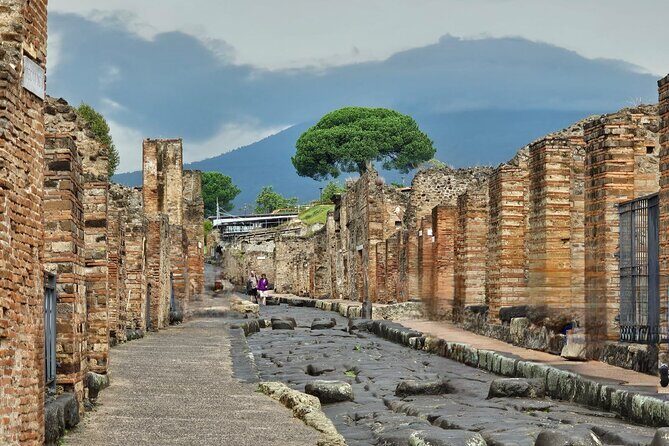
- A tight route through the city: gates, forum, temples, baths, markets, houses, theatres, amphitheatre, and streets.
- English guide service with practical communication ahead of time.
- Car choice matters: Peugeot 3008 is used, with larger vehicles available on request and for a supplement.
Why this Pompeii tour is built for cruisers (and not just day-trippers)
If you’re docking in Naples, you’re not trying to “see Italy someday.” You’re trying to maximize your hours between ship departure and ship reboarding. This tour respects that reality.
You start at Stazione Marittima (Naples cruise area) and finish back at the meeting point. That sounds obvious, but it changes the whole day. Instead of guessing bus schedules or bargaining with taxi lines, you get a ride that’s coordinated for your timeframe. The vehicle is a Peugeot 3008 (2014 model), and if you need something bigger (or more space for bags), the tour notes larger cars or mini vans can be requested for a supplement.
And because it’s private, you don’t deal with the slow shuffle of a big group tour. You can ask questions as you walk, and your guide can adjust the pace to your comfort level. In reviews, the tone is consistent: the guides—like Nino Pezzullo and even a guide named Carmen, who studied archaeology in Naples and worked on a Pompeii dig—bring real context, not just a script.
The route is also “highlights-first.” You’re not wandering for an hour trying to figure out what matters. You’re taken to the parts that make Pompeii click: public life, religion, markets, major homes, entertainment, and streets where everyday business happened.
You can also read our reviews of more private tours in Naples



Meeting at Stazione Marittima and getting to Pompeii without stress
Let’s be honest: the hardest part of a cruise excursion isn’t the destination. It’s the handoff—finding the right person, the right car, at the right time.
This experience lists Stazione Marittima as the start and end point, which reduces risk. It also notes it’s near public transportation, which is helpful if you need flexibility, and it uses mobile tickets. In reviews, people liked that pick-up was done just outside the cruise terminal, with a short walk to the car—exactly what you want when you’re balancing time and jet lag.
Communication seems to be a priority. One review praised a guide who sent a WhatsApp video with their location ahead of time, which is the kind of detail that prevents the classic “Where are you?” panic. Another review highlighted clear timing and straightforward meeting instructions.
Practical tip: Pompeii day trips are tight by nature, so plan to be ready early at the port. Wear comfortable slip-resistant shoes. You’ll be moving for hours, and Pompeii’s surfaces are not exactly a shopping mall floor.
The route, stop by stop: what you’ll see and why it matters
This tour runs about 5 hours and packs in roughly a dozen key stops. The visit lengths for each site are short, but that can be a benefit: you get orientation fast, then you understand what you’re looking at as you go.
Porta Marina and the city entrance that sets the tone
You begin at Porta Marina, one of Pompeii’s main gates. Starting at a gateway matters because it puts the city in context right away. You’re seeing how people would enter and flow into Pompeii, not just isolated ruins.
This is also a good “orientation moment.” From here, Pompeii stops feeling like random walls and starts feeling like a real place with movement and purpose.
The Forum: Pompeii’s daily-life power center
Next is the Forum of Pompeii, the civil and social hub where major public buildings overlook this central space. This is where you get a sense of how the city worked: business, public decisions, and civic life.
The Forum also helps you understand the ruins emotionally. Pompeii isn’t only about dramatic homes and statues—it’s about how people lived together, argued, traded, and made decisions in shared spaces.



Sanctuary of Apollo: faith with local roots
Then you visit the Santuario di Apollo. The choice of Apollo isn’t random. The tour info points out that Apollo fits the Greek and Etruscan presence in Campania, so you’re seeing how religion blended with regional identity.
If you pay attention here, you start to notice how public worship and politics overlapped in Roman and pre-Roman influence areas. Pompeii is a cultural map made of stone.
Macellum: the market scene (including fish details)
The Macellum is Pompeii’s market. Markets are where history becomes human—this is where people probably argued about prices and debated food quality.
A unique detail here: the courtyard had a circular structure used for selling and cleaning fish. Even if you just picture the choreography of daily trade, you’ll grasp how practical Pompeii was, not just ceremonial.
Suburban Baths: private comfort and public-style messaging
The Suburban Baths are described as private baths, different from other thermal facilities. These are the kinds of stops that give Pompeii personality.
The tour info notes there were erotic images in the changing room—basically advertisement-style messaging for the activities upstairs. It’s a reminder that Roman life could be blunt, playful, and very human.
One consideration: this stop is short, and the tone is different from “pretty ruins.” If you prefer purely monumental sightseeing, it may feel like a jolt. I’d still call it a valuable one because it shows Pompeii wasn’t sanitized.
Casa del Fauno: wealth you can read from the street
Next comes Casa del Fauno, one of Pompeii’s largest houses. The tour info emphasizes that you can perceive the wealth and social level from the street.
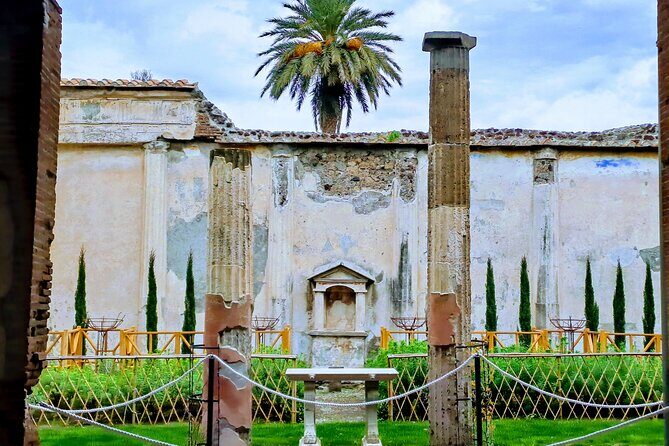
This is the sort of place where you should slow down for a moment, even if the stop is brief. Look for layout cues: how rooms connect, how space is organized, and what signals prosperity compared to smaller homes.
Teatro Grande: spectacle built for drama
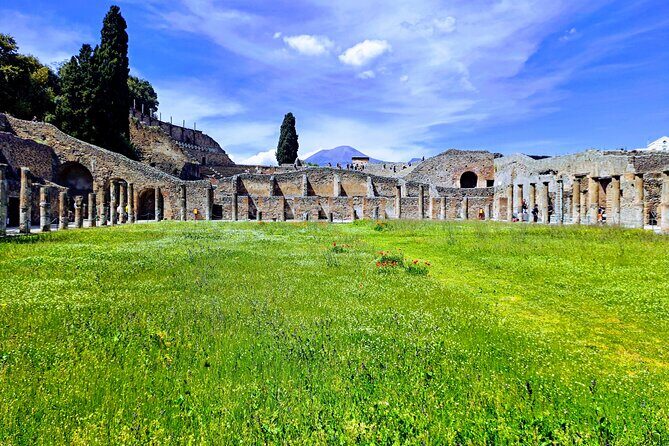
Then you reach the Teatro Grande, a big theatre built around the middle of the 2nd century BC. Greco-Roman comedies and tragedies were performed here, which means this isn’t just a building—it’s an entertainment system.
If you can picture the audience facing the stage, Pompeii gains sound. You can almost hear the crowd reaction. The short visit length works here because you get the essentials: the scale and the role it played.
Anfiteatro Romano: the oldest Roman-world amphitheatre
The Anfiteatro Romano is next, and it’s a standout because it’s described as the oldest in the Roman world. Built in 70 BC, it could accommodate up to 20,000 spectators.
Even for first-timers, it’s easy to understand why this is a highlight. The theatre explains performance. The amphitheatre explains mass spectacle—big crowd energy, engineered for viewing.
Via dell’Abbondanza: Pompeii’s main shopping street
Then you’re on Via dell’Abbondanza, one of Pompeii’s most important streets and the city’s shopping area. This is where you get a break from big buildings and instead see commerce in action.
You can think of this street as Pompeii’s “high street,” lined with shops and daily business. Short stop, big payoff: it helps you understand Pompeii as a functioning economy.
Casa dei Vettii: prosperity, decoration, and a god-leaning theme
Next is Casa dei Vettii, one of the richest and best-known houses. The tour info mentions it’s under the protection of Priapus, the god of prosperity, and that the rooms are richly decorated.
This stop can feel like a mental reward after the public spaces. Houses show you status and taste—how wealth expressed itself in daily life. Even if you only catch the basics, you’ll leave with a stronger sense of who lived here and why it mattered.
Panificio di Popidio Prisco: bread production in a real bakery
You’ll also visit the Panificio di Popidio Prisco, one of the city’s bakeries. This is one of those practical history moments that makes Pompeii feel less distant.
The stop includes an explanation of how bread was produced. That kind of detail helps your brain connect ruins to routine. People didn’t just watch plays and worship gods—they ate, worked, and bought food like you and me.
Basilica: justice and business under one roof
Finally, you visit the Basilica, described as the most sumptuous building in the Forum. It’s where business and justice were managed.
This is a strong closing stop because it ties back to the Forum. You can connect the “public square energy” to the buildings where decisions happened. It’s the administrative heart of the city, not just scenery.
Pace, tickets, and guide style: what you should expect in real time
The stop list is impressive, but the pacing matters. This tour is structured as a highlights route, with admission tickets included for the listed sites. In reviews, people appreciated that tickets were already handled in advance and that they could avoid the most chaotic waiting.
Because it’s private, you also get a more fluid experience. One review praised a guide who picked up on the group’s capability and adjusted. Another praised Nino for being professional, friendly, and for clear communication both before and during the tour.
That said, language and interaction style can affect enjoyment. English is offered, and it’s fine if you’re comfortable listening. In one outlier case, there was a concern about understanding the guide’s English after an incident. It’s not the norm in the overall rating, but it’s a reminder: if you want maximum value, come ready with questions. Pompeii rewards curiosity.
How long is long enough in Pompeii?
About 5 hours is a sweet spot for most cruisers, especially if you want an organized overview plus the biggest emotional hits. You’ll see a lot, but you won’t have time to read every inscription at a slow pace.
Here’s the trade-off: you’re getting breadth, not deep scholarship time in one building. For many first-timers, that’s perfect. You leave with a mental map of Pompeii’s major categories:
- entrance and city layout,
- public civic life (Forum, Basilica),
- religion (Sanctuary of Apollo),
- commerce and food (Macellum, Via dell’Abbondanza, bakery),
- entertainment (Theatre, Amphitheatre),
- and social class (major houses).
If you already love Roman architecture and want hours inside every room, you might later wish you had more time. But for a port day, this is a smart, efficient way to see the most meaningful pieces.
Price and value: is $216.27 per person actually worth it?
At $216.27 per person, this isn’t a bargain-basement excursion. But it can be good value once you break down what you’re buying.
You’re paying for:
- private guide time in English,
- a round-trip transfer between the cruise meeting point area and Pompeii,
- admission tickets included for the listed stops,
- and a route that keeps your day from turning into chaos.
If you’re traveling as a small group (the reviews often mention parties of 3 or 4), private logistics are where the money turns into convenience. You also save mental energy. In a cruise schedule, that counts.
If you’re a solo traveler or a couple, it may still be worth it if you strongly value timing, not spending hours figuring out transport. But if you’re cost-first and happy to do it on your own, you might compare other options. The value here is the organized day, not just the ruins.
Who should book this Pompeii private tour?
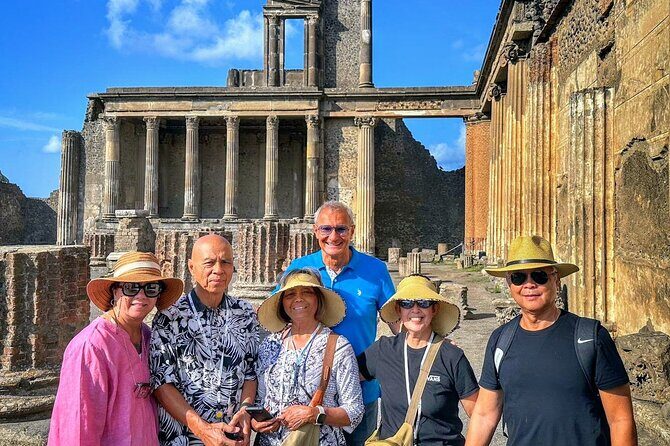
This fits best if you’re:
- on a cruise and want a Port-to-Pompeii plan that ends back at the ship area,
- traveling in a small group who prefers a private, quieter pace,
- new to Pompeii and want the big highlights plus context,
- and you’d rather spend time understanding what you’re seeing than figuring out logistics.
It’s also a great pick if you like practical history details—markets, baths, bread production, and the everyday civic system—rather than only chasing photos.
Booking call: should you choose this private Pompeii day?
I’d book it if you want a Pompeii visit that feels organized, efficient, and guided—without turning your port day into a stress test. The meeting point is straightforward, the route is packed with the most important stops, and the guide style in reviews points to real communication and context.
Do consider skipping this only if you want a slow, ultra-flexible stroll with lots of downtime in each building. Pompeii is big, and this tour is intentionally built for a high-coverage highlights route.
If your goal is: see Pompeii well, understand it fast, and get back on schedule—this private option from Naples is a strong choice.
FAQ
How long is the Pompeii private tour from Naples?
It lasts approximately 5 hours.
What price should I expect per person?
The price is $216.27 per person.
Is this tour private or shared?
It’s a private tour/activity, so only your group participates.
Where do we meet for the tour?
The meeting point is Stazione Marittima, 80133 Napoli NA, Italy.
What language is the tour offered in?
The tour is offered in English.
What vehicle is used for transportation?
Transport is carried out with a Peugeot 3008 (2014 model). Larger cars or mini vans are available on request with a supplement.
Are admission tickets included?
Yes. Admission tickets are included for the listed stops.
What should I know about weather and timing?
This experience requires good weather. If it’s canceled due to poor weather, you’ll be offered a different date or a full refund.