REVIEW · NAPLES
Pompeii and Vesuvius Tour with Pickup
Book on Viator →Operated by Sesto Continente Tours · Bookable on Viator
A day with two icons of catastrophe.
This Pompeii and Vesuvius trip is built for speed without feeling rushed: a small group (max 10), a ride in a vintage classic van, and a guided run through Pompeii’s best-preserved areas. I like the licensed multilingual guide handling Pompeii, so you spend less time figuring things out and more time reading the ruins like a living city.
The main thing to watch is logistics. Even with pickup offered, details can vary by starting point, and Pompeii admission isn’t included—so check what you’ll pay on top of the tour price before you go.
In This Review
- Key highlights worth your attention
- Vintage classic van and small-group pacing in Naples
- Pompeii entry and the guide-led start at the park
- Foro di Pompei: the city’s main square in plain view
- Macellum: the market that makes daily life click
- Casa del Fauno: luxury in Roman-republic form
- Teatro Grande and the human scale of disaster
- Via dell’Abbondanza: walk the main street logic
- Snack break and a chance to breathe in Pompeii
- Lava-stone sculptures on the way up to Vesuvius crater
- Crater walk with volcanological mountain guides (the part that matters)
- Photo opportunities that don’t rely on luck
- Tickets, price, and the real cost of doing both in one day
- Language, guides, and the small friction points that can change your day
- Who should book this tour (and who might not love it)
- Should you book this Pompeii and Vesuvius tour with pickup?
- FAQ
- How long is the Pompeii and Vesuvius tour with pickup?
- What’s included in the price?
- Is the Pompeii entrance ticket included?
- Is Vesuvius entrance included?
- How large is the group?
- Is pickup actually provided?
- What time does the tour start?
- What should I bring for Vesuvius?
- What kind of guides do you get on Vesuvius?
- Can I get a refund if I cancel?
Key highlights worth your attention
- Max 10 people keeps the pacing human and the walking more manageable
- Vintage classic van makes the ride feel like part of the day, not just transport
- Licensed guide in Pompeii at the park entrance plus stop-by-stop orientation
- Volcanological mountain guides on Vesuvius for the crater walk and fumarole explanations
- Snacks included so you don’t crash after Pompeii
- Pompeii ticket not included while Vesuvius entry is included
Vintage classic van and small-group pacing in Naples
If you’ve tried getting from Naples to Pompeii on public transport, you already know how quickly a fun plan turns into lines, transfers, and timing stress. This is designed to remove that friction. You’re on a private vehicle (in a classic vintage style), and the group stays capped at 10, which changes the whole vibe. Smaller groups mean you can ask questions, pause for photos, and actually follow along instead of trailing behind.
The timing is also built around a one-day hit: about 8 hours, starting at 9:00 am and ending back at the start point. The tour begins from 80053 Castellammare di Stabia (that’s the listed meeting point), so if you’re staying elsewhere, treat pickup as a “confirm the exact plan” item, not a guaranteed free-for-all.
Here’s the value equation I’d use: you’re paying for (1) private transport, (2) guided Pompeii orientation, and (3) a guided crater experience on Vesuvius. If any one of those parts doesn’t line up for your language needs or pickup expectations, the price starts to feel less fair—especially since the overall rating is 3.4 from 13 reviews, which suggests a few uneven experiences alongside the good ones.
You can also read our reviews of more tours and experiences in Naples.


Pompeii entry and the guide-led start at the park
Your day begins at Pompeii Archaeological Park with a licensed multilingual tourist guide accompanying you at the entrance. It’s a short, focused opening (about 5 minutes), but the key value is this: you don’t walk in blind.
Two practical notes here:
- The Pompeii admission ticket is not included, even though you get guided access into the park area.
- The stops that follow are designed to show Pompeii’s “why it matters” fast, instead of trying to cover everything.
Think of this as getting your bearings early. Pompeii is huge, and without context, you can spend hours seeing stone and statues and still feel like you missed the point. A good first guide push helps you start noticing how the city worked—politically, economically, and socially.
Foro di Pompei: the city’s main square in plain view
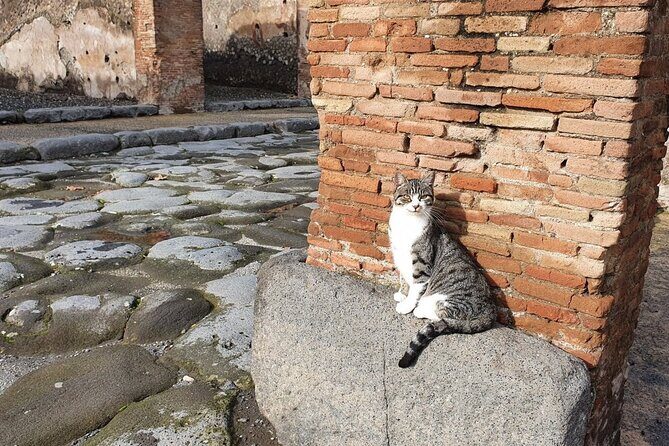
One of the earliest stops is the Foro de Pompeya (Forum of Pompeii), described as the political, economic, and religious center of the city. This is one of the best places to learn how Pompeii functions as a real urban machine, not just a frozen disaster scene.
You’ll spend about 15 minutes here, and the time is used well: the Forum is naturally readable. When you look at open areas, civic buildings, and the way movement funnels through the square, Pompeii starts behaving like a city you could walk through today.
What I like about doing the Forum early is contrast. Later, when you see houses, theaters, and a street lined with everyday activity, the Forum helps you understand what mattered most to Pompeii’s residents.
Potential drawback: 15 minutes can feel short if you’re a slow explorer. If you love spending time on one monumental location, you may find yourself wishing for more. That said, the whole point of a one-day tour is that you get variety.
Macellum: the market that makes daily life click
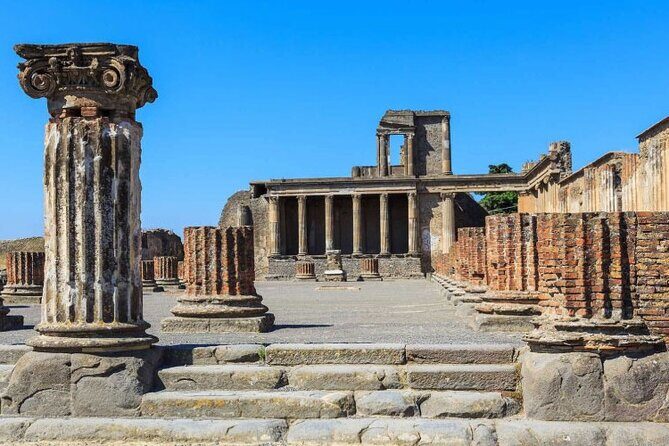
Next up is the Macellum, the provision market—basically Pompeii’s food and supply hub. This stop is also about 15 minutes, and it’s one of those places where a little explanation makes everything pop.
Why it works: markets show what people ate, how they shopped, and how daily routines shaped the city. When you’re looking at ruins, the big buildings tell the story of status; the market tells the story of living.
Also, the Macellum is positioned on the Forum side of things, so it flows naturally from the main square. You’re building a mental map as you go.
If you’re the type who wants to photograph details, this is a good stop for close-up texture shots—stone cuts, layout lines, and the way structures relate to streets.
Casa del Fauno: luxury in Roman-republic form
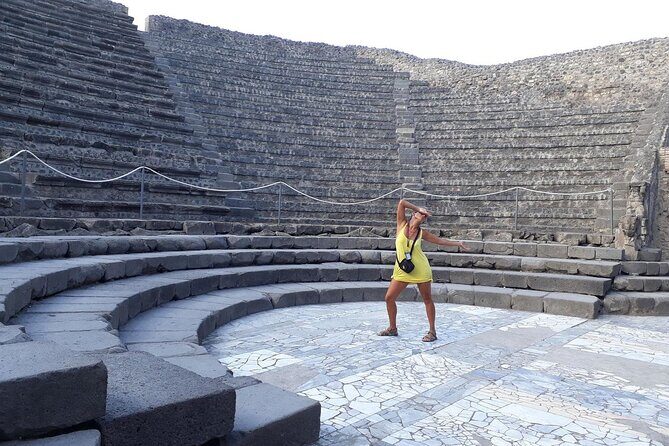
At Casa del Fauno (House of the Faun), you see what luxury looked like in Pompeii. It’s around 15 minutes, and it’s framed as one of the most luxurious aristocratic houses from the Roman republic.
This stop is valuable even if you don’t care about big names or Roman politics. Why? Because Pompeii’s houses show how social rank expressed itself in architecture. You start noticing courtyards, the organization of space, and the idea that a home could function almost like a public statement.
A small watch-out: house interiors can be partially limited by the way the site is presented and protected. You may end up seeing more foundation and layout than full furniture. That’s normal here, but it’s good to know if you’re expecting a “museum interior” feeling.


Teatro Grande and the human scale of disaster
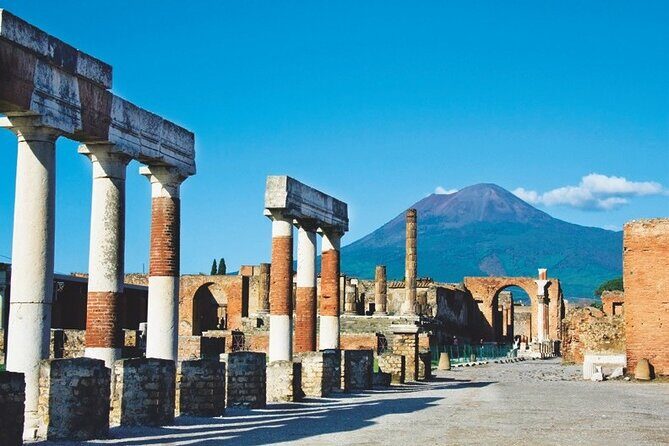
Then you move to Teatro Grande (Roman theater). Expect about 15 minutes. The theater is notable because it was buried by the eruption of Vesuvius in AD 79 and later found through excavations.
This is where Pompeii shifts from daily life to emotional scale. A theater isn’t just a building; it represents gatherings, entertainment, and the public rhythms of the city. Even in ruin, you can sense how people would have seated themselves and watched performances.
It’s also a nice transition point. Once you understand Pompeii’s social spaces, the later Vesuvius crater walk feels less like a separate attraction and more like the reason the story exists at all.
Via dell’Abbondanza: walk the main street logic

The tour includes a walking segment on Via dell’Abbondanza, about 15 minutes. This road connects key nuclei between the Forum and Porta Sarno, linking major landmarks like the Forum, the Stabian Baths, theaters, the Temple of Isis, and the amphitheater.
This is one of the stops where you learn how to read Pompeii as a city rather than a checklist. A “main street” teaches you spacing and flow: how people moved between civic, religious, and entertainment zones.
Practical tip: if the day feels crowded, stick with the side you can clearly see while walking. Pompeii is full of visual distractions, and it’s easy to miss the layout if you’re constantly looking down at the next ruin you’ll reach.
And yes—expect walking shoes to matter more than you think. Even short segments add up when you’re doing multiple stops in one morning.
Snack break and a chance to breathe in Pompeii
After the main Pompeii stops, there’s a stop for snacks and drinks, plus about 1 hour of free time. Admission for Pompeii at this stage isn’t listed as included, but the free time is clearly built in.
I like this break because it’s real-world helpful. Pompeii can be tiring—stone surfaces, uneven ground, and lots of time looking up and down. A snack break keeps energy steady so you don’t arrive at Vesuvius looking like a wilted postcard.
Use the free time to do one of two things:
- Revisit the place that caught your eye most.
- Or take photos and just wander long enough to feel the scale of the site.
If you’re with a group that moves fast, this free hour can also be your moment to move at your own speed.
Lava-stone sculptures on the way up to Vesuvius crater
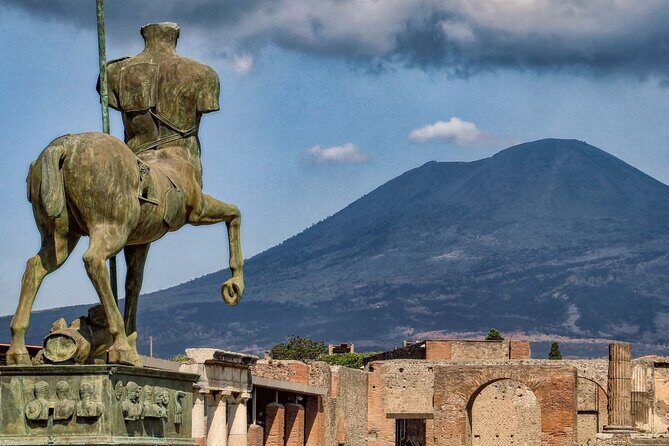
Before the crater walk, there’s an interesting detail along the route up: you can see lava stone sculptures made by different artists. It’s a small thing, but it’s one of those “this isn’t just a viewpoint, it’s a living landscape” moments.
Even if you’re focused on the crater itself, these sculptures give you a quick cultural context: people here live with volcanic materials and volcanic identity every day.
And it breaks up the drive so you’re not arriving at the checkpoint mentally flat.
Crater walk with volcanological mountain guides (the part that matters)
Now for the big moment: a guided walk to the Vesuvius crater led by volcanological mountain guides. After reaching the top with the minivan, you pass a checkpoint and then walk along the path toward the crater.
What you should expect is a guided explanation in small groups. The guides gather participants and explain “every detail” of the crater experience—plus you can admire fumaroles, the gas outlets rising toward the sky.
This is the heart of why people choose this tour over going independently. A volcano crater is not something you just look at; you understand it. Fumaroles are easier to appreciate when someone explains what you’re seeing and how they fit into the broader volcanic system.
Time on Vesuvius National Park is listed as about 2 hours, and because the walking includes a checkpoint step, it helps to plan your pace.
Practical gear matters here. The tour notes items like a hat, water, sunscreen, camera, and wind-protective clothing. Don’t treat that list like a suggestion. Wind can change fast at the top, and you’ll feel it.
Photo opportunities that don’t rely on luck
Vesuvius crater is the kind of place where you want good light and good angles. This tour is set up so you have dedicated time in the right area, plus guide-led grouping that prevents everyone from scattering completely.
Also, since they lead you along the path (instead of just dropping you off), you’re more likely to end up in viewpoints that show the crater clearly. That matters if you care about photos but still want to learn what you’re photographing.
One consideration: if you’re prone to motion sensitivity, the combination of van rides plus walking at altitude might feel like a lot. Build in slow breathing during the walk, and keep sipping water as you go.
Tickets, price, and the real cost of doing both in one day
The price is listed at $145.45 per person, and the tour includes:
- private transportation
- ride on a vintage classic van
- Vesuvius entrance ticket
- snacks
Not included:
- Pompeii entrance fee
This is where you need to do your quick math. If Pompeii admission is extra in your budget, the “cheap-and-cheerful” value becomes a more balanced “pay for convenience and guidance” value. In general, that’s what you’re buying here: fewer headaches and more structured time.
What makes it better than DIY is the combined package: Pompeii guided stops plus a crater walk with volcanological guides. What can reduce value is if pickup isn’t exactly what you expected or if you need very specific language support at every step.
One more price reality check: confirmation happens within 48 hours of booking, subject to availability. So if you’re traveling around peak season, book with some breathing room.
Language, guides, and the small friction points that can change your day
Most tours like this depend on a clean handoff between driver and guides. In the information you have, you should expect:
- English/Italian licensed guide coverage for Pompeii at key points.
- volcanological mountain guides for the Vesuvius crater walk and fumarole explanations.
Still, there’s room for friction. Some past experiences included issues like communication gaps if the driver didn’t speak English well, and a lack of guide clarity at Vesuvius for a few people who expected more hands-on explanation.
Here’s how you protect yourself:
- Go in with the expectation that the Pompeii guide is your primary language bridge.
- On Vesuvius, be ready to rely on the mountain guides for explanations during the grouped walk.
- If you need audio devices or translation tech, plan to use the guide’s spoken talk as your main source.
And if you’re the kind of traveler who gets stressed by imperfect logistics, consider confirming pickup details before you arrive.
Who should book this tour (and who might not love it)
This tour fits best if you want:
- one-day coverage of both Pompeii and Vesuvius
- a small group experience
- snacks included and structured guidance
- time focused on high-impact sights instead of trying to plan your own day from Naples
It might not be ideal if:
- you dislike structured pacing and want long stays in each ruin
- you need very strict pickup promises from your exact address without any variations
- you are sensitive to language barriers and want seamless English support everywhere
For most people, Pompeii plus Vesuvius in one day is only possible with a guided setup. The question is whether you can live with the small administrative quirks that sometimes come with one-day tours.
Should you book this Pompeii and Vesuvius tour with pickup?
My take: book it if your goal is a stress-reduced day that hits the essentials—Forum, market life at the Macellum, elite housing at Casa del Fauno, and then the crater experience with volcanological guidance. The classic van plus small group size are real quality-of-life upgrades, and the snacks are a small kindness that helps more than you’d think.
Skip—or at least think twice—if your plan depends on a perfect pickup from where you’re staying, or if you absolutely need a guaranteed English-speaking guide at every single moment. Also remember Pompeii admission is extra, so budget for it.
One last note: the experience is listed as non-refundable and not changeable, so only commit once your dates are stable.
FAQ
How long is the Pompeii and Vesuvius tour with pickup?
The tour duration is listed as approximately 8 hours.
What’s included in the price?
The price includes private transportation, a ride on a vintage classic van, snacks, and the Vesuvius entrance ticket.
Is the Pompeii entrance ticket included?
No. Pompeii admission fees are listed as not included.
Is Vesuvius entrance included?
Yes. Vesuvius entrance ticket is included.
How large is the group?
The tour is capped at a maximum of 10 travelers.
Is pickup actually provided?
Pickup is listed as offered, but the meeting point is shown as 80053 Castellammare di Stabia, Italy. You should confirm the exact plan for pickup based on where you’re starting.
What time does the tour start?
The start time is listed as 9:00 am.
What should I bring for Vesuvius?
The tour suggests bringing a hat, water, sunscreen, a camera, and wind protective clothing.
What kind of guides do you get on Vesuvius?
The crater walk is led by volcanological mountain guides, with a checkpoint and a path to the crater where guides explain details and point out fumaroles.
Can I get a refund if I cancel?
No. This experience is non-refundable and cannot be changed for any reason. If it’s canceled because a minimum number of travelers isn’t met, you’ll be offered a different date/experience or a full refund.