REVIEW · NAPLES
Pompeii and Herculaneum led by an Archaeologist with private transport
Book on Viator →Operated by Askos Tours · Bookable on Viator
Two Roman cities, one long day.
This is a private Pompeii and Herculaneum tour that pairs you with an archaeologist guide and gets you between sites by air-conditioned Mercedes-style transport, with hotel or coast pickup across Campania. The day works because you don’t waste time guessing where to go. You get the story in order, and you move from one named highlight to the next with guides like Lucio, Alfredo, Daniela, and Ivan showing how daily life, architecture, and the eruption changed everything.
I particularly like the focus on specific houses and public buildings instead of a generic sweep, from the House of the Deer at Herculaneum to Pompeii’s Forum and theaters. You also get practical time-saving help: pickup, driver, and entry handled through Pompeii Express so you can spend more energy looking and less energy figuring out tickets. The main drawback to plan for is the pace: it’s about 7 hours and it’s still a lot of walking and short stops, so bring water, go in with good shoes, and expect it to feel like a packed day.
In This Review
- Key reasons this tour works so well
- The smart structure: see two cities without the stress
- Pickup and private Mercedes-style transport across Campania
- Why Herculaneum first makes the eruption story click
- Herculaneum stop-by-stop: houses, baths, and the Black Salon
- Lunch timing between sites: keep it simple
- Pompeii highlights: brothel lane to the Forum
- What the guided pacing does for you
- How much walking is involved, and how to prepare
- Price and value: is $666.75 per person worth it?
- Who should book this tour?
- Should you book it?
- FAQ
- How long is the Pompeii and Herculaneum tour?
- Where do you get picked up?
- Is transportation included?
- What language is the tour in?
- Are tickets included or do I pay separately?
- Is lunch included?
- How many people are in the group?
- What should I wear and bring?
- Can I cancel for a full refund?
Key reasons this tour works so well
- Private archaeologist guidance: you get explanations tied to the actual rooms and street corners you’re seeing.
- Herculaneum + Pompeii in one day: you compare two different kinds of preservation without changing hotels.
- Comfortable transport: pickup and drop-off by professional driver, with air-conditioned car/van.
- Ruins focused on highlights: you hit named houses, baths, and civic spaces rather than wandering.
- Practical day planning: a lunch window between sites keeps the schedule moving.
- Family-friendly for all ages: the format works even when you have teens, as long as they can handle walking.
The smart structure: see two cities without the stress
If Pompeii is on your list, you already know the problem: it’s big, confusing, and easy to spend half the day orienting yourself instead of learning. This tour’s format solves that. You start with Herculaneum, then shift to Pompeii, with a driver handling transfers and an archaeologist guiding your route.
The payoff is that you get two perspectives in one go. Herculaneum is smaller, so it feels more manageable, and you can catch the details in homes and thermal areas that make the eruption story feel real. Then Pompeii brings the scale: the Forum, major baths, and theaters show how public life worked on a bigger stage.
You can also read our reviews of more private tours in Naples



Pickup and private Mercedes-style transport across Campania
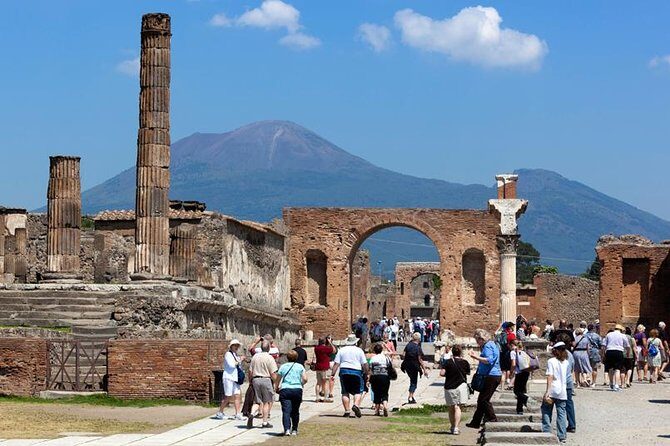
The best part of the logistics is also the least glamorous: you don’t have to arrange two separate trips, and you don’t have to fight your way through public transport while dragging a daypack.
This experience includes pickup and drop-off from your accommodation or major arrival points in the Naples area (including Salerno, Sorrento, and the Amalfi Coast). You travel in an air-conditioned Mercedes-type vehicle with a professional driver. In practice, that means you can start the day thinking about ruins, not roads.
One more practical touch: it’s set up as a private tour/activity, so your group stays together. That matters on a schedule like this, where short time blocks at each stop add up fast.
Why Herculaneum first makes the eruption story click
Starting in Herculaneum helps your brain sort the “what happened” question. The eruption didn’t hit both towns the same way, and good guides use that to explain why the sites look so different today.
In feedback from archaeologist-led days, guides describe it like this: Pompeii was buried under a rain of superheated ash, while Herculaneum was leveled by landslides of volcanic molten rock. Even without memorizing temperatures, you can feel the contrast as you move through preserved spaces and see how building materials survived differently.
Herculaneum also gives you a smoother entry into Roman life. You’ll spend time with homes, luxury details, and bath facilities that show how daily routines worked.
Herculaneum stop-by-stop: houses, baths, and the Black Salon
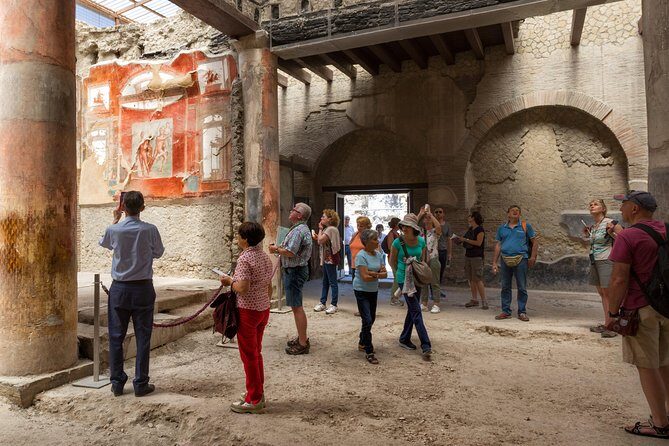
Here’s what you can expect as you walk through Herculaneum with your archaeologist guide. Times at each stop are short, so your guide’s explanations are the value-add. If something grabs you—mosaic, doorway remains, an unusual room layout—ask questions. That’s where the tour becomes more than a checklist.
Archaeological Park of Herculaneum (entry + guide meeting)
You meet at the ticket office and then step into the park with your guide. This is where you get oriented fast: what to notice, how the streets and neighborhoods relate, and what to look for in each house.
House of the Deer
This place gets its name from marble statues of stags/deer found around the peristyle. It’s a nice example of how symbolism and status show up in everyday architecture. Even in a short stop, it gives you a feel for Roman decorative taste.
La Terrazza di M. Nonio Balbo
You’ll see the story behind M. Nonius Balbus, a major city benefactor. The long inscription on his funeral altar is the kind of detail that turns a ruin into a name you can connect to civic life.
College of the Augustales
This building is linked to the cult of Emperor Augustus and the Collegium Augustalium, sometimes even connected to local civic administration. It’s a quick stop, but it helps you understand that religion and public identity weren’t separate things in Roman towns.
Central Thermae
The guide points out that the baths were organized with separate entrances for men and women, a reminder that privacy and routine mattered even in shared spaces. It’s also a good stop if you want a sense of community infrastructure, not just private houses.
Casa del Rilievo di Telefo
This home is tied to a relief scene and is notable for having its own private access to the adjoining Suburban Thermae. That link between a house and bathing facilities shows how comfort and convenience worked for wealthier residents.
House of the Skeleton
The name comes from remains found in a second-floor room in 1831. The tour uses this kind of evidence carefully: it makes the eruption story personal without turning it into shock value.
House of the Black Salon
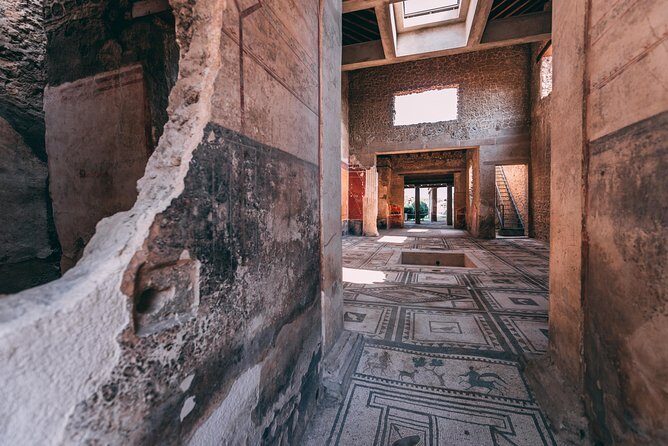
If there’s one Herculaneum mansion that grabs attention, this is it. You’ll see a monumental entrance that still retains charred remains of doorposts and the lintel. It’s the kind of visual detail that makes you stop talking and just look for a minute.
Partem Domus lignea (Casa del Tramezzo di Legno)
This stop centers on an elegant wooden partition that remained. It’s a reminder that not all Roman “artifacts” are statues; sometimes the story survives in functional interior architecture.
Casa Sannitica
You’ll get to see an atrium layout typical of the Samnites, plus a gallery with Ionic columns and fresco decoration. It’s useful for understanding regional identity and taste even within a Romanized setting.
Casa del Bel Cortile
This house is known for its courtyard and stairway with a stone balcony instead of a traditional atrium. Expect your guide to explain why layouts varied and what that tells you about how people moved through the home.
House of the Grand Portal
A central mansion in the park with charred remains of wooden elements. This is a solid closing stop for Herculaneum because it ties together scale (bigger doorway, bigger statement) and the ways materials preserved during the disaster.
Lunch timing between sites: keep it simple
The schedule includes a break for lunch between Herculaneum and Pompeii. You’ll have free time to eat on your own (the tour notes a lunch stop in between and later gives you a set lunch window in the Pompeii portion). Meals aren’t included.
My advice: treat lunch like fuel, not a full production. If you’re hungry, pick somewhere close and keep moving. The day is long enough that a slow lunch can quietly steal your best Pompeii moments.



Pompeii highlights: brothel lane to the Forum
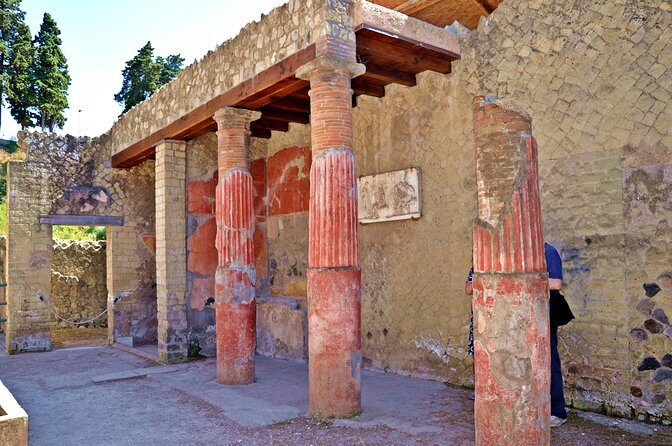
After Herculaneum, you head to Pompeii for the big-ticket sights. Pompeii’s challenge is size, so having an archaeologist guide who can point you to the right street corners saves you from the usual detours.
Here are the Pompeii stops you’ll typically cover:
Lupanar (the famous brothel)
This is the most infamous building in the city. Your guide will likely frame it with context—how the Romans handled sex work, advertising, and street-level life—so it’s not just a scandal stop.
Foro de Pompeya (main square)
The Forum is where public life felt public. You’ll get a quick look at the ancient main square and the civic rhythm around it.
Walk the main street
You’ll move along the city’s primary street. This is where scale becomes real: you can better understand distances between civic and residential areas instead of picturing it from a map.
Granaries of the Forum
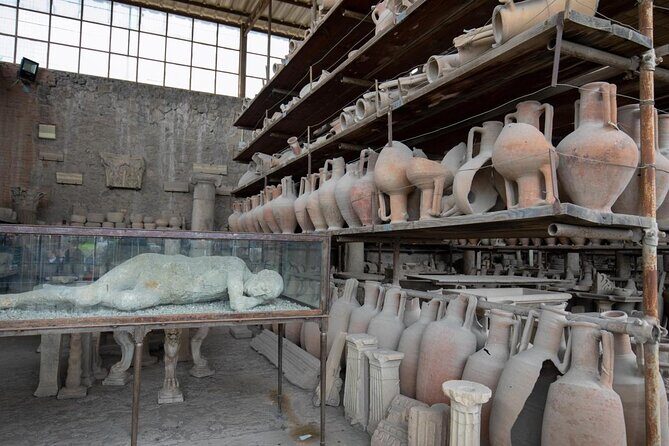
This stop is about function and detail: marble tables and baths for fountains at house entrances, plus casts of victims connected to the eruption. You might also see casts including a dog and a tree, which helps connect daily life to the disaster aftermath.
Basilica
In Roman towns, the basilica was an open portico area sheltering merchants and activities. It’s a practical stop that explains how commerce and public movement worked.
Stabian Baths (Terme Stabiane)
You’ll visit a huge bath complex, noted as among the oldest thermal areas in Pompeii. Baths here are not just for hygiene; they’re also social hubs. Short stop or not, this one helps you understand what it meant to live in a Roman city.
House of Menander
This is one of the richest homes in Pompeii for architecture, decoration, and contents. Even in limited time, it’s the type of house where your guide can point out design choices that show who paid for what.
House of the Faun
One of Pompeii’s largest private residences. It’s a strong contrast to smaller spaces you saw earlier, and it’s useful for visualizing wealth in physical form: scale, layout, and decoration.
Teatro Grande and Teatro Piccolo
You’ll visit the main theater first, then get a look at the smaller one. The main takeaway is that Roman entertainment wasn’t a niche hobby. It was infrastructure for public gatherings.
What the guided pacing does for you
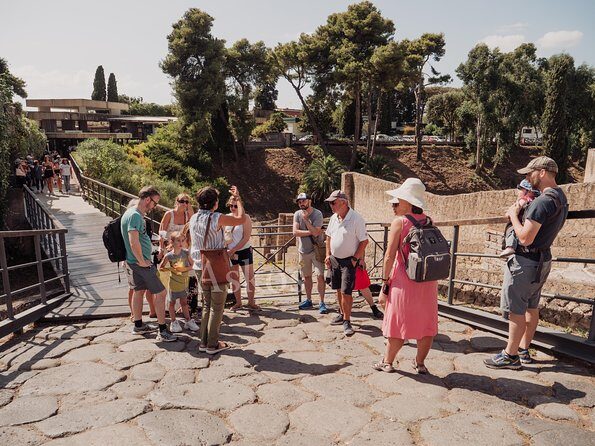
One big reason this tour gets high marks is that guides don’t just list facts. They help you notice the right things quickly. On days with archaeologists who’ve dug at these sites, the explanations tend to be specific—engineering choices, how each city’s damage affects what survives, and what daily routines looked like from the inside of a home or bath.
In the feedback, guides such as Ivan and Dr. Daniela were praised for answering questions and keeping the day engaging, even for mixed groups and mobility limitations. That’s a key value point for you to consider: with short stops at many locations, a guide who can handle questions without losing the schedule is the difference between a stressful sprint and a satisfying day.
How much walking is involved, and how to prepare
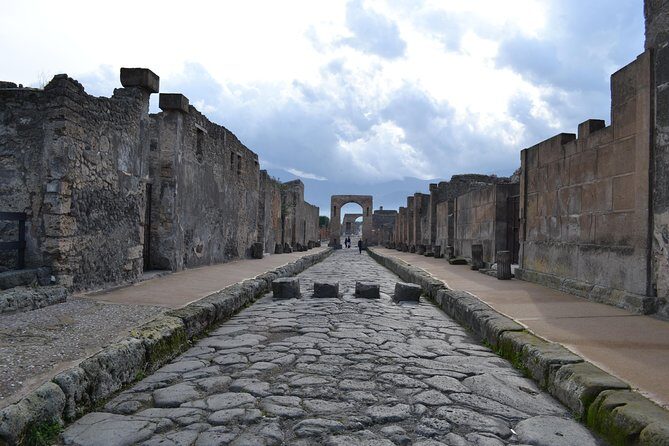
This is a 7-hour day and it includes a lot of shifting between stops across archaeological terrain. The tour explicitly recommends comfortable shoes and warns that in summer you shouldn’t wear flip-flops.
So bring:
- Water and a quick snack if you tend to get low energy
- Sunglasses and sunscreen
- A daypack you can keep on easily while walking
If you have mobility limitations, tell the company ahead of time. The tours described in feedback included guides who stayed patient and helpful with adjustments, but you’ll still want to plan for uneven ground.
Price and value: is $666.75 per person worth it?
Let’s talk numbers without pretending this is cheap. At $666.75 per person, this tour only makes sense if you value three things: expert interpretation, private logistics, and not thinking about travel time.
Here’s what you’re paying for, based on the tour details:
- Private transport (pickup, driver, air-conditioned Mercedes-style vehicle, drop-off)
- Private archaeologist guidance for both sites
- Entry handled through Pompeii Express, with Herculaneum and Pompeii covered under the same arrangement
There’s also a practical value angle: Pompeii and Herculaneum are not just “see a view” destinations. You’re spending time in places where the details matter—doorposts, household layouts, bath design, and the Forum’s function. A good guide makes those details click faster than self-guided walking.
One note to keep you from surprises: the tour information says entry tickets are included under Pompeii Express, and it also lists the Herculaneum entry price as 16 euros for adults (and a reduced rate for EU citizens ages 18–25). That means your voucher should clarify exactly what’s covered. I’d check your confirmation before you go, just to keep things stress-free.
Who should book this tour?
This tour fits best if you:
- Want Herculaneum and Pompeii in one day without juggling transfers
- Like your ruins with explanations tied to specific buildings
- Prefer private pacing over big-group herd movement
- Have limited time in the Naples area and don’t want to spend a day figuring it out
It’s also a good choice if you’re traveling with teens, as long as everyone is okay with walking. The format lets you keep the day interesting instead of turning it into a timed museum march.
Should you book it?
If you’re deciding between self-guided ruins and a guided day, I’d book this style of tour when your priority is understanding and efficiency. The combination of private transport, an archaeologist guide, and a route built around named highlights is exactly what saves you from Pompeii’s biggest pitfall: walking a lot without really seeing.
I’d skip it only if you want long, slow wandering and you hate short stop times. With a schedule built around many highlights, you won’t get an all-day lounge-through-it experience.
If that sounds like your pace, you’ll probably love how the day turns two tragedies into two vivid, understandable snapshots of Roman life.
FAQ
How long is the Pompeii and Herculaneum tour?
It runs about 7 hours.
Where do you get picked up?
Pickup is offered at your accommodation in Naples, Salerno, Sorrento, or along the Amalfi Coast, and also at the cruise port, train station, or airport.
Is transportation included?
Yes. You travel by private Mercedes-style vehicle with a professional driver.
What language is the tour in?
The tour is offered in English.
Are tickets included or do I pay separately?
The tour description lists entry for Pompeii and Herculaneum as included via Pompeii Express. The info also notes Herculaneum entry is typically 16 euros for adults, so it’s smart to confirm what your voucher covers.
Is lunch included?
No. Meals aren’t included. There is a lunch stop window in between Herculaneum and Pompeii, and you can have lunch on your own.
How many people are in the group?
It’s a private tour/activity, meaning only your group participates.
What should I wear and bring?
Wear comfortable shoes. Bring sunglasses, sunscreen, and water. In summer, the guidance is not to wear flip-flops.
Can I cancel for a full refund?
Yes. You can cancel up to 24 hours in advance for a full refund.